The Complete IELTS Listening Test Format Guide for Beginners

The IELTS listening test works like a moving train. You cannot pause it, you cannot rewind it, and it will not wait for anybody who falls behind. That one fact explains why so many candidates who speak good English still walk out of this section with a score that upsets them. Their English was never the problem. The problem was that the audio kept moving while they were still thinking about something that had already gone past.
What saves a candidate from this is knowing the test well before they sit it. The IELTS listening test format changes less than any other part of the exam, and almost nothing in it is meant to catch you by surprise. The number of questions stays the same. The order of the four sections stays the same. The kind of speaker you hear in each section stays the same. Even the tricks used to pull you away from the right answer come back in test after test. Somebody who has studied how the test is built walks into the room already knowing what is coming, and that is worth more than a long list of new words.
What the IELTS Listening Test Format Asks You to Do
It helps to fix one thing first, because most candidates come in with the wrong goal and it makes the exam harder than it needs to be.
You are not there to understand every sentence. You are there to catch the answer moments, which are the small pieces of information that answer the questions in front of you. Everything else is background noise, and once you are willing to treat it that way, you stay with the audio instead of running after it.
Think about what happens to someone who tries to follow every word. One sentence is still going round in their head when the next two arrive, and because the recording never stops, a small delay turns into a big one within a minute. Someone who is hunting for answers lets ordinary talk wash over them and listens hard only when something they need is close. Both candidates hear the same recording, yet one finishes calm and the other finishes lost.
The Four Parts of the IELTS Listening Test Format
There are four parts and each one has ten questions, so you answer forty questions in all. The place, the speakers and the question types change as you move through them, but the marking does not change at all.

Part 1 covers questions 1 to 10. It is a conversation between two people about an everyday matter, such as booking something or asking for information. One person asks most of the questions while the other answers, and that makes this the easiest part to follow. The questions usually come as a form, a table or a set of notes with gaps, so the answers are plain facts like names, dates, times, places and amounts. One answer is nearly always spelt out loud for you.
Part 2 covers questions 11 to 20. Only one person speaks here, and the topic is still an everyday one, so the language stays easy. The questions change shape, though, and you will meet multiple choice, matching and map labeling. Traps also turn up far more often than they did in part 1.
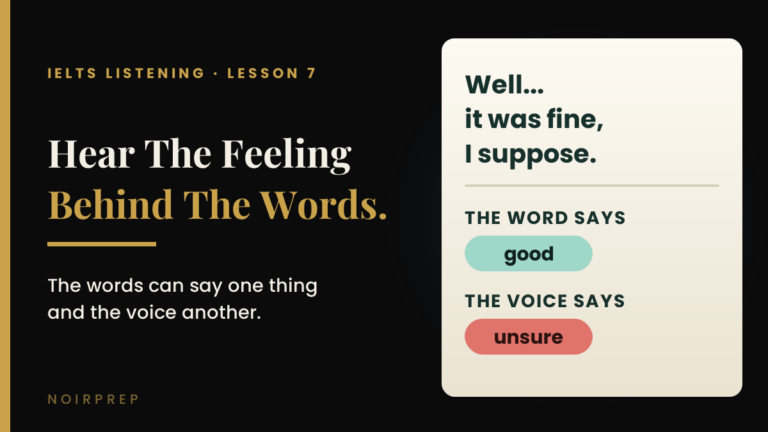
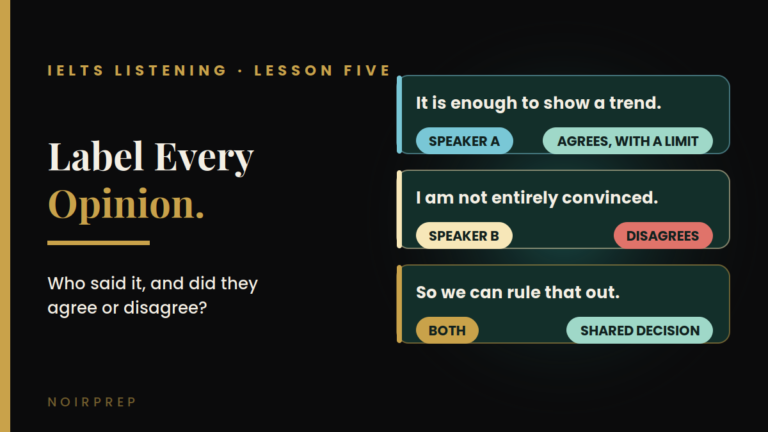
Part 3 covers questions 21 to 30. This is a study conversation between two or sometimes three people, usually students talking with a tutor about a piece of work. Most candidates start to slip here, because opinions are mixed together, people disagree politely rather than clearly, and it is easy to lose track of who said what.
Part 4 covers questions 31 to 40. One speaker gives a talk on an academic subject with nobody interrupting. The questions are mostly note completion, and getting through them depends on following how the talk is ordered and staying one step ahead of the speaker.
Every Question Is Worth the Same One Mark
There is one thing about the scoring of the IELTS listening test format that gets far less attention than it should, because it decides where your study time ought to go.
All forty questions are worth one mark each. A name spelt slowly for you in part 1 is worth the same as the hardest question in part 3. The exam gives you nothing extra for surviving the hard sections and no excuse for dropping the easy ones. That makes the early marks the cheapest ones in the whole test.
Most candidates do the opposite of what this suggests. They spend their study time worrying about the academic sections, which feel frightening, and then drop four or five marks in part 1 through spelling and broken word limits, which feel too easy to be worth practising. Those marks cost just as much and they are far easier to keep, since the speakers are slower, the topic is familiar, and the answers are simple facts.
Why Paper and Computer Need Different Practice
One more difference should shape how you practice, and many candidates never think about it until they are sitting in the exam room.
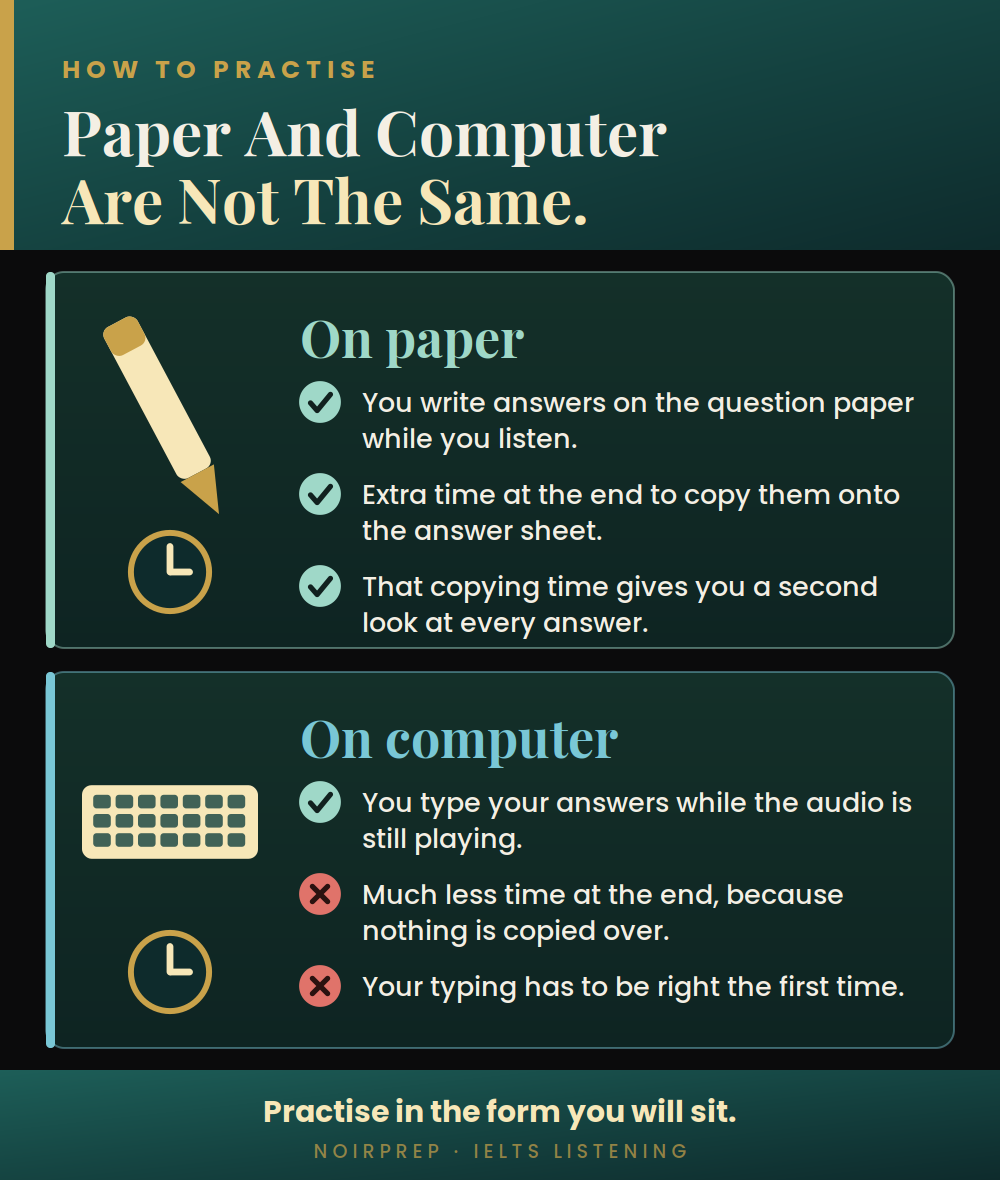
On the paper test you write your answers on the question paper while you listen, and you are given extra time at the end to copy them onto the answer sheet. That copying time is a real safety net, because it gives you a second look at every answer you wrote in a hurry.
On the computer test you type while the audio plays, and the time at the end is much shorter because there is nothing to copy. Your typing has to be right the first time, and anybody who has only ever practiced with a pen will find their hands slowing them down at the worst moment. So practice in the form you are going to sit. If your test is on a computer, type your answers while the recording runs rather than writing them in a notebook and tidying them up later.
The Three Things the Audio Does to Mislead You
This section is not only testing your English. It is testing whether you stay in control under pressure, and the recording has three steady ways of pulling you away from the right answer.
The first is speed. You are given very little time to take in what you heard and write it down before the next piece of information arrives.
The second is changed wording. The words in the audio hardly ever match the words printed in the question. A question about a fee will be answered by a speaker talking about a price or a charge, so a candidate sitting there waiting for the word fee hears nothing useful at all.
The third is the trap. A speaker gives a detail and then corrects it, changes it, or mentions something interesting that was never needed. The first answer you hear is often not the one you are supposed to write.
Treating all of this as ordinary listening is what loses marks. Treating it as a game with patterns you can learn to spot is what wins them back.
Why a Right Answer Can Still Score Nothing
Word limits need their own explanation, because this is where candidates throw away marks they had already earned. An answer that breaks the limit is marked wrong even when the information in it is correct.
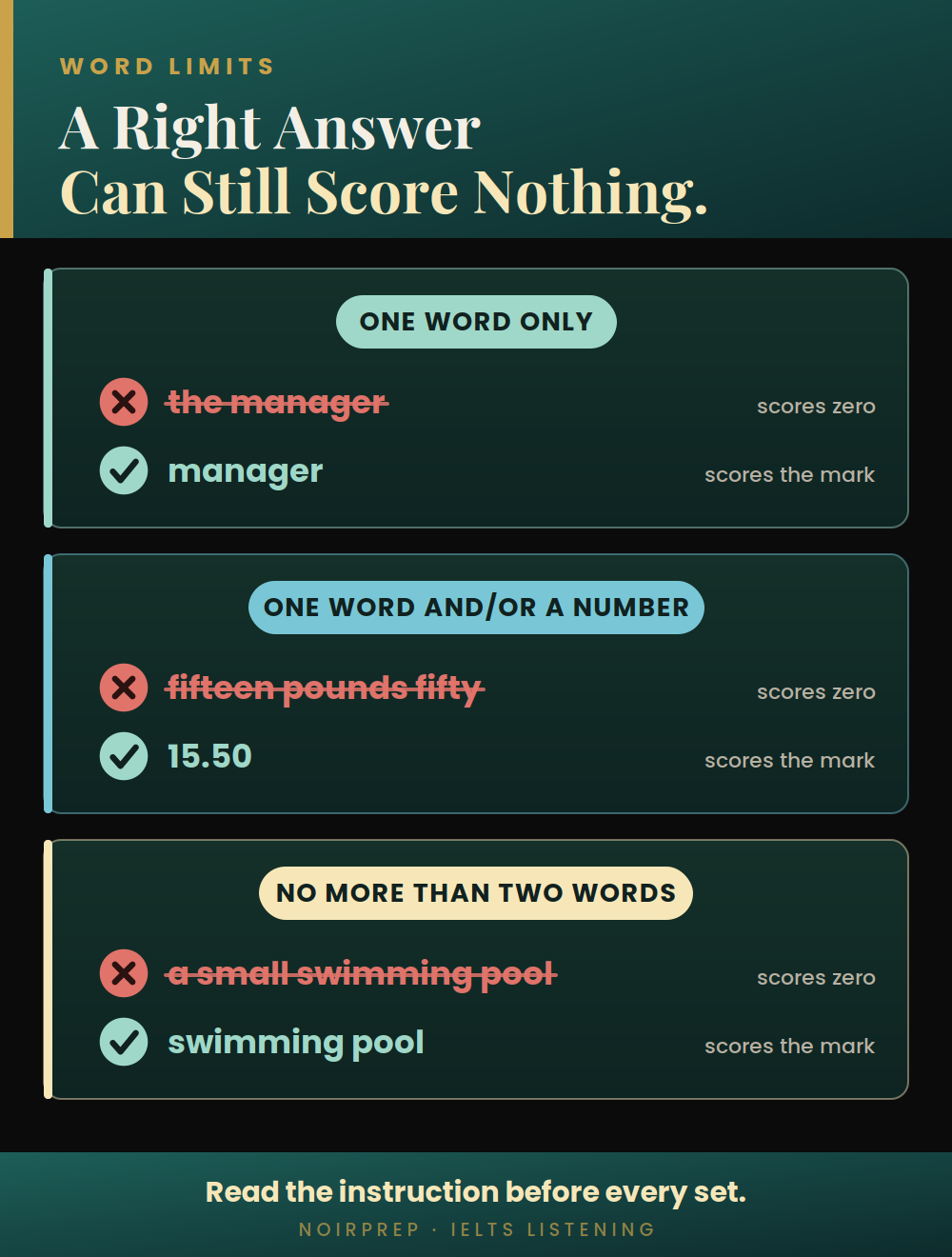
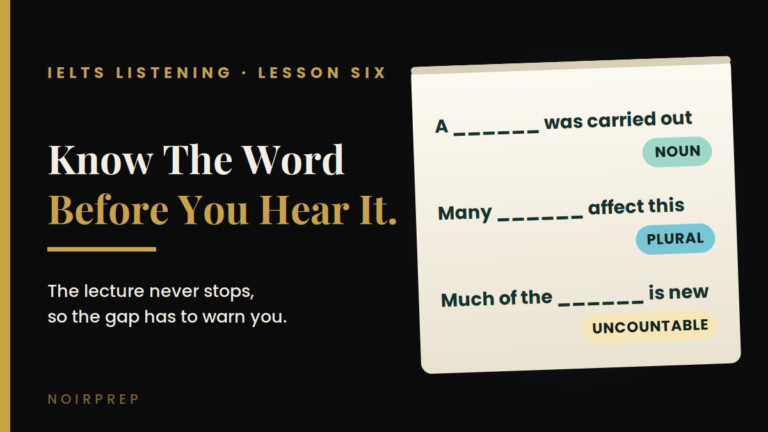
When the instruction says one word only, it means one word, and a word with the or a in front of it counts as two. When it says one word and or a number, you may write one word, or a number on its own, or one word together with a number. When it says no more than two words, you may write one word or two, and never three.
Three habits break these rules more than anything else. Candidates add a small extra word because the sentence reads better with it. They change the form of what they heard and write a plural where the speaker said a singular. Or they write two words where only one was allowed. None of these feels like a mistake at the time, which is exactly why they cost so much.
Read the instruction before each set of questions, then read it again in your checking time at the end. It takes a few seconds and it protects every answer under it.
Practicing the IELTS Listening Test Format Before the Next Lesson
Take a full listening test and sit it once under real conditions, which means one play of the audio, no pausing, and no reading the script first. Mark it honestly, then look only at the answers you got wrong and put them into three groups.
The first group is answers you never heard at all. The second is answers you heard correctly but wrote in a way the instruction did not allow, through a spelling error, a wrong plural, or too many words. The third is answers where you wrote the first thing the speaker said and the speaker changed it later.
Count how many sit in each group, because the three groups have three different causes and three different cures. Whichever group is biggest tells you which lesson in this series you need to read most carefully.
Next lesson: IELTS Listening Skills: How to Listen for Answers Instead of Words