IELTS Listening Part 2: How to Beat Multiple Choice Questions

Only one person speaks in this section and the topic is still an everyday one, so most candidates relax when it begins. That is the mistake. IELTS listening part 2 is where the recording stops simply telling you things and starts tempting you, and multiple choice is the question type it uses to do it.
Here is the pattern you need to know before anything else. The wrong answer may usually comes first. It is said early, it is said clearly, and it fits the question beautifully. Then the speaker quietly removes it and gives you the real one. Candidates who write the moment they hear something that fits lose the mark while feeling certain they were right.
Everything in this lesson is about not falling for that.
Every Question Has Two Kinds of Words
Most candidates read a question, underline a noun, and then wait to hear that noun in the recording. It is the most common habit in the exam and it is why so many answers go wrong.
Take this question. What is the main reason the schedule was changed?
Schedule and changed are the topic words. They tell you the general area, so you know roughly where in the recording to pay attention. They do not tell you what the answer is.
Main reason is doing the real work. That is the control word, and it is telling you something important, which is that several reasons will be mentioned and only the principal one counts.
A weak candidate reads that question and thinks it is about the schedule. A strong candidate reads the same question and thinks it is about the schedule, but the job is to find the main cause and ignore the smaller ones. One question, two readings, and the second one is what scores.

What Each IELTS Listening Part 2 Control Word Is Asking For
The same control words come back test after test, and each one is a precise instruction.

Main and mainly mean several reasons will be given and the answer is the principal one, so never take the first reason you hear. Reason and why send you listening for cause, carried by because, due to, or the main factor. First is about order, so the answer is the first step in a sequence rather than something simply mentioned early.
Where wants one specific place rather than the general setting, when wants one specific time, and how much wants a figure.
Best, better, worst and least are comparisons, so the answer has to beat the others, and an option that is merely good is wrong when the question asks for the best. Only is a restriction, which means the limiting condition is the answer rather than the thing itself. Included separates what the price covers from what is available at extra cost, because something can be mentioned, offered, and still not included.
Problem sends you listening for the trouble rather than the plan that solves it. Purpose and function ask what a thing is for, which is not the same as what it is. Change asks for the difference rather than either state on its own. And recommend means the speaker must actively suggest the thing, since describing it or praising it in passing is not a recommendation.
So read every question twice in your preparation time, once for the topic and once for the control word, then say the task to yourself in plain words.

How IELTS Listening Part 2 Hides the Answer
There are five things that can happen to an option in the recording, and candidates who score well can tell them apart.
An option can be mentioned, which means nothing on its own. It can sound possible for a moment. It can be rejected. It can be corrected. Or it can be confirmed. Only the last one earns the mark.
That is why two sets of signals matter more than anything else in this section.
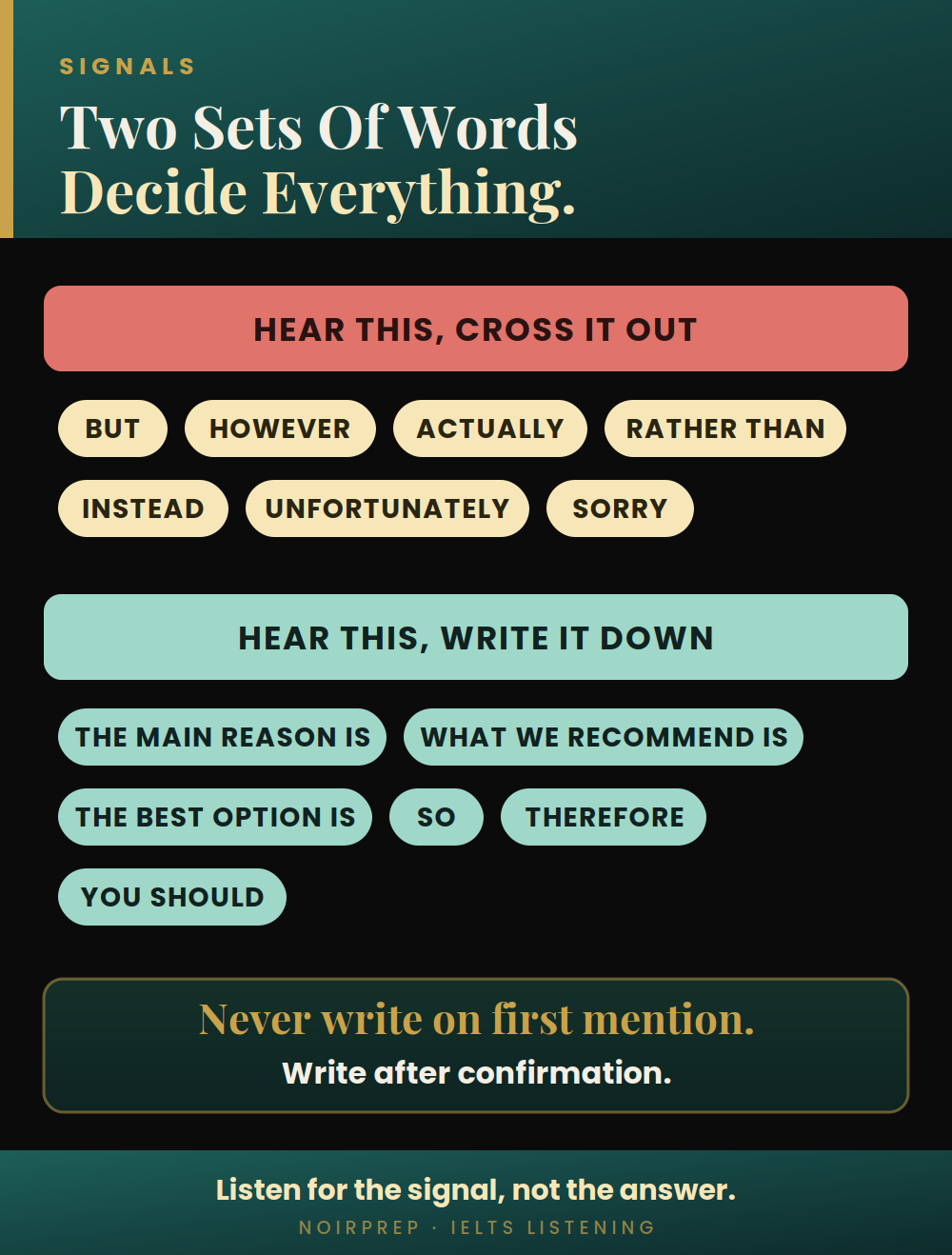
Rejection signals tell you to cross an option out, and they include but, however, actually, rather than, instead, not this but that, unfortunately and sorry.
Confirmation signals tell you to write, and they include the main reason is, what we recommend is, the best option is, so, therefore, the important thing is, and you should.
The rule is short enough to remember under pressure. Never write on first mention. Write after confirmation.
The Elimination Method, Step by Step
Here is a question worked through in the order you meet it in the exam. Notice that nothing in this recording is corrected or rejected out loud, which is what makes it realistic.
Step 1. Read the question and find the control word
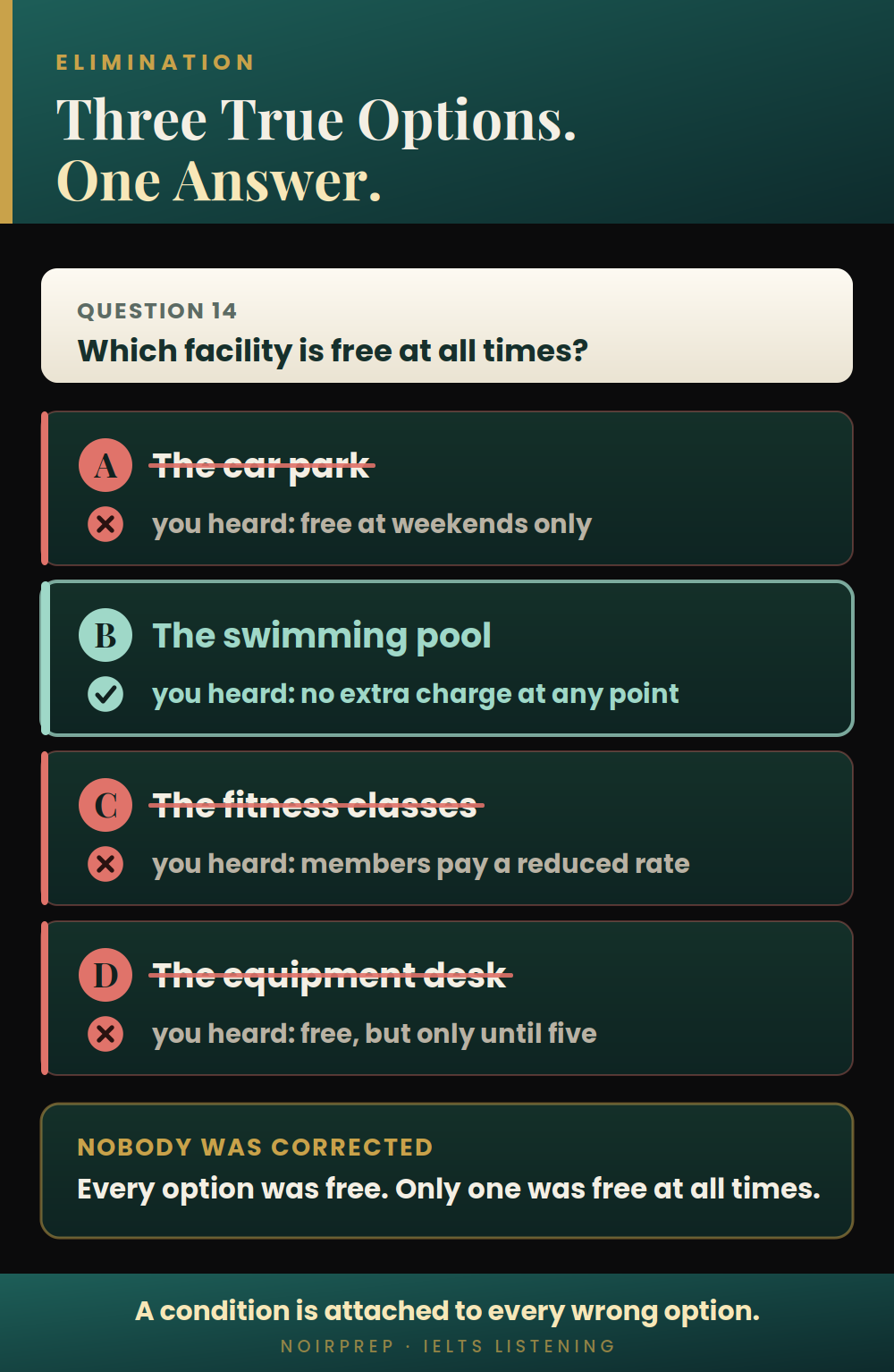
Question 14. Which facility is free for members at all times?
Topic word: facility. Control phrase: free at all times.
Two conditions sit inside that phrase, and an option has to satisfy both. It must cost nothing, and it must cost nothing always. One of those is easy to hear. The other is where the marks go.
Step 2. Read the options before the audio starts
A. The car park B. The swimming pool C. The fitness classes D. The equipment desk
Step 3. Listen
SPEAKER: Your membership gives you access to the building from six in the morning until ten at night. The pool is open throughout those hours, and there is no extra charge at any point. Parking costs nothing at weekends, though on weekdays you will need a ticket from the machine like everybody else. The classes, which is yoga, circuits and so on, are open to all members, and members pay a reduced rate rather than the full price. You can also borrow rackets from the equipment desk free of charge, as long as you bring them back before five, when the desk closes.
Step 4. Cross them out one at a time
A, the car park. Parking costs nothing at weekends, so it is free, and a candidate hearing costs nothing will often stop there. But on weekdays you will need a ticket, so it fails at all times. Crossed out.
C, the fitness classes. Open to all members, which sounds generous, and then members pay a reduced rate rather than the full price. Reduced is not free. Crossed out.
D, the equipment desk. Free of charge, said plainly, which makes this the most tempting option in the list. Then comes as long as you bring them back before five, when the desk closes. Free, but not at all times. Crossed out.
B, the swimming pool. Open throughout those hours, meaning the whole time the building is open, and there is no extra charge at any point. Both conditions satisfied. This is the answer.
What actually did the eliminating
No option was ever rejected. No speaker said sorry or actually or however. Every single one of those four facilities was described in a positive way.
What removed three of them were four small phrases that most candidates hear and do not weigh. At weekends. On weekdays you will need a ticket. A reduced rate. Before five.
This is what IELTS listening part 2 really does. It does not lie to you and it does not warn you. It attaches a quiet condition to each wrong option and waits to see whether you were listening to the whole sentence or only the first half of it.
A Second Question, Where the Answer Is Never Said in Your Words
Question 17. What was the main reason the festival moved to a new site?
Control phrase: main reason. So several reasons will be true, and only one of them caused the move.
A. The old site was too small B. Local residents complained about the noise C. The cost of using the old site rose D. Parking at the old site was difficult
SPEAKER: We had outgrown the old park, certainly. Last year people were standing on the footpaths because there was nowhere else to go. We also had one or two letters from neighbors about the music running late, and parking was always a headache, as anybody who came in 2024 will remember. But what finally forced our hand was the figure the council quoted us in January. It was close to double what we paid the year before, and at that point staying where we were simply stopped being possible.
A, too small. Admitted openly, and illustrated with people standing on the footpaths, which makes it feel like the answer. It is true. It is not the main reason. Crossed out.
B, complaints about noise. Also true, and also given a detail, which is letters from neighbors. Still not the reason they moved. Crossed out.
D, parking. Called a headache, which is strong language, and given a year to make it vivid. True again. Crossed out.
C, the cost rose. Here is the difficulty. The word cost is never used. The recording says the figure the council quoted us was close to double what we paid the year before, and your job is to recognize that as a rise in cost. The phrase what finally forced our hand is the confirmation. This is the answer.
Two things made this question hard, and both of them are standard.
The three wrong options were all true, all admitted by the speaker, and all supported with a convincing detail. The right option was never said in the words printed on your paper, so a candidate waiting to hear the word cost heard nothing and chose from what was left.
The IELTS Listening Part 2 Traps Have Names
Once you can name them, you stop falling for them.
The first mention trap puts a convincing option early in the recording, and the cure is to wait for confirmation. The correction trap gives a detail and then changes it after sorry or actually. The background trap gives context before the answer, and candidates mistake the setting for the point, when background always comes before the answer rather than instead of it.
The comparison trap offers several options that all sound suitable when only one satisfies best or most. The restriction trap describes something real that is limited by a condition, and the condition is the answer. The included against extra trap mentions something available that the price does not cover.
The worst of them is the partial match trap, where an option matches the topic perfectly and fails the control word completely. Both worked examples above ended that way, and that single sentence would save most candidates two or three marks.
Practicing IELTS Listening Part 2 Before the Next Lesson
Take any set of multiple choice questions and, before you play a single second of audio, do one thing.
Go through each question and underline the control word. Not the topic. The control word. Beside it, write what that word is asking you to find, such as the main cause, or the first step, or the one that beats the others.
Then play the recording once and answer it.
When you mark it, look only at what you got wrong and name the trap that caught you. Did you write on first mention. Did you take the background for the answer. Did you choose something that matched the topic but failed the control word.
Name it each time and it catches you less often. That is the whole method.
Next lesson: IELTS Listening Part 3: Following an Academic Conversation