IELTS Listening Part 1: How to Catch Every Detail First Time

Ask any candidate which section of the listening test worries them and almost nobody says the first one. The speakers are slower. The subject is ordinary. The answers are simple facts, not opinions. It feels like the part you do not need to prepare for.
And that is why so many people lose four or five marks in IELTS listening part 1 without ever noticing. They heard the answer. They understood it. Then they wrote it down wrongly. A letter dropped from a name. Fifteen written when the speaker said fifty. An answer put down too quickly, before the speaker had finished changing their mind.
So this lesson is not about understanding the recording. You will understand it. It is about the short journey between hearing the answer and getting it on the page, which is where the marks are actually won and lost.
What IELTS Listening Part 1 Really Is
Think of a phone call, not a lesson. Someone is booking a room, joining a class, reporting a lost bag, complaining about a service, or asking what a place offers. The other person is writing their details down.
Because it is a real conversation, it moves fast. Things are said once. People change their minds halfway through a sentence, the way we all do.
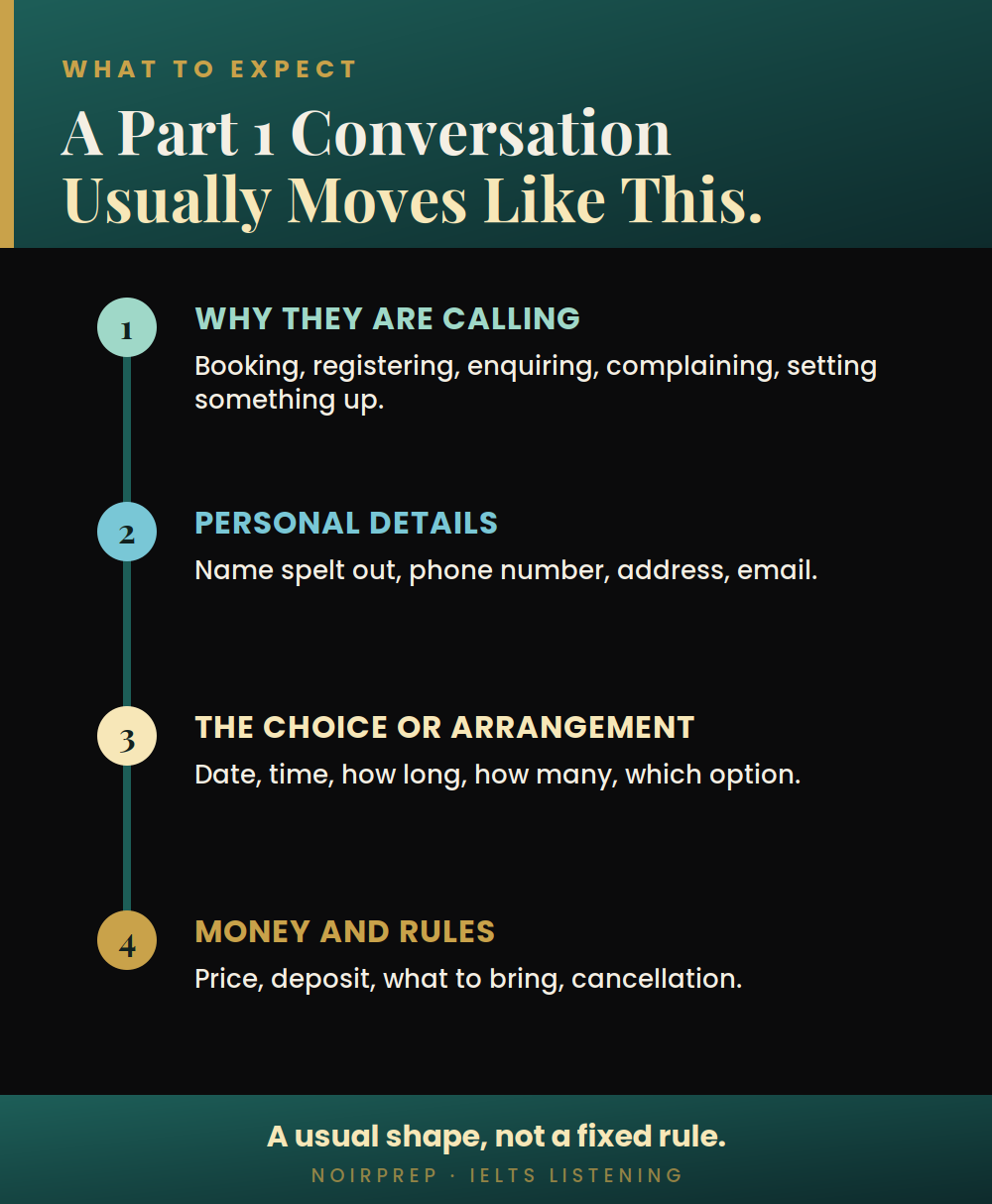
The helpful part is that most of these calls move through the same stages. The caller says why they are calling. Their details are taken. A choice or an arrangement is made. Money and rules come up near the end.
This is a usual shape rather than a fixed rule, so do not expect every stage every time. What it gives you is a reasonable idea of what is coming next.
The Answers Come From the Same Few Places
Listen to enough of these and you see the answers fall into three groups.
The first is personal details. A name, usually spelt out for you. A phone number. An email address. A house number and street. A postcode.
The second is the booking. What is being booked. The date and the time. How long it lasts. How many people are coming. And which option the caller chooses, such as morning or evening, standard or premium.
The third comes near the end and it is about money and rules. The price. A deposit. How they will pay. And the small conditions, such as bring your passport, arrive ten minutes early, or cancel three days before.
Knowing these three groups changes how you listen. You stop hoping the answer turns up and start waiting for it.
The Five Answer Types in IELTS Listening Part 1
This is the best habit you can build for this section, and it uses nothing but the preparation time the exam already gives you.
Before the audio starts, go through each gap and decide what kind of answer belongs there. There are only five kinds, so it takes seconds.
Some gaps need a spelled word, like a name or a street, and you take those letter by letter. Some need a number, like a price or a phone number, and you write those as they are spoken. Some need a date or a time. Some need a choice, where a few options are mentioned and you wait for the one that is picked. And some need a rule, like a deposit or a deadline.
Mark each gap with its type and your listening changes completely.

Spelling Is Where Most Marks Are Lost
The second a speaker starts spelling, stop reading ahead. Put your eyes on that one gap and write every letter as it comes. The spelling is given once, and it does not come back.
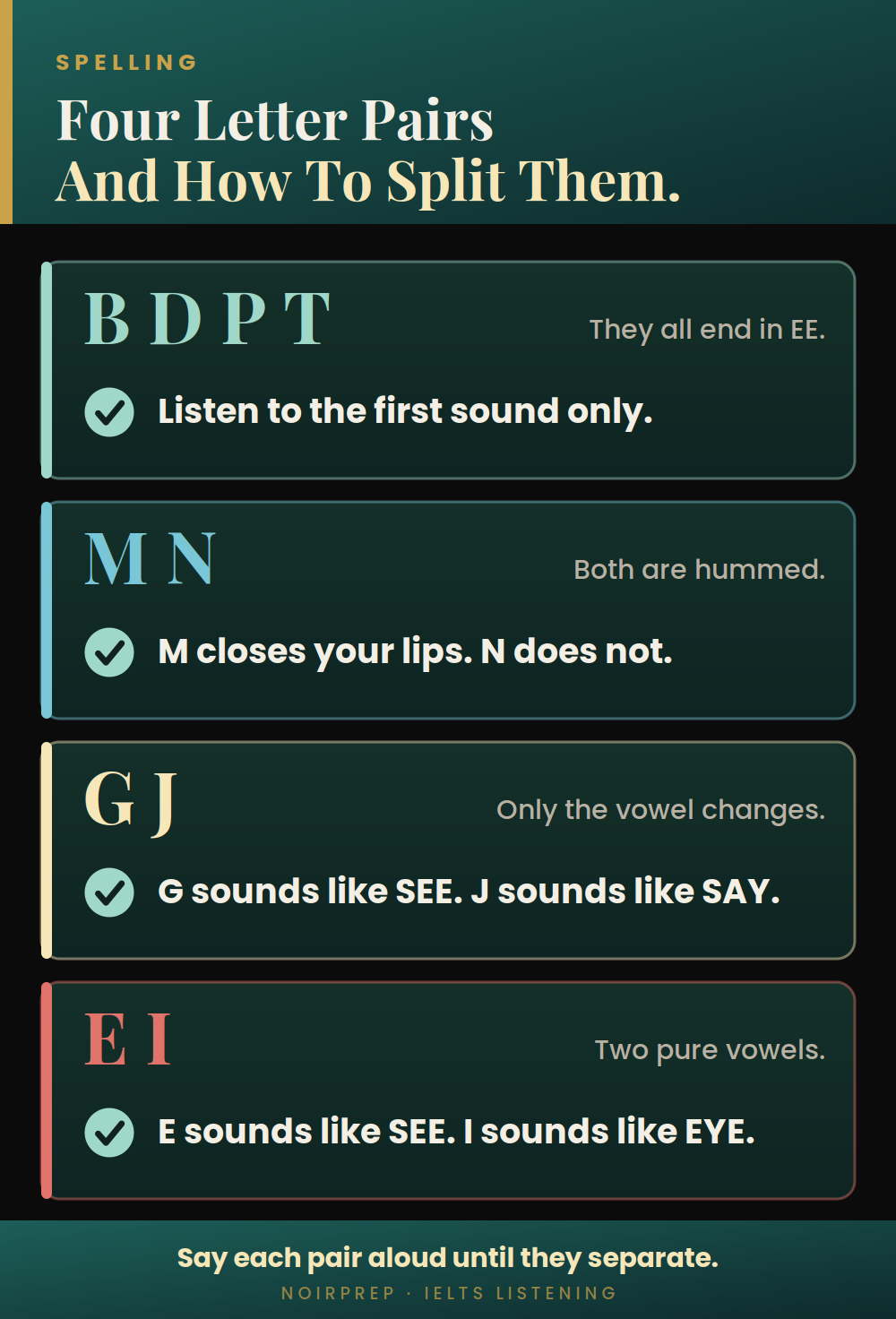
A handful of letters cause nearly all the problems, and each one has a way around it once you know what to listen for.
B, D, P and T all end in the same ee sound, so the ending tells you nothing. The difference is at the start, and that is where your attention should go.
M and N are both hummed, which is why they blur together. The difference is your lips. M closes them and N does not, so M sounds slightly muffled and N sounds sharper.
G and J differ only in the vowel. G rhymes with see and J rhymes with say. Say those two out loud a few times and they will never sound the same again.
E and I are the same kind of problem. E rhymes with see and I rhymes with eye.
Spend five minutes with those four pairs and most spelling errors disappear. If you still miss a letter, write your best guess and keep going.
Write Numbers While They Are Being Said
Numbers arrive in long runs here, like phone numbers, prices and times. The mistake is to listen to the whole run and then write it from memory.
Four pairs catch people out over and over. Thirteen and thirty. Fourteen and forty. Fifteen and fifty. Sixteen and sixty.
There is a simple way through them. Listen to the ending rather than the beginning. Teen finishes with an n sound, and ty finishes with an ee sound. Thirteen ends in n. Thirty ends in ee.
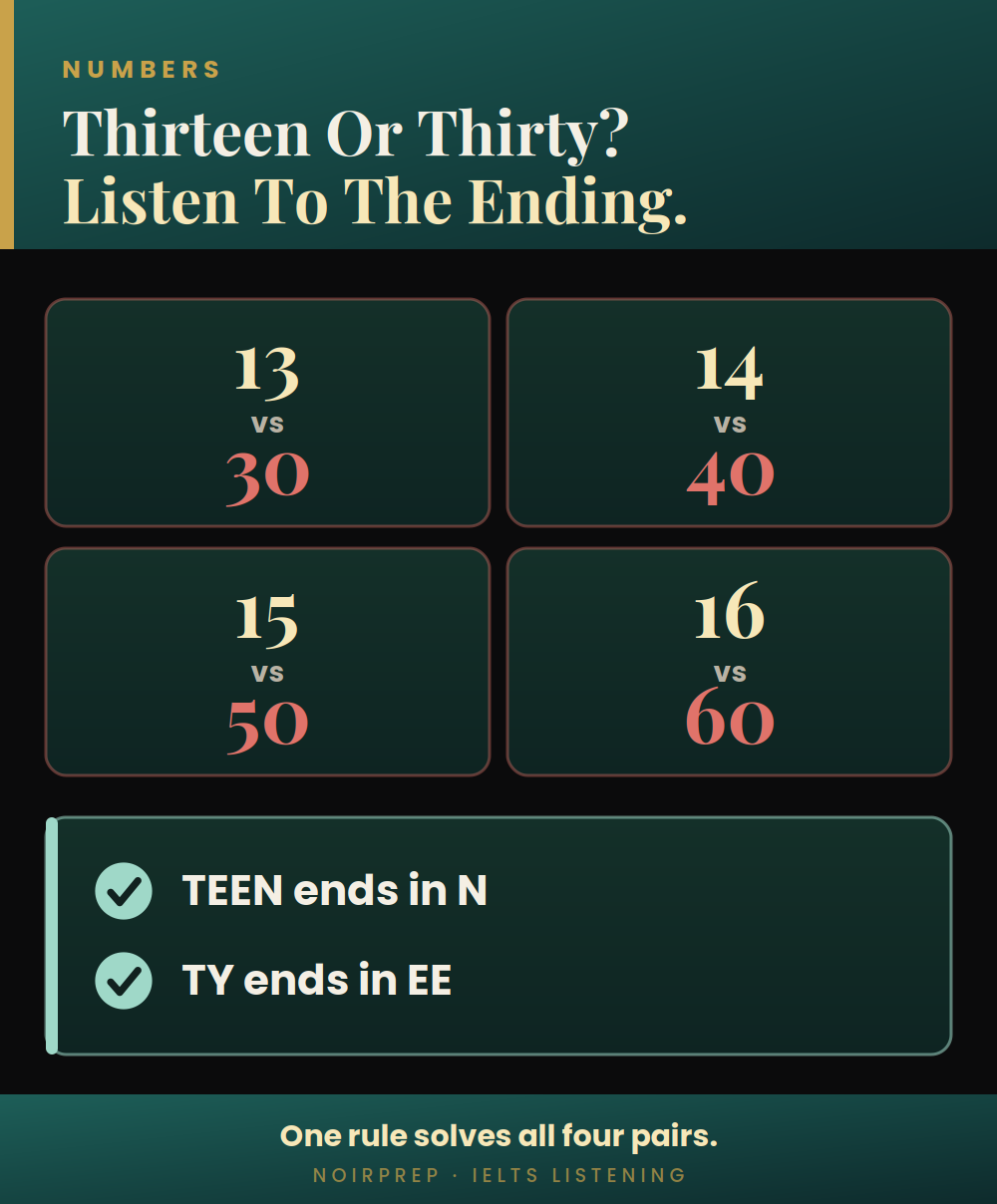
Write numbers as they come, digit by digit. Trying to hold a phone number in your head for even three seconds is how answers disappear.
The Speaker Will Change Their Mind
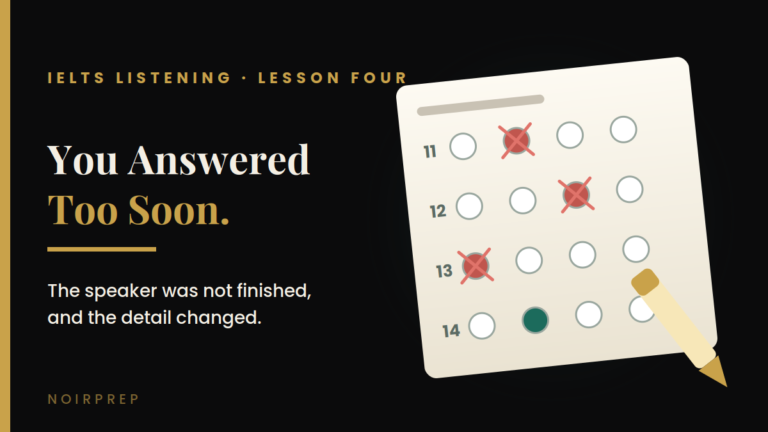
This happens in nearly every recording, and it is done on purpose. The last version is the one that counts.
You will hear things like Tuesday, actually Thursday. Or room 14, sorry, 40. Or at 2:15, no, 2:50. The first detail is always said clearly and confidently, and that is what makes it a trap.
When it happens, do not freeze. Cross it out, write the new one, move on.

Choices work the same way. Two or three options are offered before one is picked, like standard or premium, weekday or weekend. Hearing the options is not the skill. Knowing which one was chosen is the skill.
Details Get Confirmed One at a Time
Candidates often wait for a tidy summary at the end of the recording. It rarely comes, and waiting for it is a poor plan.
What happens instead is that details are settled as the conversation moves, usually right after somebody has changed something. The speaker corrects a detail, the other person repeats it back, and that repetition is your confirmation.
So listen for the short phrases that close a detail. So just to confirm. Okay, I have got. Let us go with. We will put you down for. Each of those means the detail before it is now final, and that is the version to have on your page.
When you hear one of them, glance at the answer you wrote for that gap. If what you hear does not match what you wrote, change it immediately and keep moving. Those few seconds are the cheapest correction the exam gives you, and they come several times in the section rather than once at the end.
It Is Not Only Names and Numbers
Many candidates prepare for personal details and then lose marks on ordinary words, because ordinary words sound unimportant.
Listen for availability. Fully booked means the real answer is whatever comes next. Earliest slot means that time is the answer. We can fit you in at confirms the booking.
Listen for facilities, like parking, wifi, a lift, breakfast or air conditioning. And listen for conditions, like bringing identification, paying a deposit, or a cancellation deadline.
These are tested a lot for one simple reason. They sound so plain that candidates relax while they are being said.
Practicing IELTS Listening Part 1 Before the Next Lesson
Take one section and do it in two stages instead of one.
Start with the preparation time on its own, and do not play anything yet. Go through every gap, write beside it which of the five answer types it needs, and circle the word limit at the top. Give yourself sixty seconds and stop, because sixty seconds is what you get.
Then play the audio once and answer it properly.
Now mark it, and look only at what you got wrong. Ask which of four things caused each mistake. Was it the spelling. Was it the number. Did the speaker change the answer while you kept the first one. Or did you write too many words.
Four causes, four different fixes. In this section, all four can be sorted out inside a week.