IELTS Listening Skills: How to Stop Missing Easy Answers
You can understand almost every word in a listening recording and still reach the end of the section with half your answers missing. It happens to candidates with good English all the time, and it is one of the most frustrating parts of this exam, because nothing felt difficult while it was going on. The words made sense as they went past. They simply did not end up on the answer sheet.
The reason is hardly ever vocabulary. It is that nobody has you the IELTS listening skills that turn understanding into marks, and the first of those skills is deciding what you are listening for before the recording even begins.
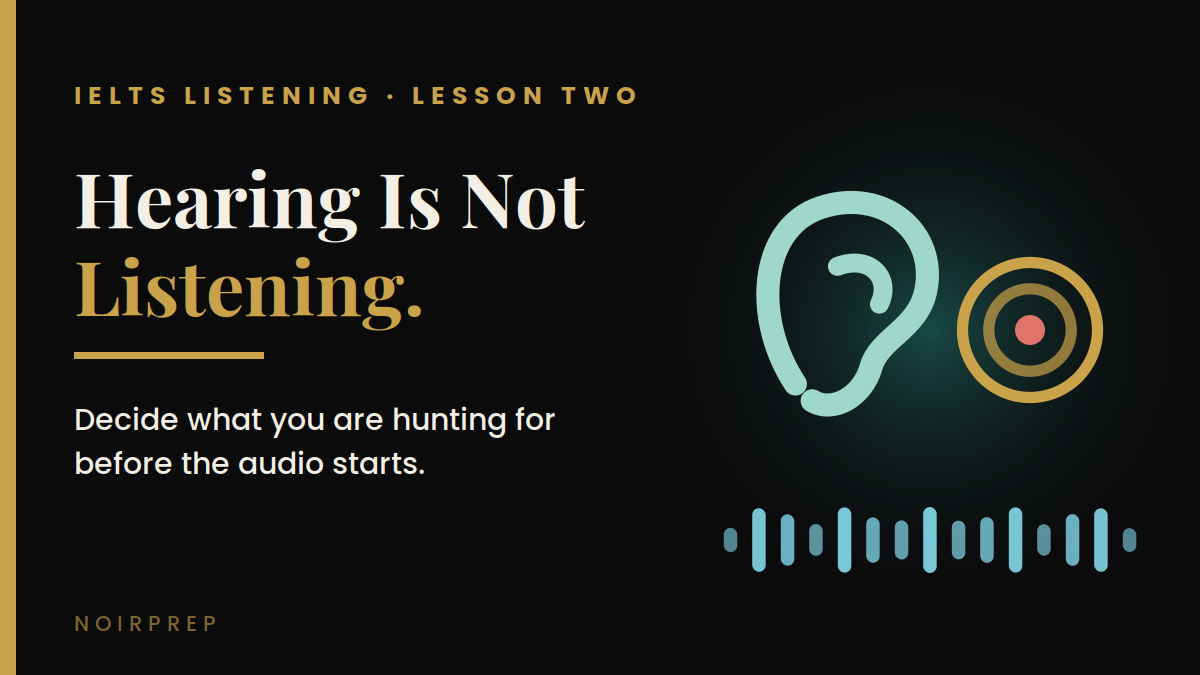
You get a short gap to look at the questions before each section starts. Most candidates spend it reading through them. The ones who score well spend it choosing what they are going to hunt for, so that by the time the first speaker opens their mouth, they already know what kind of answer is coming.
That is really the whole difference between hearing and listening. Hearing is passive, because the sound arrives and you hope to follow it. Listening is active, because you have already picked out what you want, so you notice it the moment it is said.
The IELTS Listening Skills Begin With Knowing the Shape of the Answer
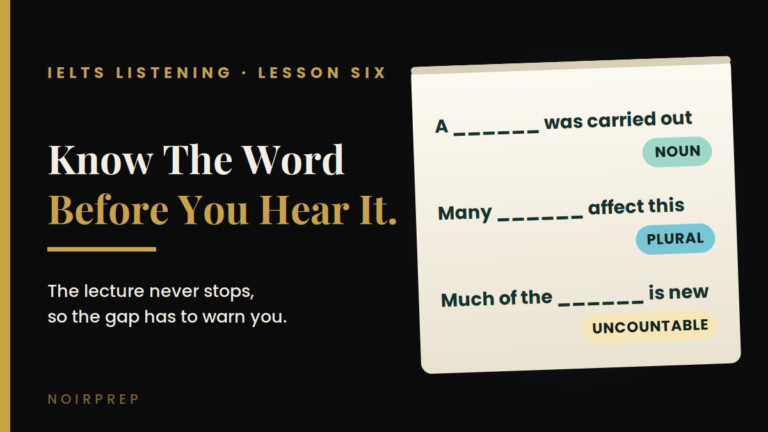
Look at any gap in a question and you can work out what kind of word belongs there before you hear anything at all.
If the gap needs a name, it will usually be spelt out for you, so be ready to write it letter by letter. If it needs a number, it will be a price, a time, a date or an amount. If it needs a place, listen for a street, a building or an area. If it needs a reason, wait for words like because, or due to, or the main cause of. And if the gap simply needs a missing word, ask yourself which word would fit that sentence.

Take a question that says the fee is something. One candidate waits and hopes. The other has already decided that a number is coming, so for that whole paragraph he ignores everything that is not a number. When the figure is said, he has it written down before the sentence ends.
This is why the preparation gap matters so much. Used well, it is not reading time. It is the moment you decide what you are hunting for, and that decision is what turns plain hearing into the IELTS listening skills the examiner rewards.
The First Skill Is Following the Story
Candidates rarely get lost because one word was too hard. They get lost because they stopped knowing where they were in the conversation.
Following the story means being able to answer five small questions at any moment while the audio runs. Who is speaking. What the topic is. Where the speakers have got to. What they are trying to do. And what has changed since the start.
If you can answer those five, you cannot be lost.

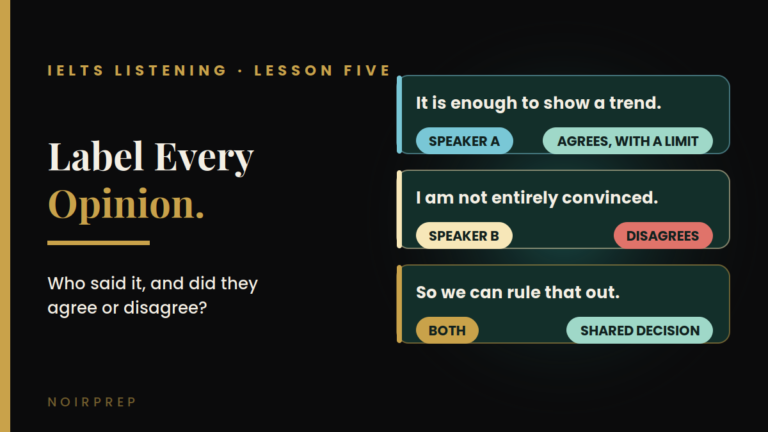
The useful part is that IELTS builds its recordings along the same few patterns every time. Part 1 moves from a greeting, to the reason for the call, to personal details, to a booking or arrangement, and ends with a confirmation. Part 2 opens with an introduction, gives an overview, goes through three to five points in order, adds a reminder, and closes. Part 3 starts with a topic, moves into opinions, runs into a disagreement, works towards a solution, and ends with a decision. Part 4 introduces the subject, gives the main idea, lists points in order, adds examples, and finishes with a summary.
Once you know these patterns, you have a rough idea of where in the recording your next answer is likely to turn up.
The Words That Warn You an Answer Is About to Change
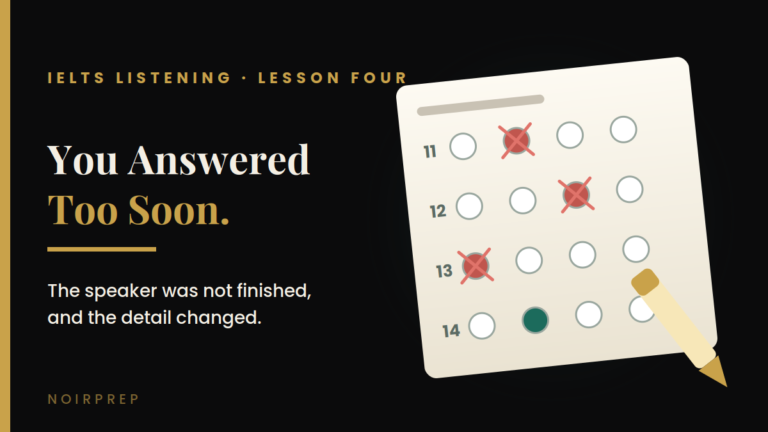
Of all the IELTS listening skills, this is the one that saves the most marks, because it protects you from writing down an answer the speaker is about to take back.
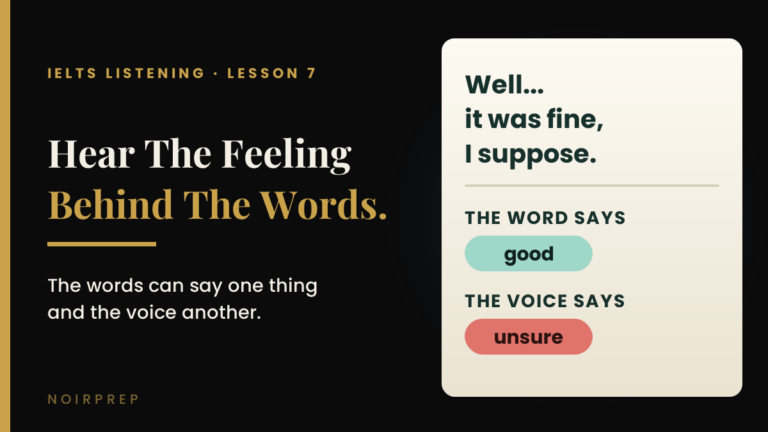
Some phrases nearly always mean a correction is coming. When somebody says actually, they are about to change what they just said. Sorry, I mean, is a straight replacement. No, not that, is a rejection, and the real answer comes next. Rather, introduces a contrast. But that changed, tells you the detail you wrote is now wrong. In fact, usually means a better version of the idea is on its way.
When you hear any of these, hold your pen. The answer is the version that comes after, not the one that came before.

There are also phrases that tell you the detail is now settled, such as so we will go with, or let us put that down, or so that leaves us with. That is your signal to write.
The Second Skill Is Listening for Meaning
The recording will not use the same words that are printed on your question paper, and a candidate waiting for an exact match is waiting for something that never comes.
Three habits deal with this. First, find the key word in each question, which is usually the main noun or verb, because it tells you what the answer is about. Second, expect the same idea in different words, so a question about a fee may be answered by a speaker talking about a price, a charge or a cost. Third, learn small groups of related words before the exam, so that increase, go up, rise, grow and climb all feel the same to you, and so do decrease, drop, fall, reduce and decline.
None of this needs difficult vocabulary. It needs ordinary words that you know well enough to recognize instantly.
Every Answer Has Three Layers
This one idea explains almost every trap in the exam.
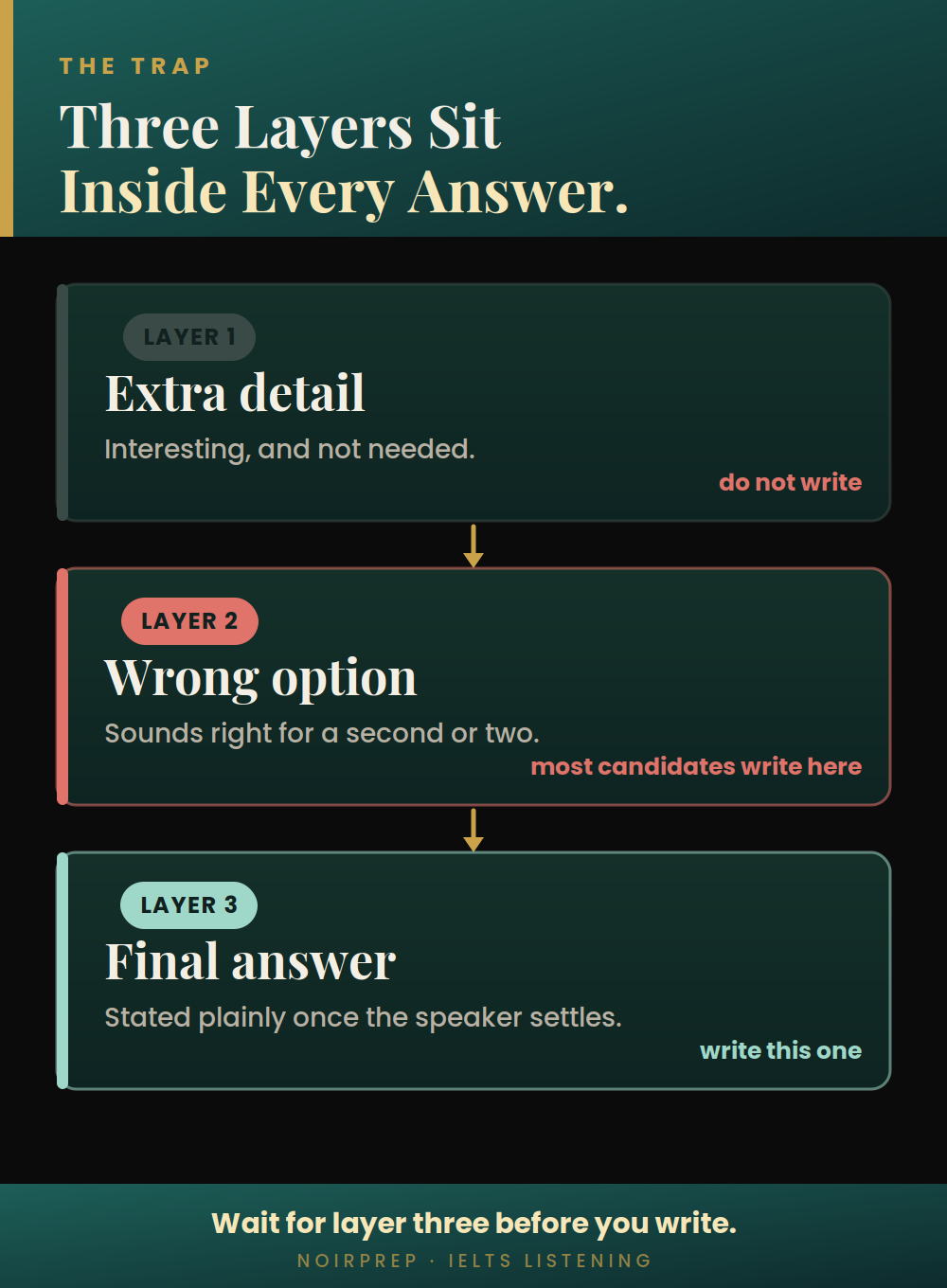
Around each answer there are usually three layers of information. The first is extra detail, which is interesting and not needed. The second is a wrong option, which sounds right for a second or two, and this is where most candidates commit. The third is the final answer, confirmed and plainly stated, and this is the one to write.
Candidates stuck at band 6 write at layer two. Candidates who score well have trained themselves to wait for layer three.
How to Train These IELTS Listening Skills at Home
I want to be honest with you about this part, because the practice I am going to describe will not feel pleasant at first. That is the point of it. Practice that feels comfortable is exactly what leaves candidates panicking in the exam hall, since nothing in that room is going to wait for them to feel ready.
So when you sit down to practice, play the recording and leave it running, whatever happens. If an answer escapes you, let it go and carry on. I know how hard that is, and I know the temptation is to stop the audio and listen to that part again. Resist it, because the thing you are really training is your ability to recover, and you cannot train recovery if you never allow yourself to fall behind. Once the recording has finished, that is when you go back and ask yourself three things. Where did I get lost. Which warning words went past me. At what point did the topic change without my noticing.
There are three drills that build these IELTS listening skills, and each one is something you will actually be doing in the exam room, so the practice carries straight over.
The first is the preparation gap itself. Set a timer for sixty seconds, take one set of questions, and in that minute underline the keyword in each question and write above every gap what kind of answer belongs there, whether a name, a number, a place or a reason. Then play the audio. You are not inventing an exercise here, you are rehearsing the exact minute the exam gives you, and most candidates have never once practiced it on purpose.
The second is writing while the speaker is still talking. Most candidates wait for the sentence to finish, understand it, and then write, and in those two seconds the next piece of information has already gone past. Practice putting the answer down the moment you hear it. It feels rushed at first and it is the habit that keeps you level with the recording.
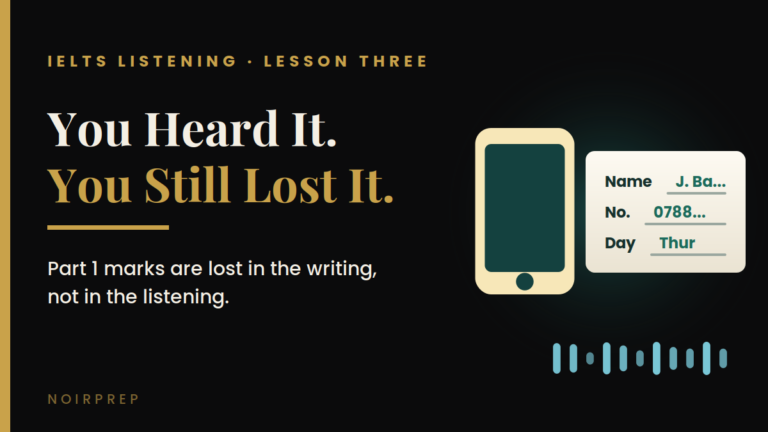
The third is marking your own paper honestly. After each practice test, go through the answers you got wrong and sort them into three piles. The ones you never heard at all. The ones you heard but wrote in the wrong form, through spelling or a plural or too many words. And the ones where you wrote what the speaker said first and the speaker changed it afterwards. Three piles, three different problems, three different cures, and the biggest pile tells you where your next week of practice should go.
What to Do Before the Next Lesson
Find a listening section you have already done and marked, and use it again in a different way.
Play it a second time, but do not answer anything. Instead, write the five tracking questions down the side of a page and keep answering them while the audio runs. Who is speaking. What the topic is. Where they have got to. What they want. What has changed. It will feel strange at first, because your hand wants to write answers, and that is exactly the habit we are loosening.
Then play it one more time and listen for nothing but the warning phrases. Every time you catch one, write it down along with whatever the speaker said immediately afterwards.
Do this once, properly, and you will learn more about your own IELTS listening skills than five more practice tests would teach you. The reason is simple. It shows you the exact moment where you stopped listening and started guessing, and until you can see that moment, there is no way to fix it.
Next lesson: IELTS Listening Part 1: Form, Note and Table Completion