How to Identify Tone and Attitude in IELTS Listening: 9 Clues That Work

Some questions in the IELTS listening test do not ask what a speaker said. They ask how the speaker feels about it. The question might read “What is Maya’s attitude to the interviews?” or “How does the lecturer feel about the new method?”, and the options are words such as pleased, doubtful, worried or critical.
These questions catch many candidates, because the speaker almost never says the feeling out loud. Nobody says “I am doubtful” or “I am disappointed”. The feeling is carried by the way the words are said and by the words that were chosen, so you have to listen for it.
What Tone Means in IELTS Listening
Tone is the attitude or feeling a speaker has towards the subject. It shows whether the speaker feels positive, negative, neutral, worried, confident or unsure about what they are discussing.
You will meet tone most often in the conversation in Part 3, where students and tutors give opinions, and in some multiple choice questions in Part 4. The question words give it away. Look for attitude, opinion, feel, sounds, and what does the speaker think about.
The most important thing to remember is that tone is not the topic. A speaker can talk about a serious problem in a hopeful voice, and a speaker can talk about a pleasant subject in a bored voice. So never choose an option because of the subject. Choose it because of the feeling.
Four Things You Can Hear
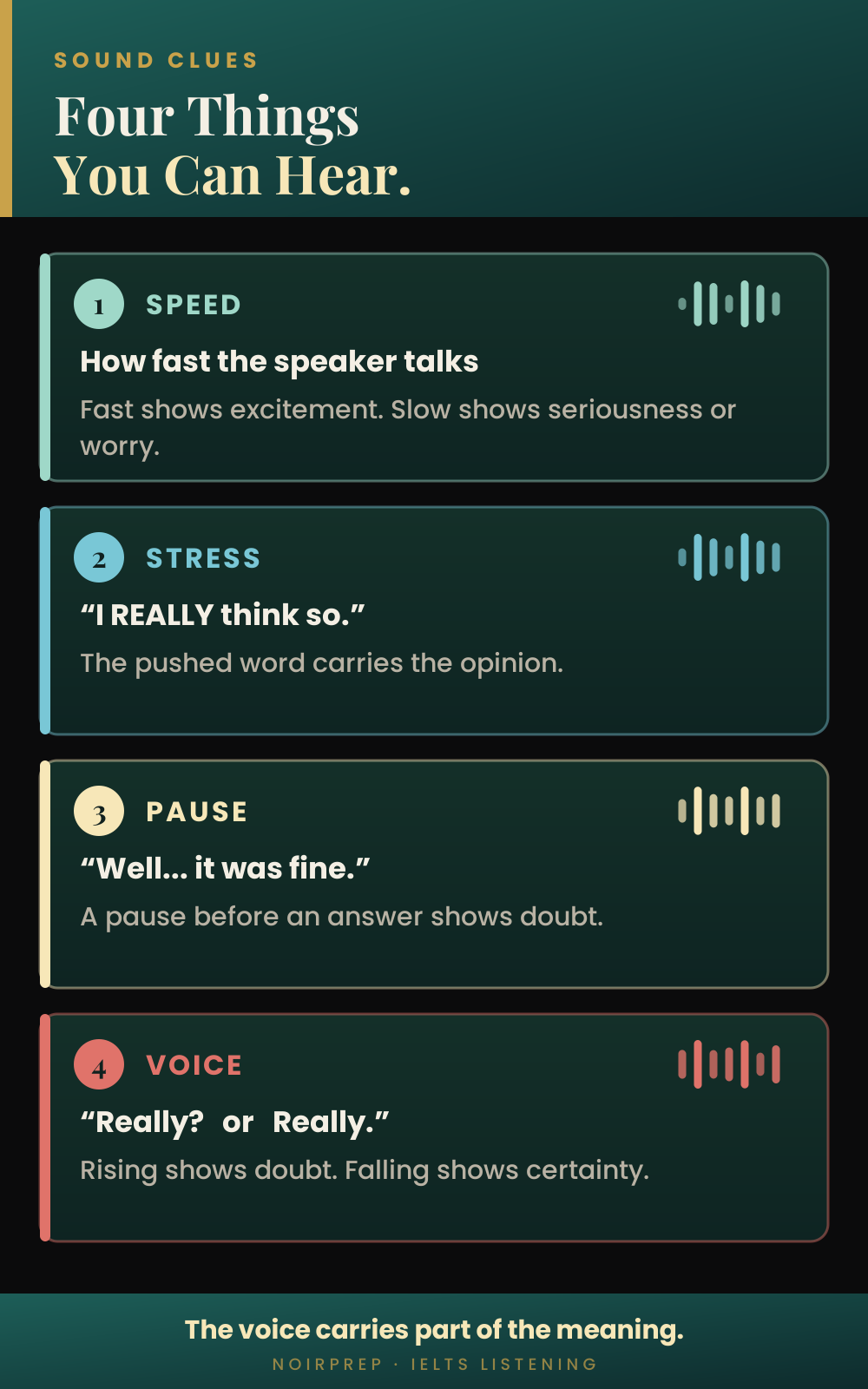
Unlike reading, listening gives you the voice, and the voice carries a great deal of the meaning. Four things are worth training your ear for.
The first is speed. When a speaker talks quickly, it often shows excitement or strong feeling. When a speaker slows down, it often shows seriousness or worry.
The second is stress. The word a speaker pushes hardest is usually the word that carries the opinion. In “I really think this is important”, the stress on really tells you the speaker holds a strong view.
The third is pausing. A pause before an answer, or a pause in the middle of a sentence, usually shows doubt. If a speaker says “Well… it was fine, I suppose”, the pause and the weak words show that the speaker is not really satisfied.
The fourth is the movement of the voice. A voice that rises at the end can show surprise, doubt or a question, and a voice that falls shows certainty. Compare “Really?” with “Really.” The first shows that the speaker is surprised or unconvinced, and the second shows that the speaker agrees.
Five Word Clues That Work in Every Part
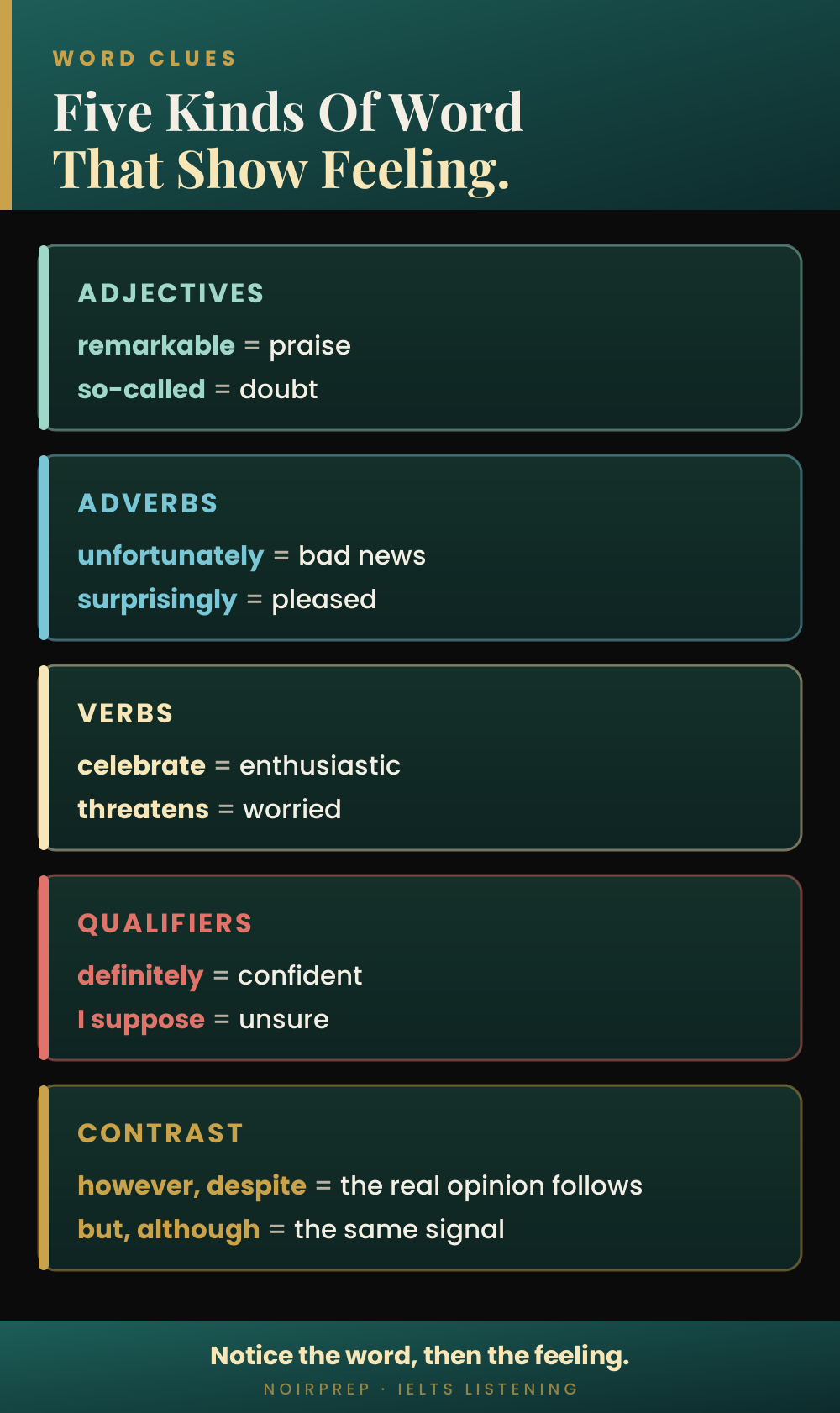
The words themselves also carry feeling, and they are easier to catch than the voice, so train yourself to notice five kinds.
Adjectives show approval or disapproval. Remarkable and exceptional are praise. So-called and disappointing are criticism.
Adverbs show how strong the feeling is. In “Unfortunately, the project was severely delayed”, the two adverbs tell you something bad happened. In “Surprisingly, the results exceeded all expectations”, they tell you the speaker is pleased.
Verbs can carry emotion too. When a speaker says that scientists celebrate a discovery, the speaker is enthusiastic, and when a speaker says that a policy threatens public safety, the speaker is concerned.
Qualifying words show how sure the speaker is. Clearly and definitely show confidence. Rather, I suppose, I am afraid and somewhat show that the speaker is careful or unsure.
And contrast words, such as however, although, despite and but, usually point to the real opinion. The speaker often says something polite first and then gives the true feeling after the contrast word.
A Worked Example
Here is a short conversation between a tutor and a student called Maya, who is talking about a research project. The delivery is written in brackets so that you can imagine how each line sounds.
TUTOR: So, Maya, how did the survey go? MAYA: Honestly, it went better than I expected. [said quickly, with energy] I thought nobody would reply, but we received over two hundred responses. TUTOR: And the interviews? MAYA: Well… [a pause] they were fine, I suppose. Some people did not really want to talk, and the recordings are not very clear. TUTOR: What about the report deadline? MAYA: I am afraid it is rather tight. [said slowly] We still have to analyse everything, and I really do not think we can finish by Friday. TUTOR: Would an extension help? MAYA: Definitely. [with strong stress] That would make a real difference.
Now four questions, each with three options.
- How does Maya feel about the survey response? She is A surprised and pleased, B disappointed, or C unsure.
- How does Maya feel about the interviews? She is A delighted with them, B not fully satisfied with them, or C certain they will be useful.
- How does Maya feel about the deadline? She is A relaxed, B worried, or C amused.
- How does Maya feel about an extension? She is A uncertain, B unwilling, or C strongly in favor.
The answers are A, B, B and C.
In question 1, the phrase “better than I expected” and the earlier “I thought nobody would reply” show that the result was a pleasant surprise. In question 2, the word fine sounds positive, but the pause, the words “I suppose” and the problems that follow show that Maya is not satisfied. A candidate who chose A because they heard fine has been caught by the word and missed the tone.
In question 3, the phrase “I am afraid”, the slow delivery and the word tight all show worry. In question 4, the stress on definitely and the phrase “a real difference” show a strong wish for the extension.

The Tone Words You Will See in the Options
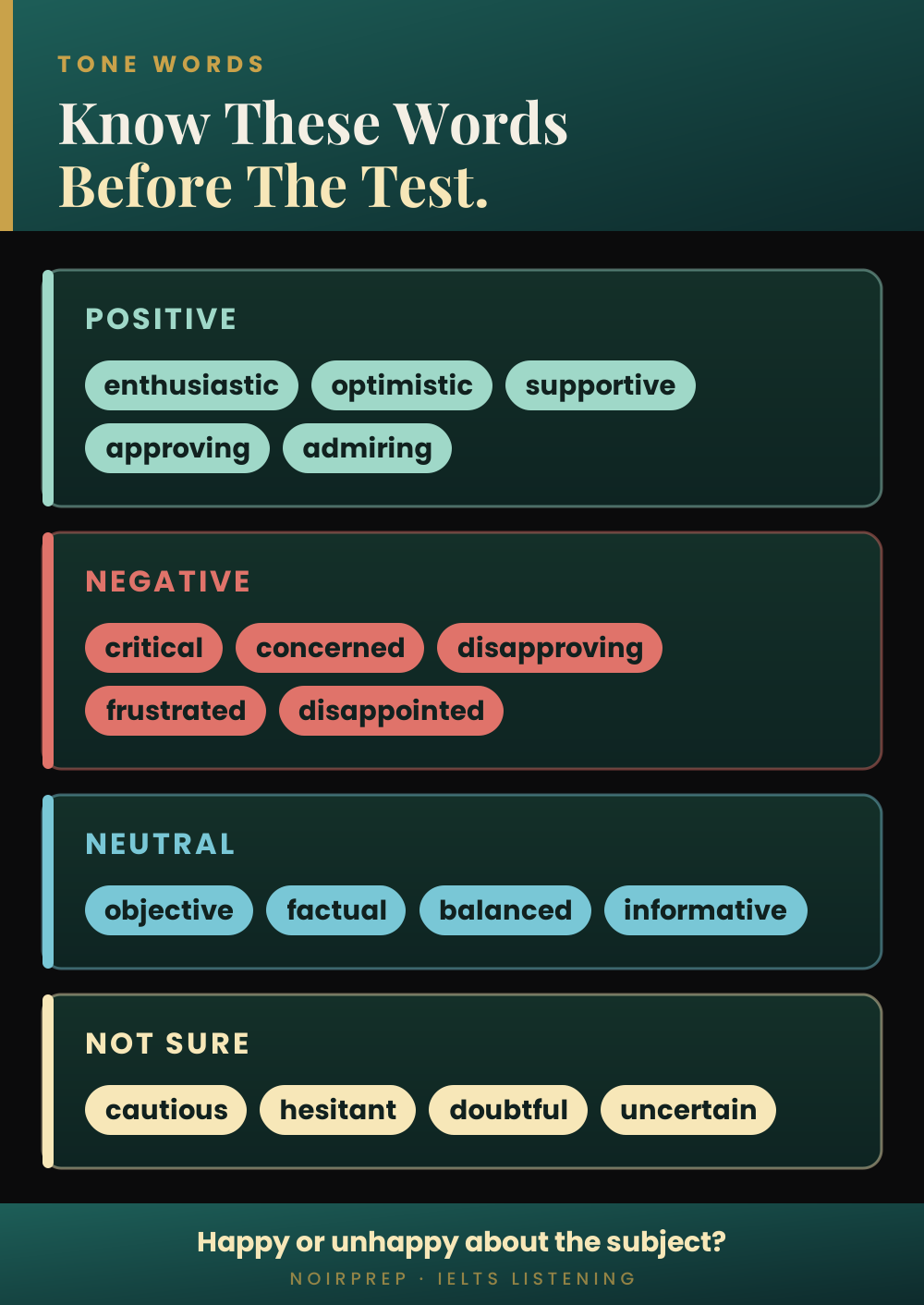
The options in these questions use a small group of words again and again, and you should know them well before the test. It helps to sort them by feeling.
Positive words include enthusiastic, optimistic, supportive, approving and admiring. Negative words include critical, concerned, disapproving, frustrated and disappointed. Neutral words include objective, factual, balanced and informative. And there is a fourth group for speakers who are not sure, which includes cautious, hesitant, doubtful and uncertain.
If you are not sure which group a speaker belongs to, ask one simple question. Is this person happy or unhappy about the subject?
Three Mistakes That Cost Marks
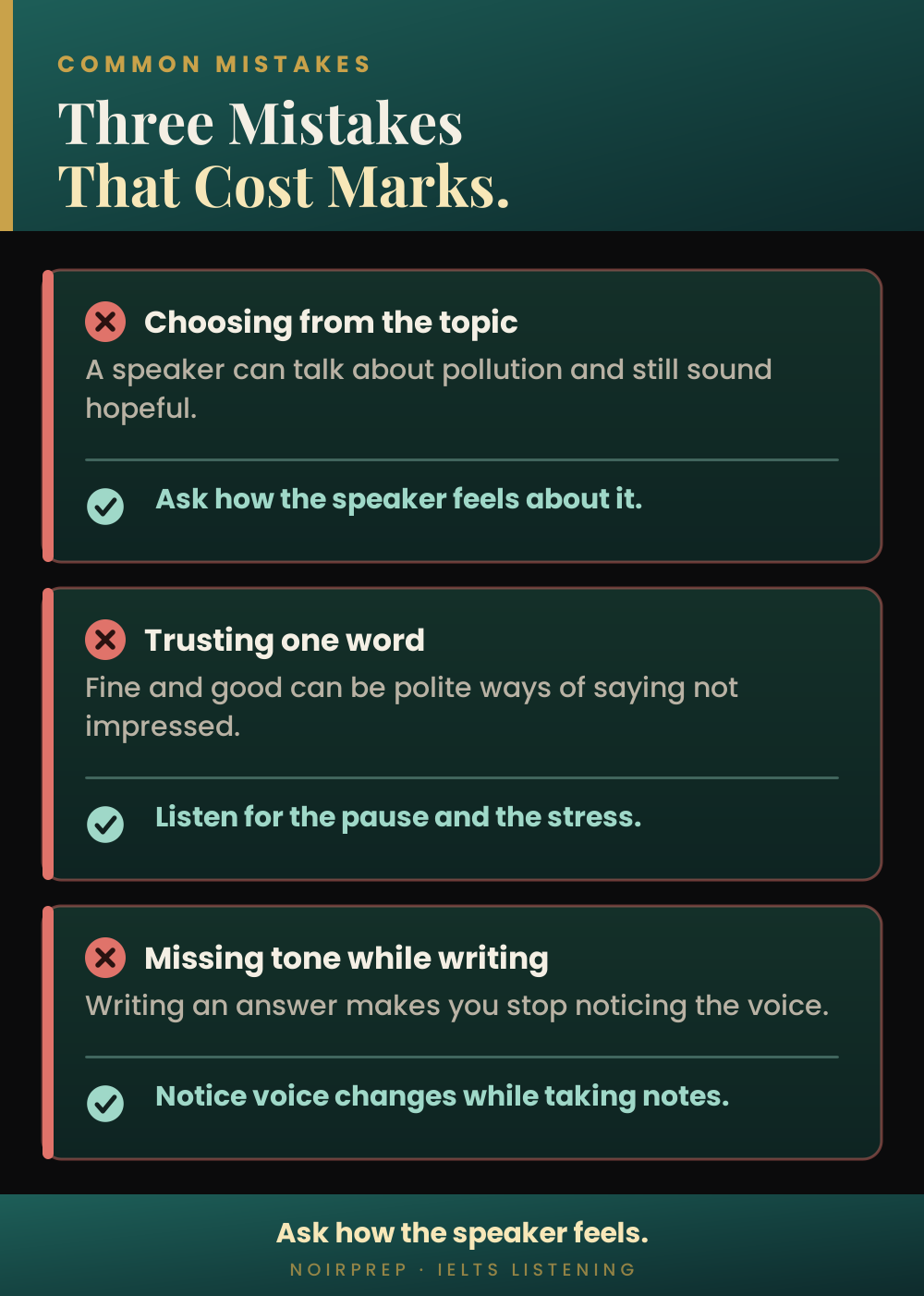
The first mistake is choosing the tone from the topic. Because a speaker is talking about pollution, many candidates choose a negative option, but the speaker may be hopeful about the solutions. Always ask how the speaker feels, and not what the speaker is talking about.
The second mistake is trusting one word. The word fine, the word good and the word interesting can all be polite ways of saying that the speaker is not impressed. Listen to the whole sentence, and to the pause and the stress around the word.
The third mistake is missing the tone because you are busy writing. When you are working hard to write an answer, you stop noticing how the speaker sounds. Train yourself to notice a change in the voice while you are taking notes, because that change is often the answer to the next question.
Practicing IELTS Listening Tone and Attitude Before the Next Lesson
You do not need a test paper to train this skill, because every conversation and every news report contains tone.
Choose a short video or a news interview and listen to one speaker for two minutes. Every time the speaker says something about a subject, write one word for the feeling, such as pleased, worried or doubtful, and then write the clue that made you choose it. The clue might be a stressed word, a pause, or a word such as unfortunately.
Then listen again and check whether the feeling you chose still fits. If you changed your mind, ask yourself which clue you missed the first time.
When you practice with a real Part 3 recording, mark every wrong answer with one of the three mistakes above. After a week you will see which mistake you make most often, and that is the one to work on first.
Next lesson: Map and Plan Labelling in IELTS Listening