IELTS Listening Part 4 Tips: How to Predict Every Answer

One person speaks for the whole of this section, on an academic subject, and they do not stop. There are small natural pauses, but nothing is repeated and nothing waits for you. By question 31 you have already been listening for twenty minutes, and tiredness is part of what the exam is measuring.
So IELTS listening part 4 is not really a memory test. It is a timing test. The candidates who do well are the ones who know what kind of word is coming before it arrives, catch it, write it, and move on without looking back.
That skill has a name worth using, which is synchronizing. You stay level with the speaker instead of running behind them.
In IELTS Listening Part 4, the Gap Tells You What Is Coming
Look at any gap in your notes and the words around it will tell you what sort of word belongs there. This is the whole of the preparation time, and it is worth doing properly.
If the gap follows a, an, each or every, a single countable noun is coming. If it follows many, several or a number of, the answer is plural, and writing the singular form will cost you the mark even though you heard correctly. If it follows much, a little or less, the noun is uncountable, which means words like information, research, evidence and data, and none of those ever take an s.
Verbs give themselves away just as clearly. After to, you need the base form of a verb. After can, may, might, should or must, you also need a base verb. And after is, was or were, you are listening for a passive form, such as collected, recorded or analyzed.
Adjectives are the same. When you see the gap followed by reason, effect or result, an adjective is coming, usually something like main, primary or key. When the gap follows is, was, seems or becomes, an adjective is coming too.

So before the audio starts, write the word type beside every gap. Noun, plural noun, uncountable, verb, adjective. It takes under a minute, and it is the single most useful habit in IELTS listening part 4.
A Worked Example
Here are four lines of notes from a lecture on rooftop gardens. The instruction says one word only.
Method A ______ was carried out across twelve buildings Many ______ affect how well the plants survive Much of the ______ is still unpublished The main ______ is cost
Before listening, mark each one.
Gap one follows a and comes before was carried out, so it is a single countable noun and the verb is passive. Gap two follows many, so the answer must be plural. Gap three follows much of the, so it is uncountable and cannot end in s. Gap four follows the main and comes before is, so it is a noun.
Now the lecture.
SPEAKER: Before I turn to the results, a word about the method. A survey was carried out across twelve buildings in the city center, over two growing seasons. Now, many factors affect how well rooftop planting survives, and we looked at four of them in particular, which were wind exposure, soil depth, water supply and, perhaps surprisingly, the weight the roof can carry. Much of the data is still unpublished, so what I am giving you today is provisional. And the main obstacle, as you would expect, is cost.
The answers are survey, factors, data and obstacle.
Look at what the predictions did for you. In gap two the speaker says factors, and a candidate who was not expecting a plural writes factor and loses the mark on a word they heard perfectly. In gap three, data is uncountable, so anybody who writes data is wrong. And gap four is the interesting one, because almost every candidate expects the word reason after the main. The speaker says obstacle. If you had written reason from habit rather than from listening, you would have lost it.

Every Lecture Has the Same Shape
Most of these lectures are built the same way, and knowing the shape tells you roughly where you are.
It opens with the topic and the main idea. Then it works through its points in order, usually three or four of them. Then it gives examples and evidence for those points, and this is where a great many answers hide, because candidates relax during examples. Then it closes with a short summary that often repeats the key terms.
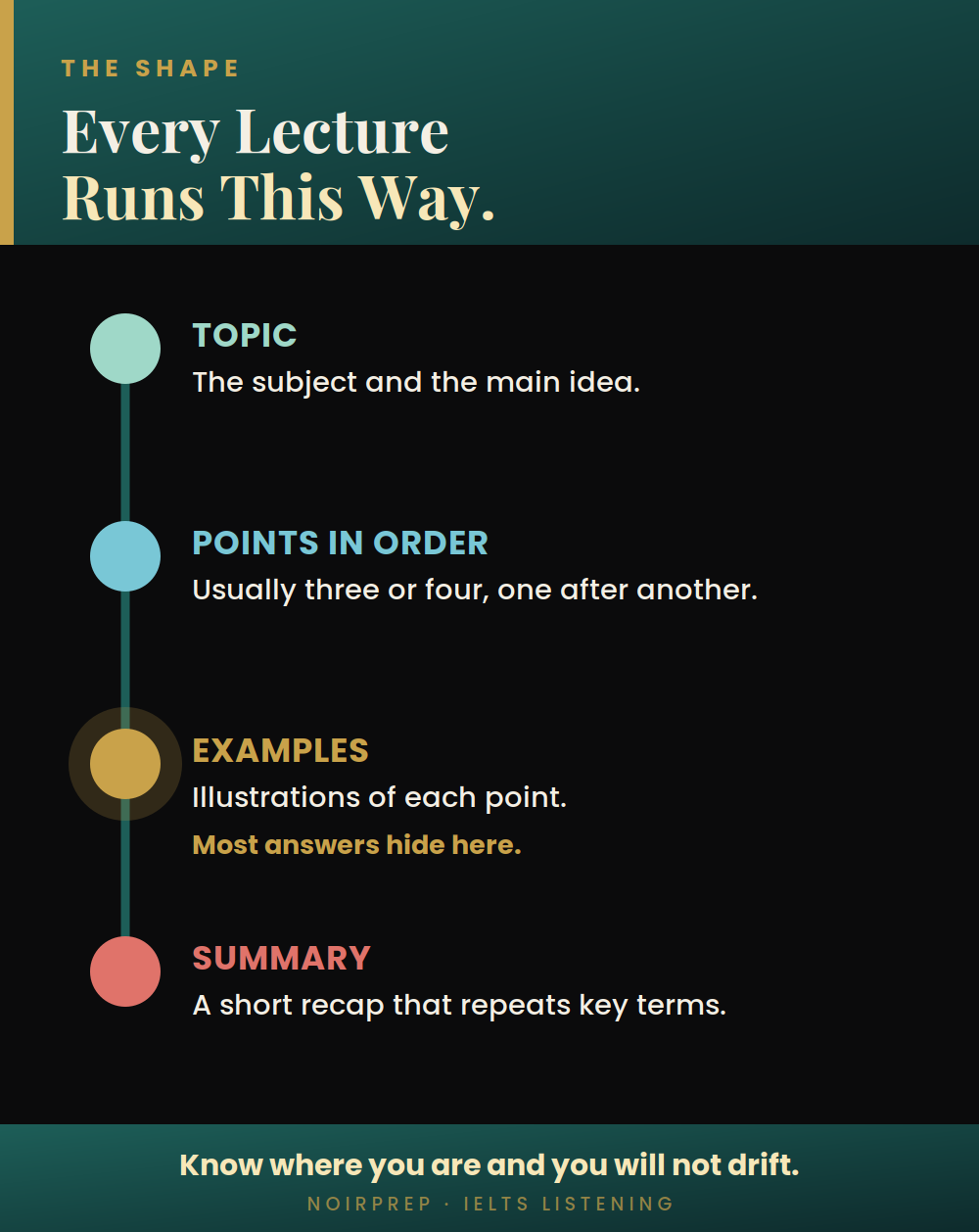
If you know you are in the example stage, you know not to drift.
The Phrases That Drop the Answer
Certain phrases are followed almost immediately by something you need, so train your ear to treat them as warnings.
Firstly, secondly and finally tell you a numbered point is arriving. The key point is tells you the next statement matters. This leads to and as a result tell you the answer is the consequence. For example, such as and for instance tell you the answer is the example itself. And in other words is a gift, because the speaker is about to repeat the idea more plainly, which gives you a second chance at something you missed.

Three other groups are worth knowing. Contrast words, which are but, however, although, whereas and yet, almost always mean the real point is coming after them rather than before. Cause words, which are because, since, therefore and as a result, tell you a reason or a consequence is arriving. And when you hear this, that, it or they, the speaker is pointing back at an idea they have already given, so stay with it.
Lock the Grammar In Before You Move On
A word can be exactly right and still score nothing if the form is wrong, so give each answer one second as you write it.
Does it match the number in the sentence, meaning singular or plural. Is it an uncountable noun that should not carry an s. Is it the right type of word, so a noun where a noun fits and a verb where a verb fits. And does the sentence read naturally when you say it back to yourself in your head.
That last check is the most useful one. If something feels grammatically wrong, it almost always is, even when the word sounds close to what you heard.
The Last Two Minutes
When the audio finishes, use whatever time you are given on five things, in this order.
Spelling, especially academic words. Plural endings, because the s is the easiest thing in the world to miss at speed. Word limits, because one word means one word. Blanks, because an empty gap scores zero and a sensible guess sometimes does not. And grammar fit, by reading each sentence back one final time.

Practicing IELTS Listening Part 4 Before the Next Lesson
Take any Part 4 section and do not play it yet.
Go through every gap and write the word type beside it. Noun, plural, uncountable, verb, adjective. Then go a step further on half of them and write down two or three words that would actually fit, because guessing in advance sharpens the ear far more than people expect.
Then play the recording once and answer properly.
When you mark it, sort your mistakes into two piles. The ones where you did not hear the word, and the ones where you heard it and wrote the wrong form. If the second pile is bigger, your listening is fine and your checking is not, and that is a much faster problem to fix.
Next lesson: Tone and Attitude in IELTS Listening