IELTS Listening Part 3 Tips: How to Know Who Said What

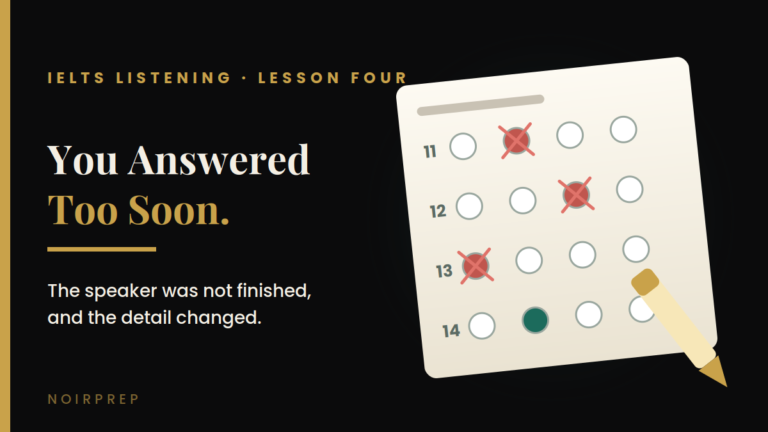
Something changes at question 21, and candidates usually feel it before they understand it.
Part 1 asked for facts, such as a name, a date or a price. Part 2 asked you to follow one speaker and judge which option matched what that speaker meant. Both of those are demanding, but in both of them there is only ever one voice to trust.
IELTS listening part 3 removes that. Two or three people are now discussing a piece of work, and they do not agree. So the question is no longer only what was meant. It is who meant it, how strongly, and whether they still think so by the end of the conversation.
The words themselves are rarely the problem. The problem is that everybody is polite, nobody says no clearly, and opinions keep moving while you are listening to them.
The best way to see it is to look at a real exchange before we talk about rules.
Start With One Real Conversation
Two students are discussing a survey they have carried out.
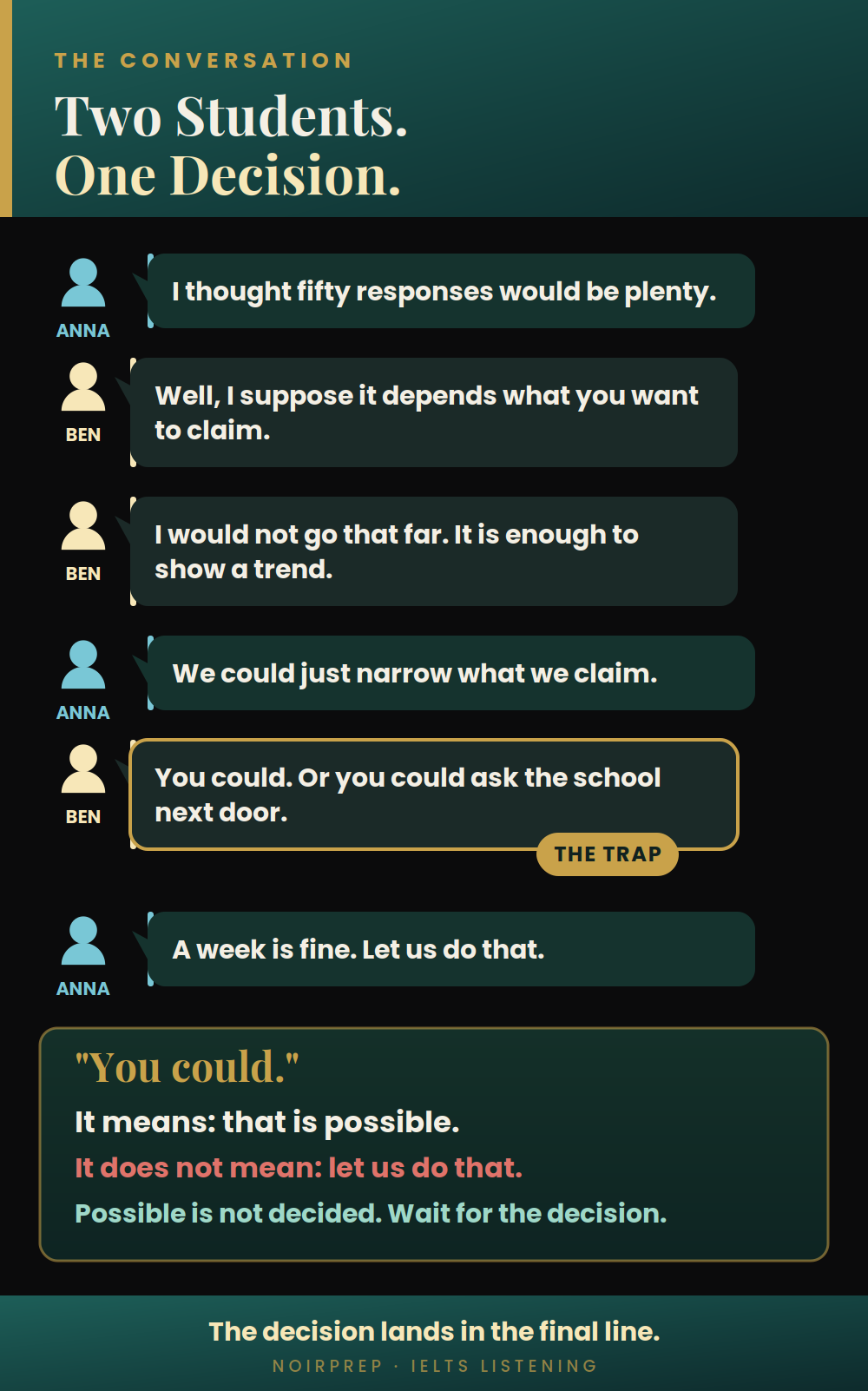
ANNA: I thought fifty responses would be plenty, honestly.
BEN: Well, I suppose it depends what you want to claim.
ANNA: You are not convinced.
BEN: I would not go that far. It is enough to show a trend. But if you want to say anything about the year groups separately, fifty spread across five years is only ten each.
ANNA: Hmm. That is a fair point. We could just narrow what we claim.
BEN: You could. Or you could ask the school next door for another fifty, which takes about a week.
ANNA: A week is fine. Let us do that.
Question 24. What do the students decide to do about their sample?
A. Narrow what they claim from the data
B. Collect more responses from a second school
C. Repeat the survey next term
Take them one at a time.
C is easy. Nobody mentions next term. Cross it out.
A is the trap. Anna suggests it, and Ben replies with two words, you could. That sounds like yes. It is not yes. It is what people say when they are about to suggest something better, and the word that proves it is the next one, which is or.
B is the answer. Ben offers the second school, and Anna closes the matter with let us do that.
Now look at Ben at the start. He says I would not go that far, which sounds mild and means he partly disagrees. He says it is enough to show a trend, which sounds like praise and is actually a limit. Nothing in that conversation is said directly, and yet every position in it is clear once you know what to listen for.
Now a second question on the same conversation, because this is where most candidates come unstuck.
Question 25. What does Ben think about the fifty responses they already have?
A. They are too few to show anything
B. They are enough for a general conclusion
C. They are enough to compare the year groups
A is wrong, although it feels right because Ben is clearly raising a problem. He never says the responses show nothing. He says the opposite.
C is wrong, and it is wrong for the opposite reason. Ben says that fifty across five years is only ten each, which is him explaining why the data cannot do this.
B is the answer, and it comes from six words in the middle of his turn. It is enough to show a trend.
Notice what this question did to you. Ben spends most of his speech sounding doubtful, so a candidate listening for a feeling rather than for a statement hears doubt and picks A. The answer was the one positive thing he said, and he said it while objecting to something else.
That is the real difficulty in IELTS listening part 3. A speaker can disagree and agree inside the same sentence, and the question decides which half you need.
That is the section in one exchange. Here are the four rules that get you through it.
Rule One. Never Give One Speaker’s Words to Another
If the question asks what Ben thinks, only Ben’s words count. Everything Anna says is background, however interesting it sounds.
If the question asks what they decide together, you are waiting for the place where they end up agreeing.
Candidates lose these marks in one particular way. They hear a strong opinion, they write it down, and they never stop to check whose mouth it came from.
If you lose track of who said something, do not guess. Wait. People in this section repeat and rephrase constantly, and within a few seconds it usually becomes clear again.
Rule Two. In IELTS Listening Part 3, No Never Sounds Like No
These are the phrases that mean disagreement, said by people being careful not to be rude.
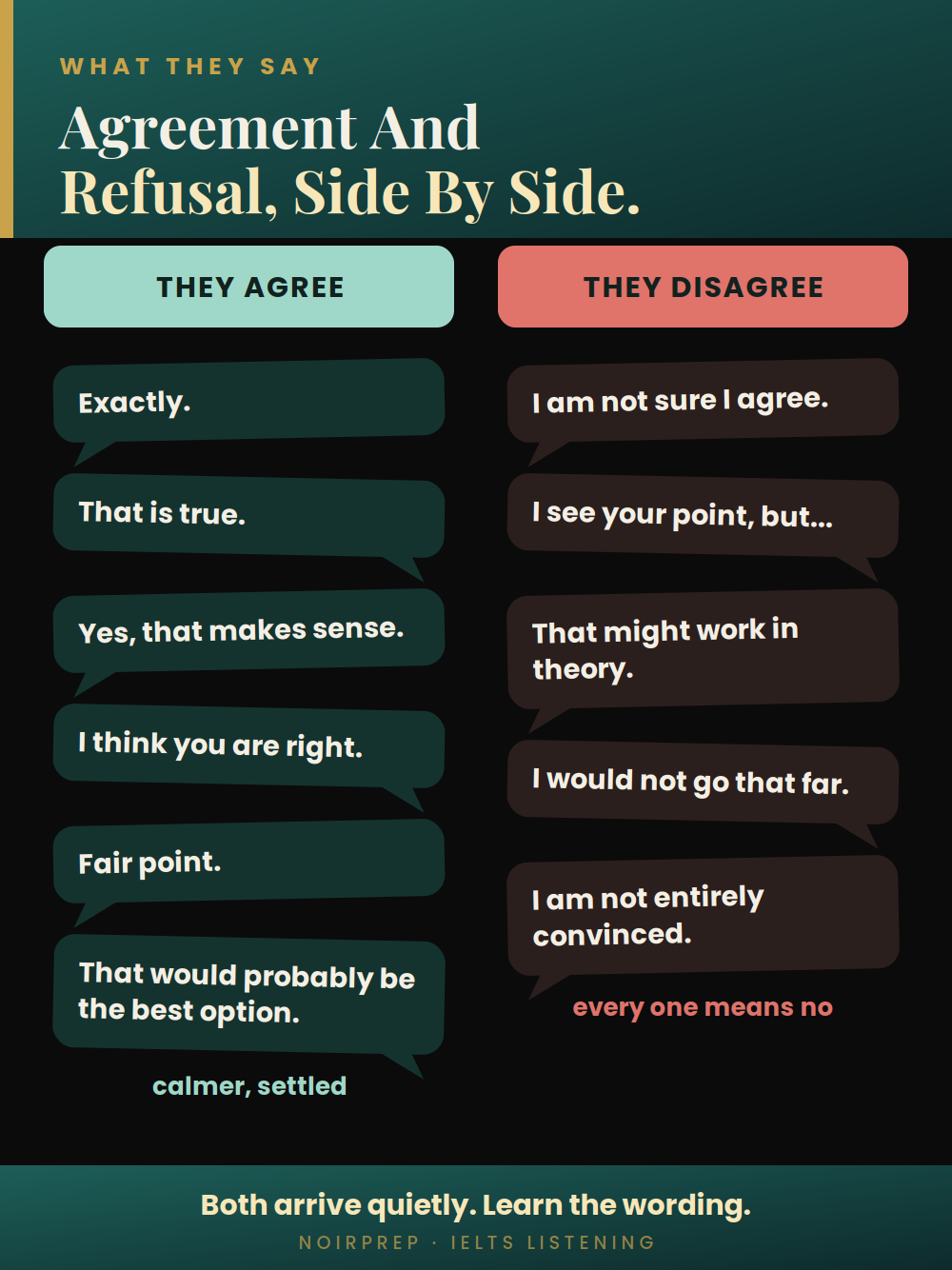
I am not sure I agree. I see your point, but. That might work in theory. I would not go that far. I am not entirely convinced.
Every one of those is a rejection. None of them sounds like one. This is the most common reason candidates lose opinion questions here.
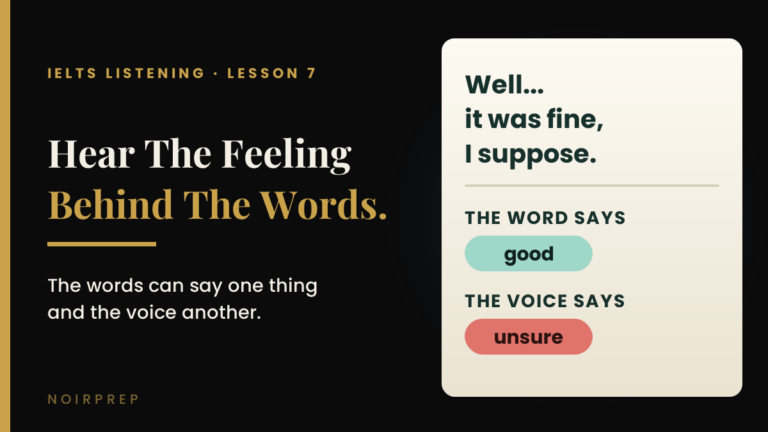
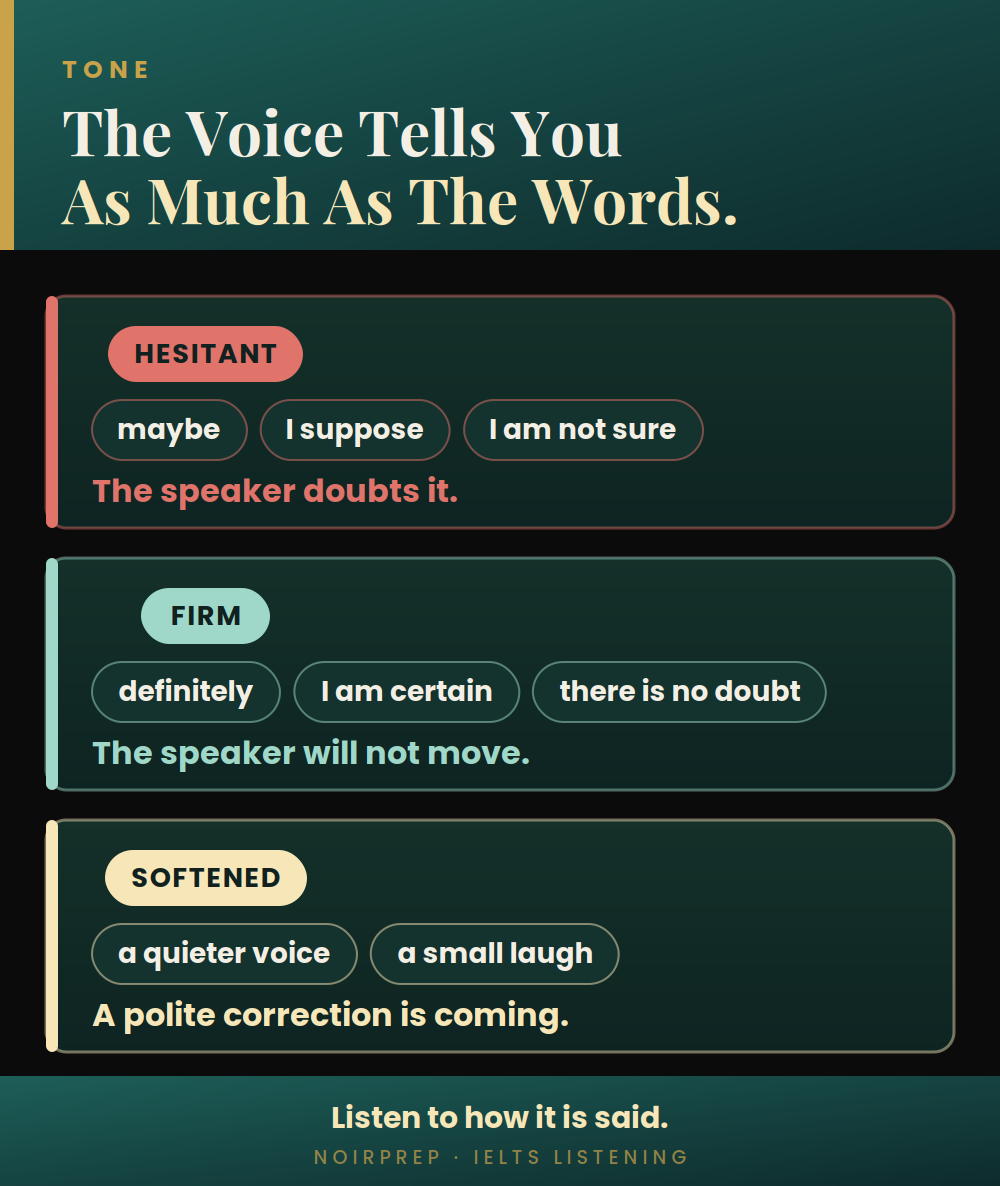
The voice tells you as much as the words. Hesitation, with maybe, I suppose, or I am not sure, means doubt. A firm voice, with definitely, I am certain, or there is no doubt, means the speaker will not move. And a small laugh usually means they are not taking the idea seriously.
Rule Three. Agreement Is Just as Quiet
Agreement arrives softly too. Exactly. That is true. Yes, that makes sense. I think you are right. Fair point. That would probably be the best option.
When a question asks about both speakers, the answer sits where they come together. They may support the same idea, accept the same reason, or reject the same option.

You can hear it as well as read it. The conversation gets calmer when people agree. That drop in energy usually means the discussion has reached its end.
Rule Four. Most of What You Hear Is Just Talk
The worst habit in this section is treating every sentence as important.
Academic conversations are full of material that leads nowhere. Examples that illustrate a point instead of making it. Side remarks. Thoughts that trail off. Ideas floated while somebody is still thinking. Repetition of something already said. Extra detail added after the answer has gone past.
So do not grab the first interesting thing you hear. Wait for the moment somebody actually answers the question. It always comes, and it comes later than you expect.
Five Questions While the Audio Runs
Keep these moving in your head and you will not drift.
Who is speaking now. Are they agreeing or disagreeing. Is this a real opinion or are they still thinking aloud. Has the question’s condition actually been met. Is this settled, or are they still arguing.
Each one takes a second. Together they keep you oriented in a conversation built to lose you.

Practicing IELTS Listening Part 3 Before the Next Lesson
Take one Part 3 section and play it twice, doing a different job each time.
The first time, answer nothing. Take a page, write each speaker’s name at the top of a column, and put every opinion underneath the person who said it. That is the whole exercise, and it trains the one skill this section is really testing.
The second time, answer the questions properly.
Then mark it, and ask one question about each mistake. Did I give the opinion to the wrong person, or did I take background talk for the answer. Those two mistakes cause nearly every lost mark here, and the cures are different.
Next lesson: IELTS Listening Part 4: The Academic Lecture