What Is Paraphrase in IELTS? The Golden Rule Every Candidate Needs First
Most candidates who lose marks in IELTS Reading and Listening do not lose them because their English is weak. They lose them because they were looking for the wrong thing.
They were looking for words. The test was testing meaning.
This is the first lesson for a reason. Paraphrase sits underneath all four tests. It decides whether you find the answer in Reading, whether you hear it in Listening, whether your Writing sounds repetitive, and whether your Speaking sounds natural. Before you learn a single question type, learn this.
What Paraphrase Actually Is
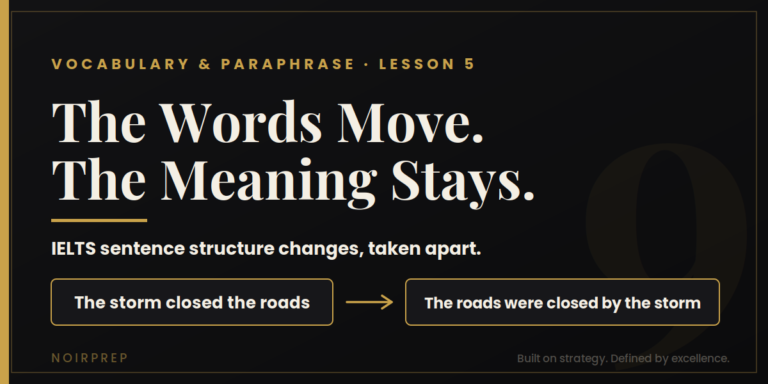
A paraphrase is the same meaning expressed in different words, or in a different structure.
IELTS uses paraphrase everywhere. True, False, Not Given. Sentence completion. Summary completion. Matching information. Matching headings. Multiple choice. In almost every question you will ever face, the question and the passage are saying the same thing in two different sets of words.
This is deliberate. The test is not trying to see whether you can find a word. Anyone can find a word. The test is checking whether you understood the idea well enough to recognize it when it is dressed differently.
If you cannot recognize paraphrase, correct answers will sit in front of you and stay invisible.
The Golden Rule
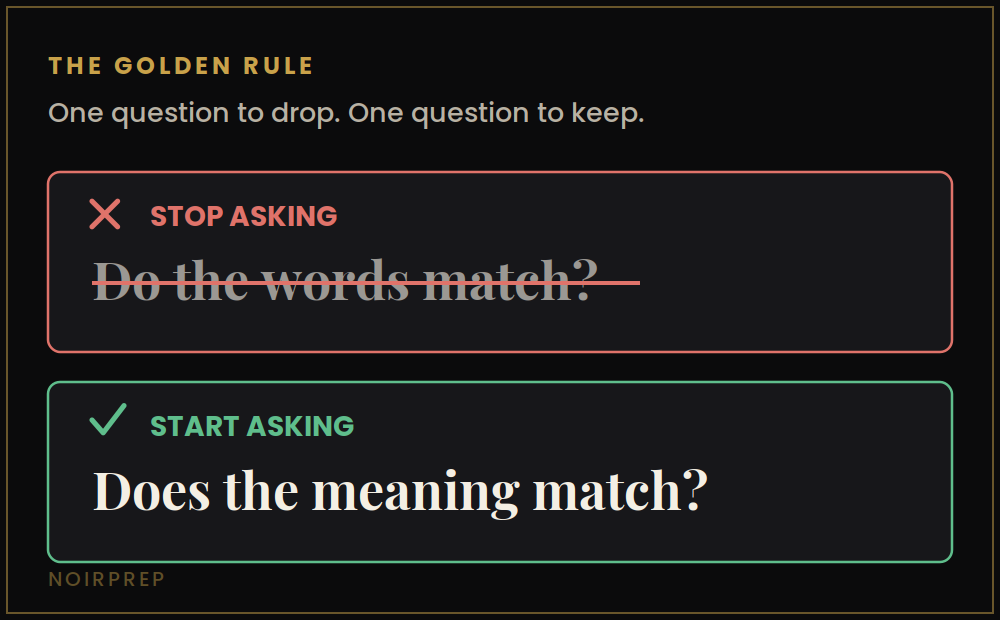
Everything in this lesson rests on one question you ask yourself while you read, and on one question you must stop asking.
It looks small written down. In the exam room it is the difference between Band 6 and Band 8.
Word Spotting Versus Meaning Matching
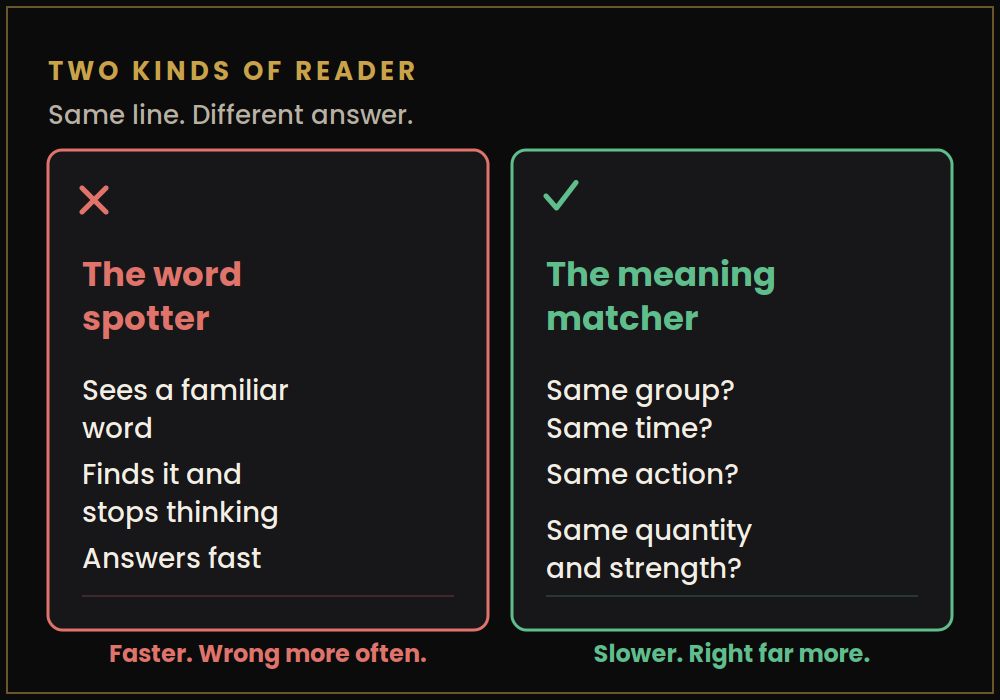
Two candidates read the same line and walk away with different answers.
The first one is hunting. She has a word in her head from the question, she finds it in the passage, and the moment she sees it her thinking stops. The real difference was sitting in another word entirely: some instead of all, may instead of must, after instead of before, Class A instead of all classes. She never looked there, because the word she was hunting had already appeared and she felt safe.
The second one is checking. She is slower on every question, and she is right far more often. Speed that produces wrong answers is not speed.
The Five Questions That Decide It
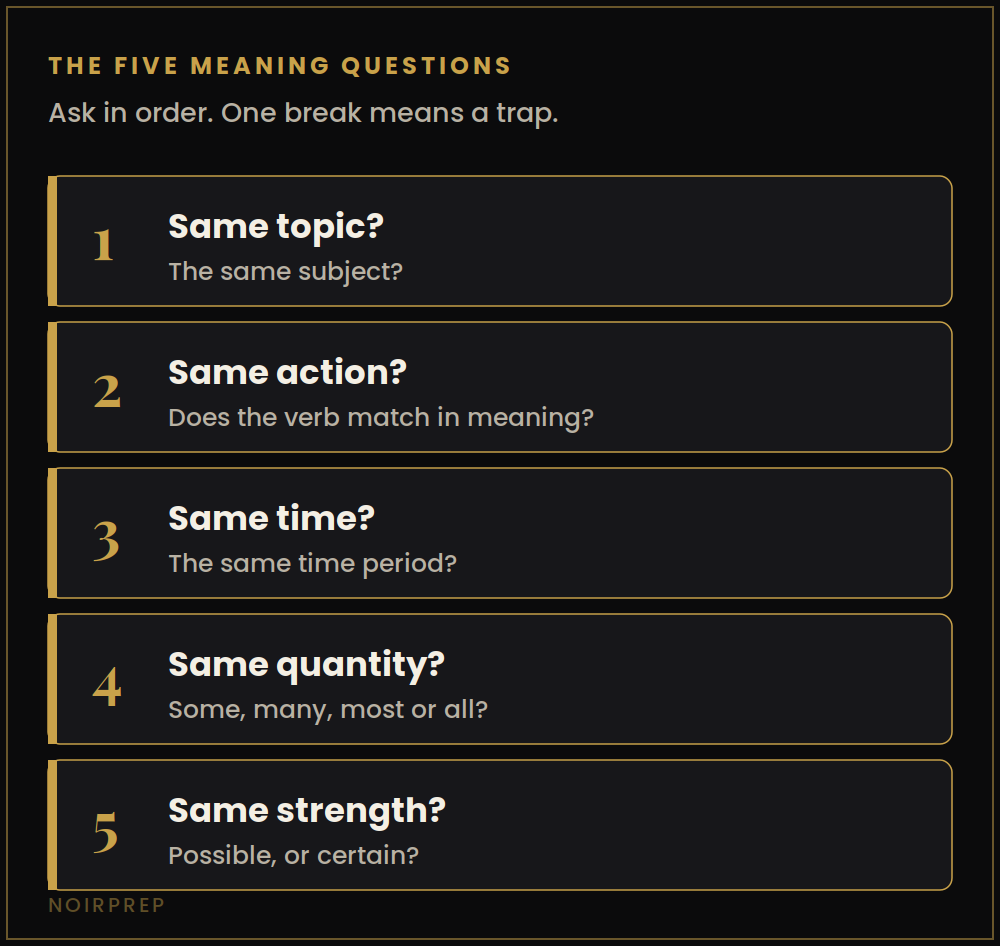
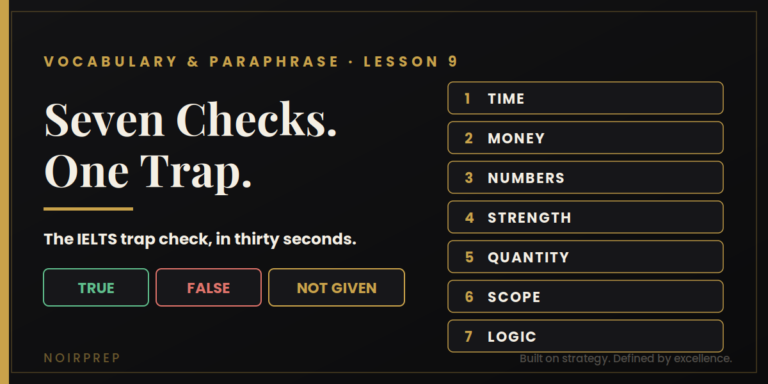
Here is what the second reader is actually doing. She is running five checks, in order, every time she compares a question with a sentence from the passage. They take seconds once they become a habit.
Learn them in this order and use them in this order. If all five hold, the meaning matches. If even one of them breaks, stop. You have found a trap, not an answer.
Now Test Yourself
Below are four pairs. In each one, read the question, read the passage sentence, and decide before you look at the verdict on the right.
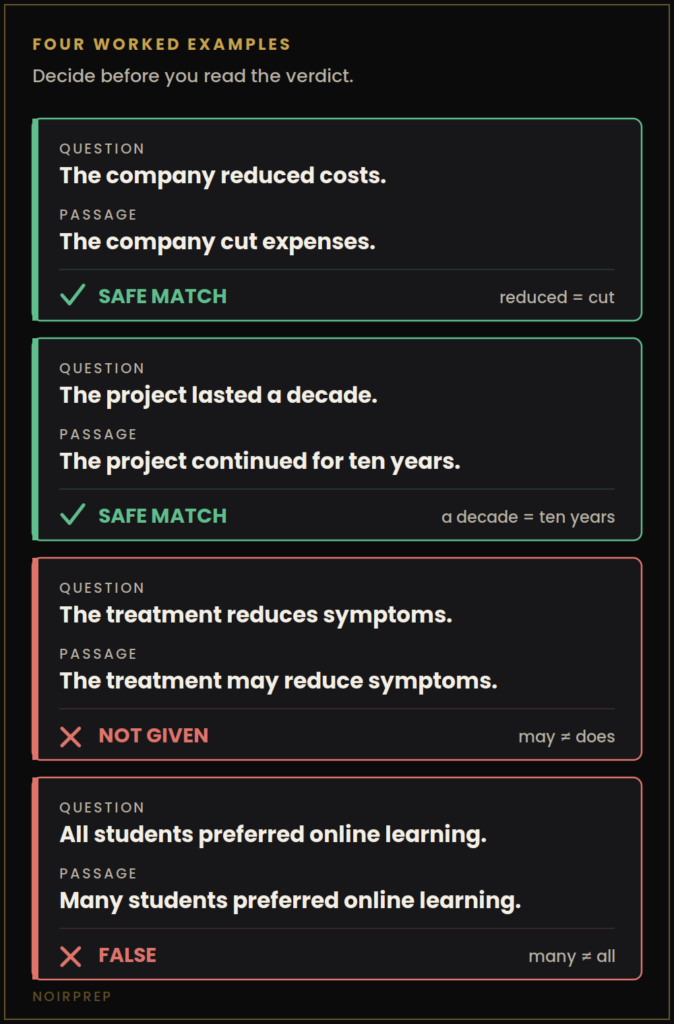
Look at what happened in those four.
In the first pair, not a single important word is shared, and a word spotter finds nothing. Yet every one of the five checks holds, so the meaning is identical.
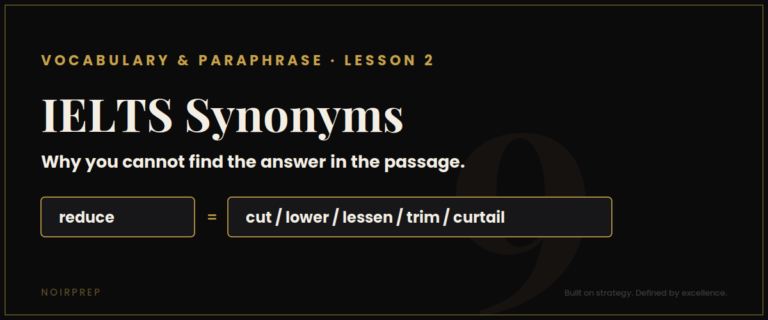
In the second, the question uses one short word and the passage stretches it into a longer phrase. IELTS does this constantly, and a candidate scanning for the short word goes straight past the phrase without a flicker.
The third pair is where it turns. The overlap is almost total, which is exactly why it is dangerous. Four checks pass. The fifth one, strength, does not: a possibility is not a certainty. One small word carried the whole answer, and it was not the word anyone was scanning for.
The fourth is the same lesson from a different direction. Everything holds until you reach quantity, and the question has claimed more than the passage ever said.
Notice the pattern. In both traps, everything matched except one word, and that one word was the answer.
Paraphrase Does Not Stop at Reading
Everything so far has used Reading examples, because Reading is where you can see the problem on the page. But the same skill decides your Listening score, and there it is harsher.
In Listening, the audio rarely matches the question words. The recording will say the idea in its own way, once, at speaking speed, and then move on. You cannot go back and stare at it. Worse, speakers behave like real people: they correct themselves, change a detail halfway through, and mention several possibilities before confirming the real one.
That is why prediction matters so much. Before the audio begins, read the question, take the key word, and quickly ask yourself what else that idea could sound like. If the question says main reason, the speaker may say the real cause, the main factor, or the key reason. If the question says first, you may hear initially, before anything else, or on arrival.
Doing this puts your brain into expecting mode. Instead of waiting to hear a word, you are waiting to hear a meaning, and meaning is what actually arrives.
The same habit protects your Writing and Speaking. A candidate who can only say a thing one way repeats that one wording all the way through an essay or a two-minute answer, and the examiner sees a narrow range of language. A candidate who has trained paraphrase has options, and the answer sounds natural rather than rehearsed.
Why the Test Is Built This Way
It can feel as though IELTS is hiding answers on purpose. In a sense, it is, and the reason is fair.
If the passage used exactly the same words as the question, the test would only be checking whether you can match shapes on a page. A candidate who understood nothing could still score well by hunting for letters. By changing the wording, IELTS forces you to prove you understood the idea itself.
So the wording changes are not cruelty. They are the actual test.
What You Should Take From This
Paraphrase is not a vocabulary problem. You do not fix it by memorizing longer word lists, though a strong synonym bank certainly helps. You fix it by changing the question you ask yourself while you read.
Stop hunting for matching words. Start testing for matching meaning.
The NoirPrep Rule: if the words look different, check whether the meaning is the same. If the words look identical, check twice as hard.
The ones that catch strong candidates are never the sentences that look strange. They are the sentences that look obvious.
Where to Go Next
In the next lesson we take the six core paraphrase patterns one at a time, so you can recognize each one on sight instead of working it out from scratch every time. After that we drill the six trap zones: time, money, numbers, strength, quantity and scope.
For now, take the five checks into your next practice passage. Do not rush them. Ask all five, on every answer you choose, until asking them stops feeling like extra work and starts feeling like reading.
That is when your score moves.
One Comment