The IELTS Trap Check: Seven Checks Before You Answer
You have about twenty seconds. One sentence in the question, one in the passage, and three answers in front of you that all look reasonable.
That is the real difficulty with True, False and Not Given. It was never the English. It is the clock, and knowing where to look while it runs.
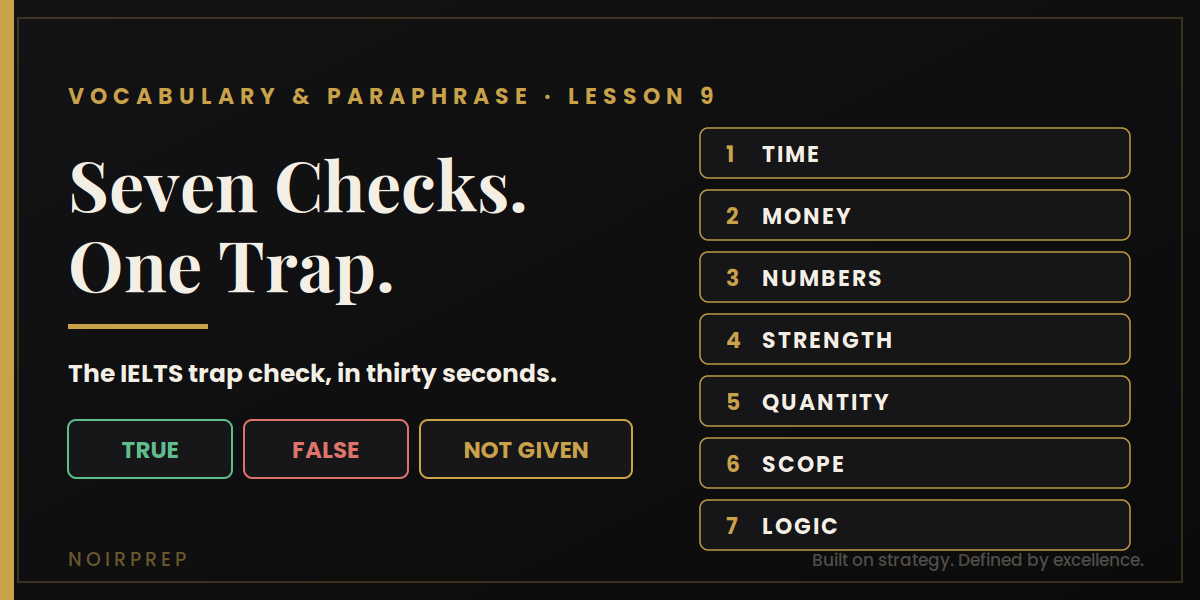
The IELTS trap check solves that. It is a fixed routine you run on every decision, and it works because it never asks you to think about which trap you might be facing. It simply walks you past all of them.
Seven things to look for. Same order, every time. Then one decision.
The IELTS Trap Check, in Thirty Seconds
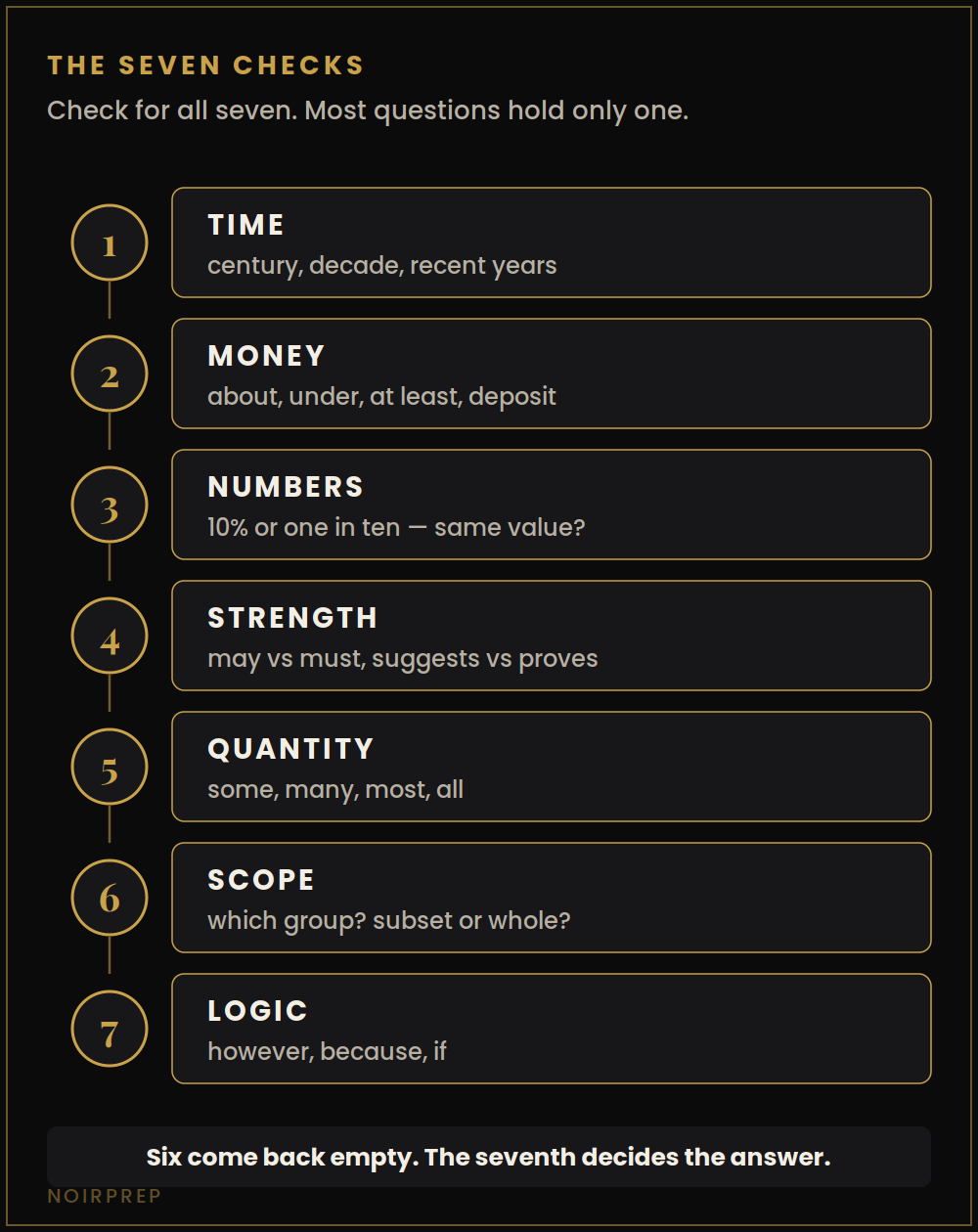
You’ve found the sentence in the passage, and you’re fairly sure it answers the question. Before writing anything down, however, check for these seven.
One important thing about this list, since candidates misread it constantly.
You are not going to find seven traps in one question. A question almost always contains one. Sometimes none at all, and occasionally two, although that’s rare. The seven are simply the places a trap can hide, and you’re running your eye over all of them to see which one is there.
That’s why the whole thing takes thirty seconds rather than five minutes. Six of the checks come back empty almost instantly. No dates in the sentence? Time is done. No figures? Money and numbers are done too. You are not examining seven things. You are eliminating six and landing on one.
And don’t jump ahead to the checks that look relevant. The order feels fussy at first, but it’s doing real work, and the one you skip is almost always the one that was holding the trap.
Why the Checks Run in That Order
Time and money come first for one reason: they’re quick. A date either matches or it doesn’t, and you’ll see it in a second. There’s no sense agonizing over scope when the years were wrong all along.
Numbers follow. Since a percentage rewritten as a fraction is nearly always safe, clearing it early gets one distraction out of the way.
Then come strength and quantity. Honestly, these two are where most lost marks are hiding. May against does. Many against most. If only two checks ever got tightened up, it should be these.
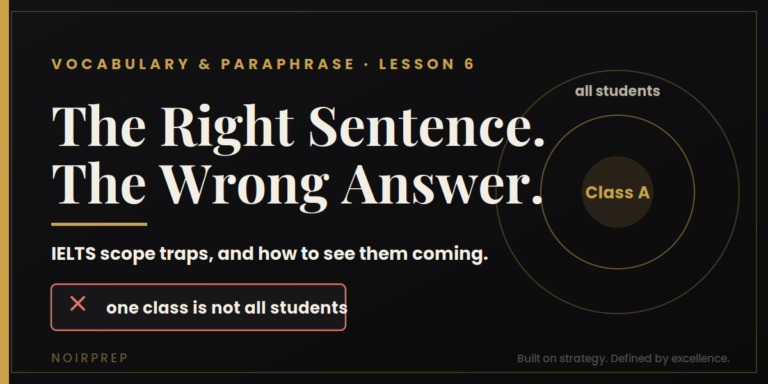
Scope sits late on purpose. By then you’ve confirmed the sentence really is about your subject, which leaves only one question: does it cover the same group of people?
Logic closes it. After all, a however or a because can flip a sentence you’ve already accepted, which is a horrible way to lose a mark you’d basically won.
Then One Decision
Once the checks are done, you have three possible answers and no fourth option, however much you’d like one.
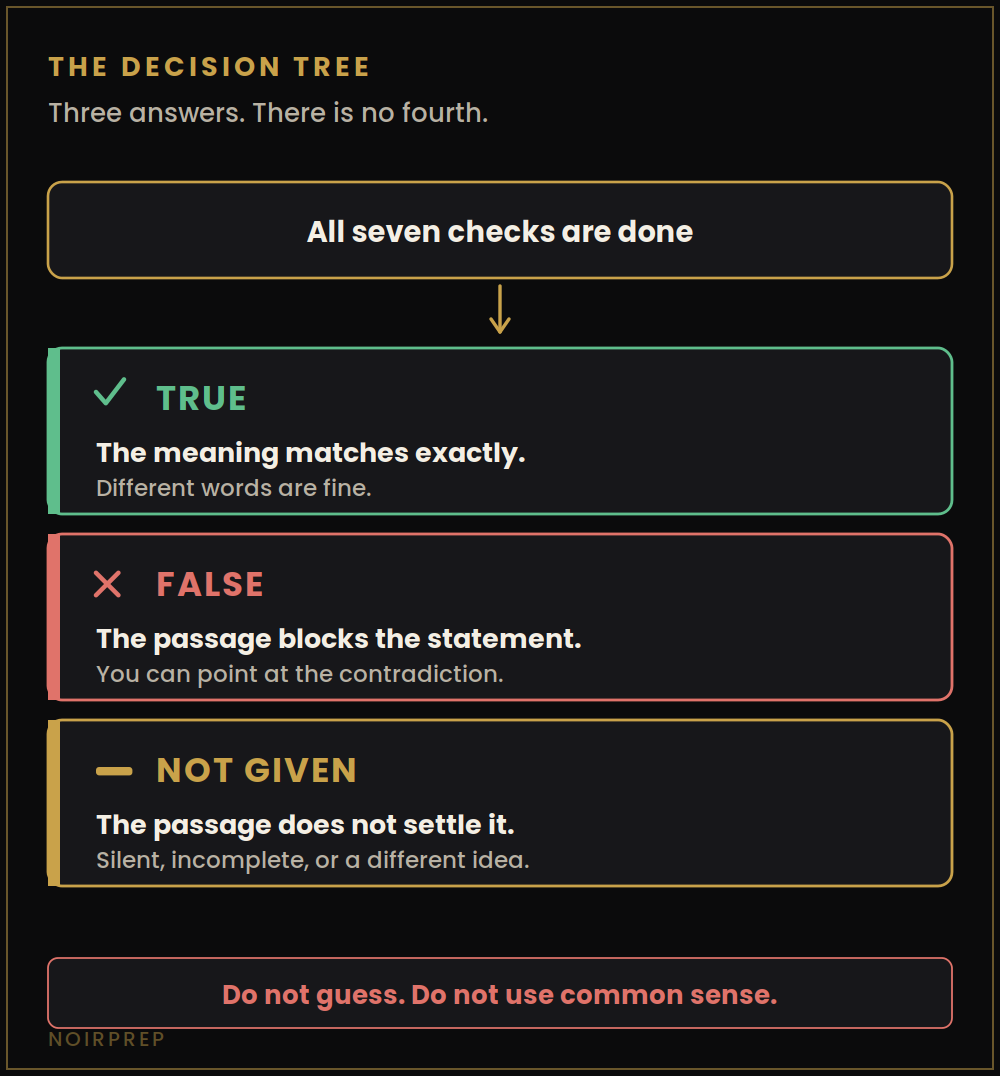
True is rarely the problem. Almost everything goes wrong in the gap between False and Not Given, which makes this the place to slow right down.
False or Not Given? The Test That Settles It
Both answers feel like “the passage doesn’t say that”, which is exactly why they get mixed up. But they’re asking different questions.
False means the passage blocks your statement. It discusses the same point and gives you contradictory information: opposite meaning, wrong detail, wrong logic direction.
Not Given, on the other hand, means the passage doesn’t discuss this specific idea clearly enough to confirm or deny it. Either it’s silent, or it’s incomplete, or it’s talking about something related but different.
The test comes down to one question: can you point at words in the passage that contradict the statement?
Point at them, and it’s False. Can’t point at anything, and it’s Not Given instead. Absence isn’t contradiction.
Five Ways a Passage Blocks a Statement
That word blocks is doing a lot of work here, so it’s worth seeing what blocking actually looks like.
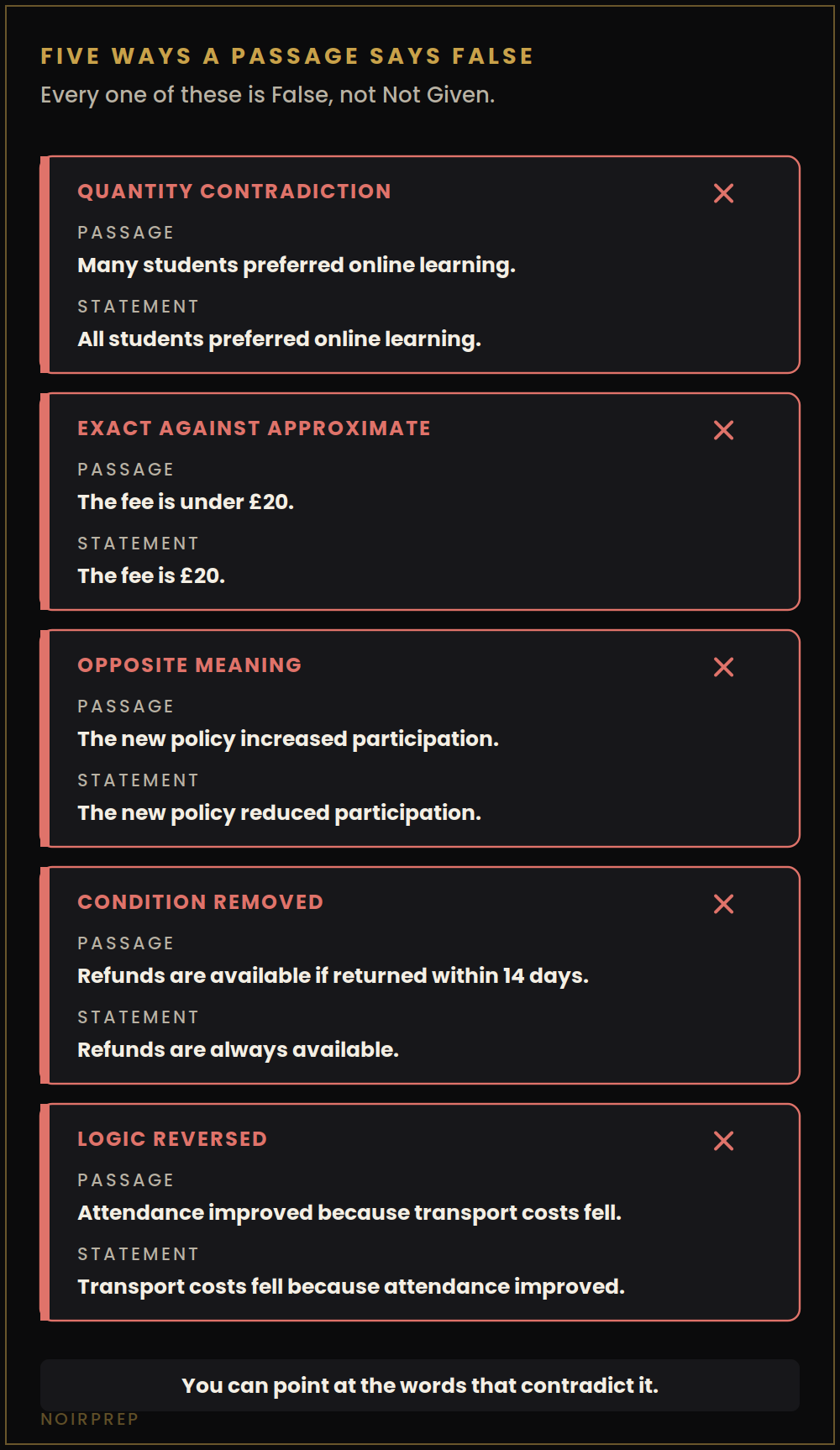
Read those carefully. The last two catch people who are otherwise reading well.
Take the condition that gets removed. The passage says refunds are available if the item comes back within 14 days. The statement says refunds are always available. That statement has quietly promised something the passage never did.
And when the logic reverses, every single word can match. Attendance improved because transport costs fell is not transport costs fell because attendance improved. Same words, arrow pointing the other way, completely different claim.
The No Sixth Sense Rule
Now the biggest single source of Not Given mistakes, and it isn’t weak English. It’s imagination.
That sounds correct. That’s what usually happens. The writer probably means this.
Every one of those thoughts is a wrong answer arriving in disguise. Worse, they feel like understanding, which is precisely what makes them dangerous.
There’s only one question that counts: where exactly does the passage say this?
If the passage doesn’t prove it, don’t invent it. When you can’t point to specific evidence in the text, either the answer is Not Given or you’re about to choose the wrong one.
Oddly enough, this catches strong candidates hardest, which seems unfair until you think about it. They know the subject, they fill the gap from memory without noticing, and the mark disappears.
Three Ways a True Answer Gets Built
True answers come in three shapes, and the third one surprises people.
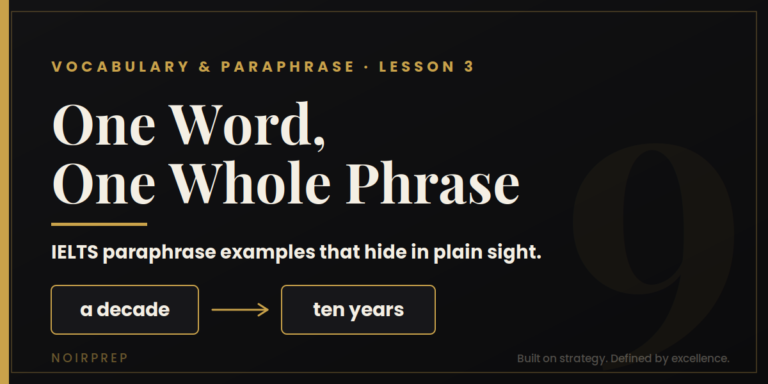
True by paraphrase. The passage says the project lasted ten years, the statement says a decade. Same meaning, different words.
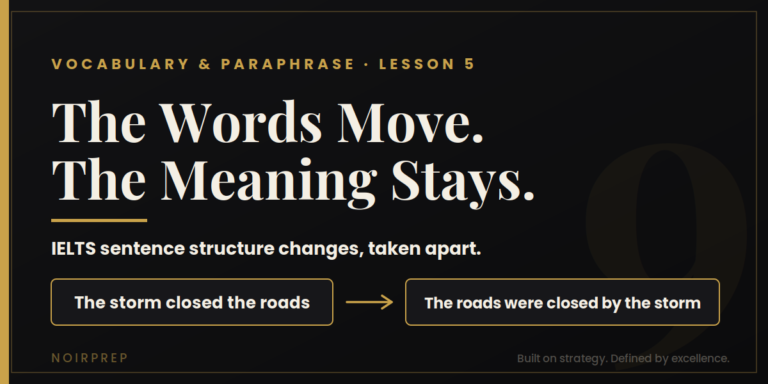
True by flipped structure. The passage says road closures occurred because heavy rain fell, the statement says heavy rain caused road closures. Same logic, rearranged.
True by implied meaning. The passage says the lecture ended at 2 p.m., while the statement says that by 3 p.m. the lecture had finished. Nobody wrote that sentence, yet the passage makes it unavoidable.
That third kind worries students, since it looks like exactly the guessing they’ve just been warned against. It isn’t. There’s a clean line between what the passage forces to be true and what merely sounds plausible, and the test is whether you could defend it to someone arguing the opposite.
Watch It Run
One question, taken the whole way through.
Question: Most workers received training. Passage: Many workers were trained.
Time: nothing to compare. Money and numbers: nothing there either, meaning two more checks gone in a second.
Strength: both sentences say it plainly and neither hedges, therefore nothing has moved.
Quantity: and there it is. Many means a large number, whereas most means more than half, and the passage never proved more than half. You can’t upgrade it just because it feels close.
Scope and logic never run at all. The routine already has what it needs.
Not Given, then. Fourteen seconds, no agonizing.
Notice how little actually happened there. Six of the seven checks found nothing, and the one that mattered was quantity. That is the normal shape of a question, not an easy one.
Twelve Pairs to Test Yourself
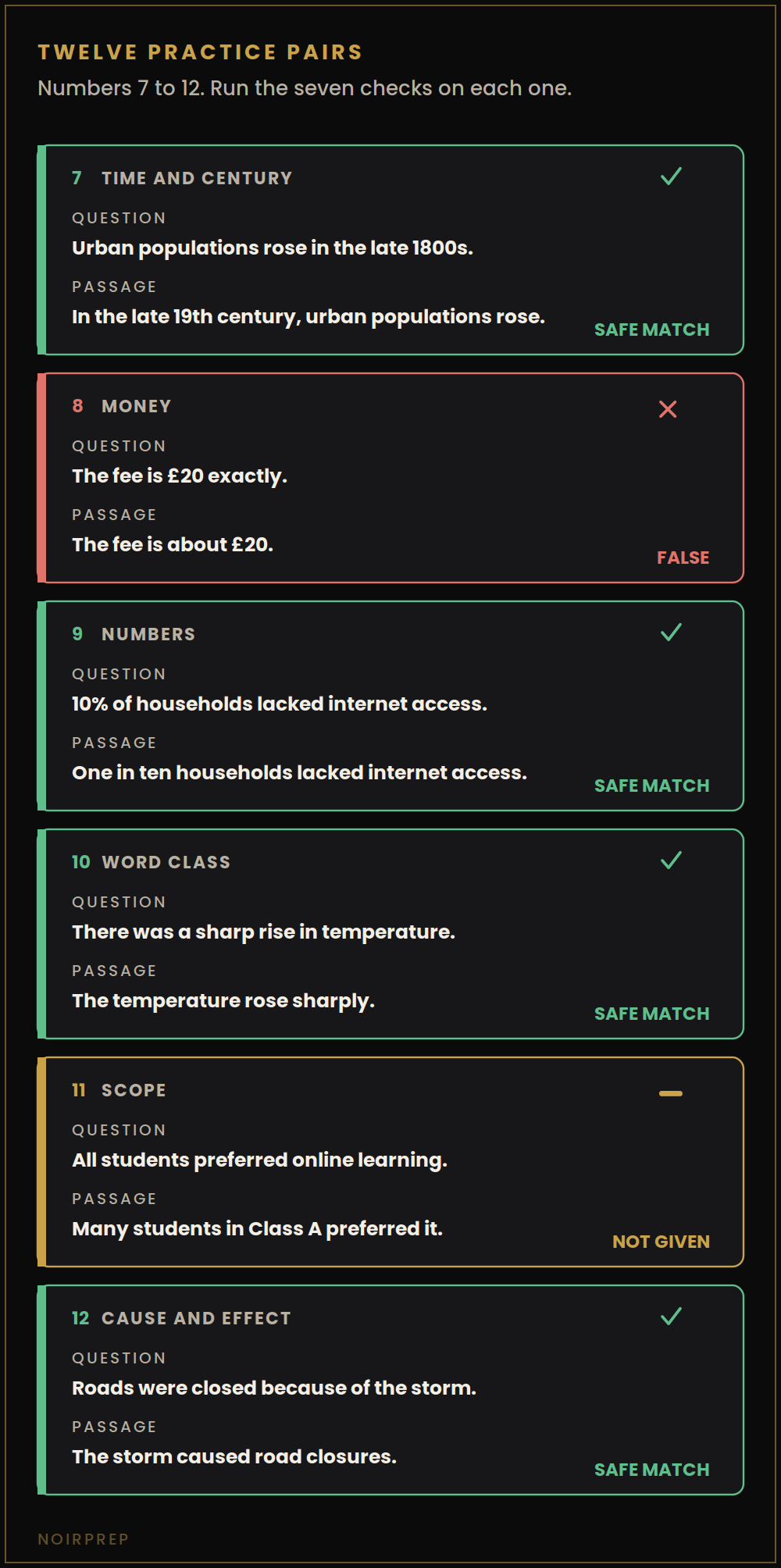
Twelve question and passage pairs below, covering every pattern and trap in the series. Some match, some don’t.
Work through them with the routine, one check at a time, and say your answer out loud before you look at the verdict.
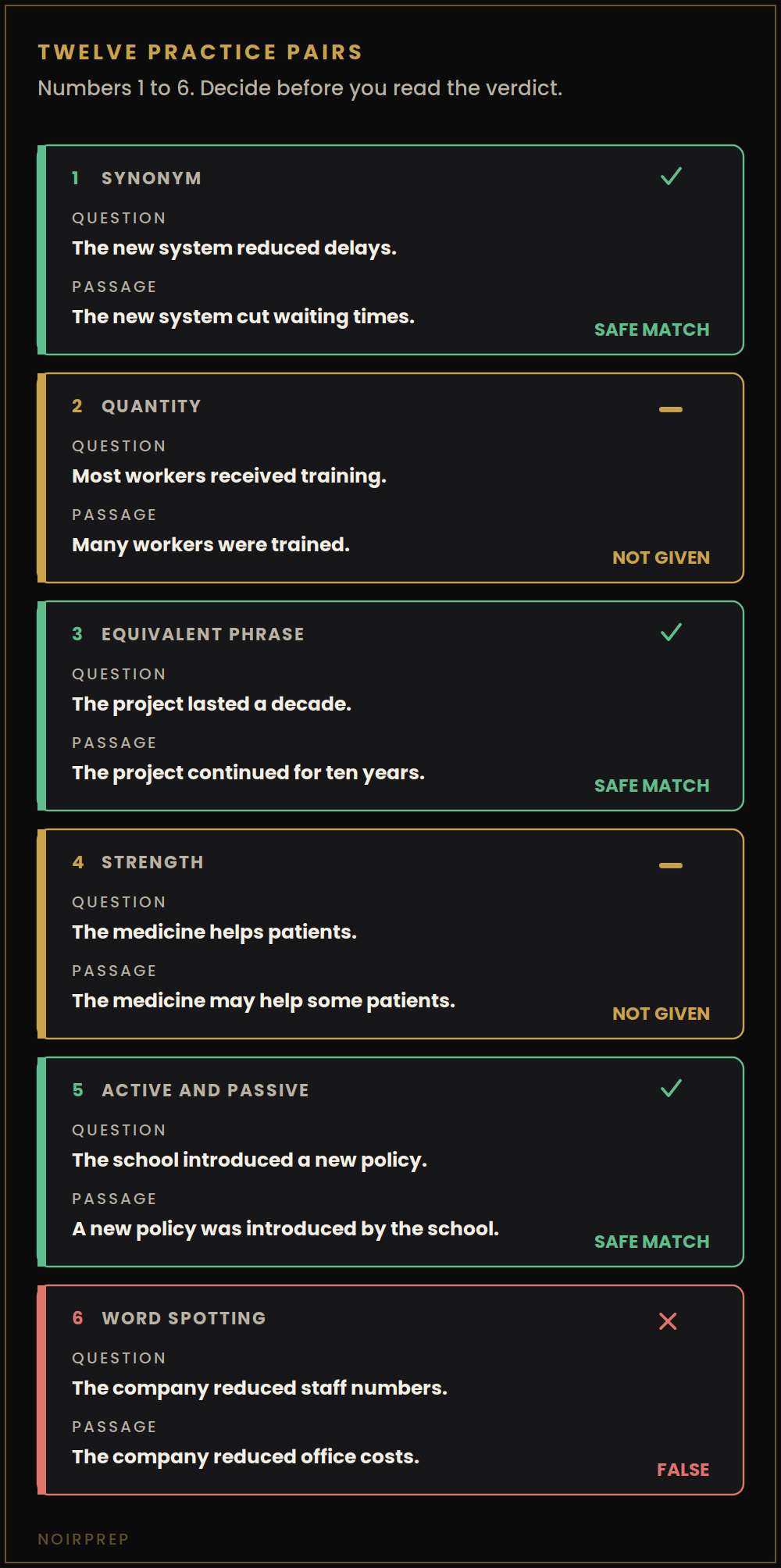
Ten or more, and the checks are working. Meanwhile, eight or nine is completely normal at this stage. Below eight, there’s no need to redo all eight lessons. Go back to whichever check kept catching you, since it’ll be one check failing over and over rather than twelve separate problems.
A Shorter IELTS Trap Check, for When Time Runs Out
Seven checks in thirty seconds is fine for most of the paper. In the last five minutes it isn’t, and pretending otherwise helps nobody.
Carry a short version instead. Three checks, roughly ten seconds.
Strength. Does the question sound more certain than the passage?
Quantity. Has many become most, or some become all?
Scope. Is the passage talking about the same group?
Those three catch most traps between them. So if nothing else survives from this series, let it be these.
The Four Weeks Before Your Test
Knowing the IELTS trap check and running it under pressure are two different things, and here’s how to close that gap.
Week one. Run all seven checks on every True, False and Not Given question, and note which check decided each answer. By Friday the weak one will be obvious. Everybody has one.
Week two. Keep running all seven, but stop writing them down. Meanwhile, reread the lesson covering whatever week one exposed.
Week three. Now start timing. Thirty seconds a decision, then twenty. That speed comes from the order being automatic, never from skipping steps.
Week four. Short version on half your practice, full routine on the other half. You’re teaching yourself to feel which one the clock will allow.
Four weeks is plenty. None of it is difficult, after all. It just needs repeating until it stops being a decision.
The Rules Behind All of It
In short, everything across these eight lessons comes down to twelve sentences. Keep them somewhere you’ll see them in the week before your test.
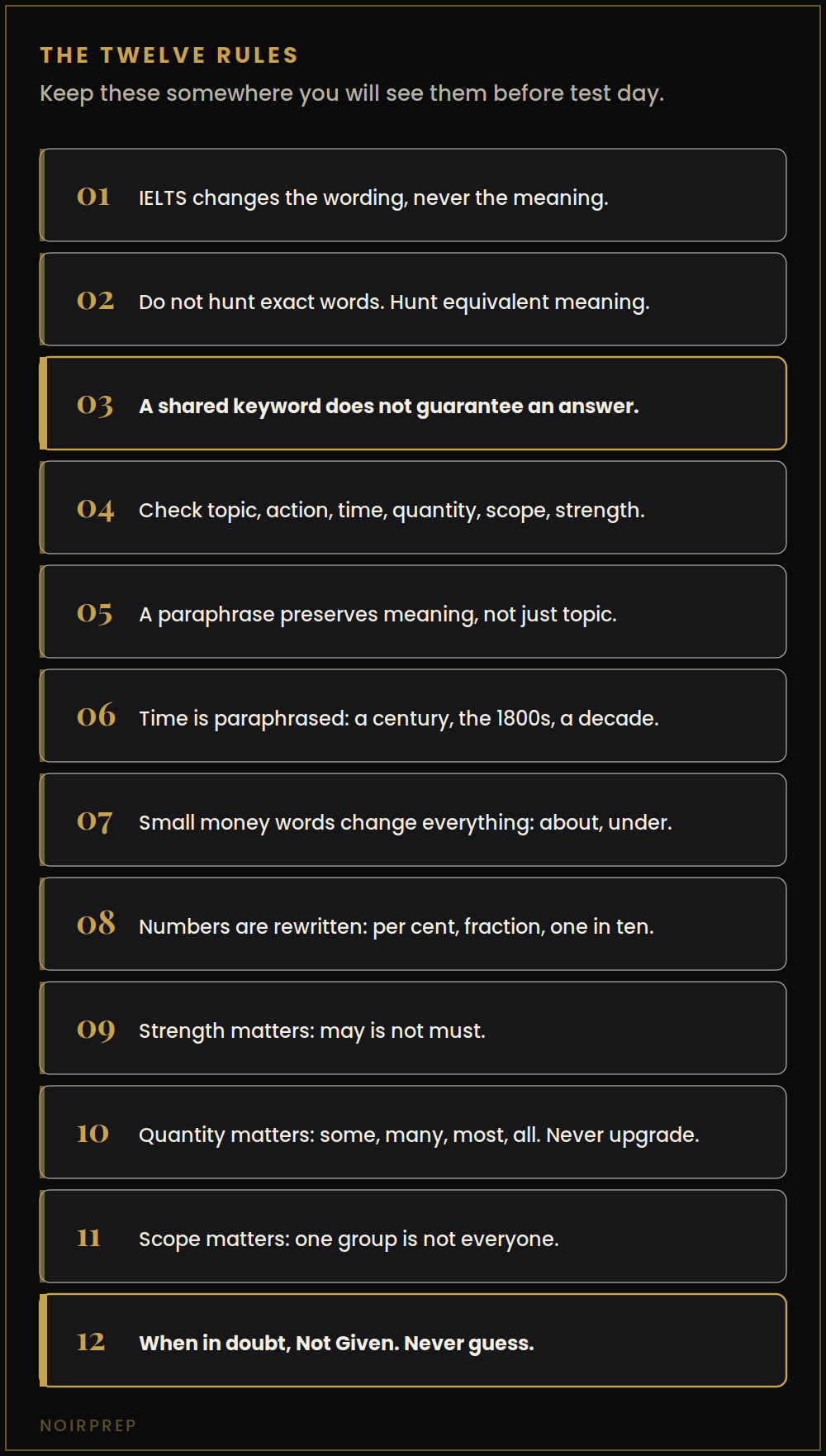
Rule three is the one to carry above all the others: a shared keyword does not guarantee a correct answer. Nearly every mistake in this series began with somebody forgetting it.
What You’ve Got Now
Look back at where you started.
You can spot the six ways IELTS rewrites a sentence without touching its meaning. The six zones where one small word changes the claim are familiar now. And you can tell the difference between the word that finds your paragraph and the word that proves your answer.
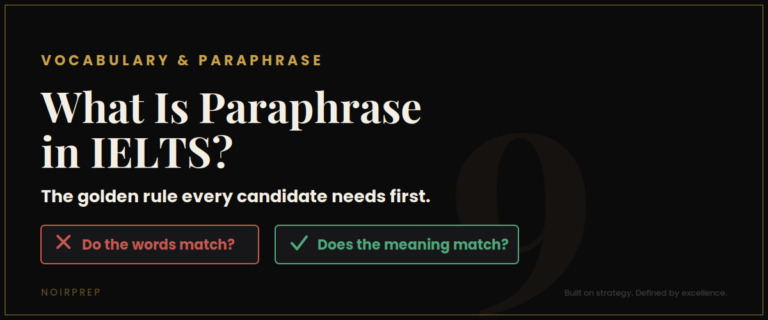
Above all, though, you’ve stopped asking whether the words match.
That was always the point. Everything else has been practice for the question you now ask without thinking: does the meaning match?
Take the IELTS trap check into your next practice paper and run all seven, slowly, even when the answer looks obvious. Expect it to feel like a chore for about a week.
Eventually it stops being a routine at all, and simply becomes the way you read.