IELTS Keywords: The Topic Word Finds the Place, Not the Answer
IELTS keywords aren’t single words. Each one is a doorway, because sitting behind it is a whole family of words the passage might use instead.
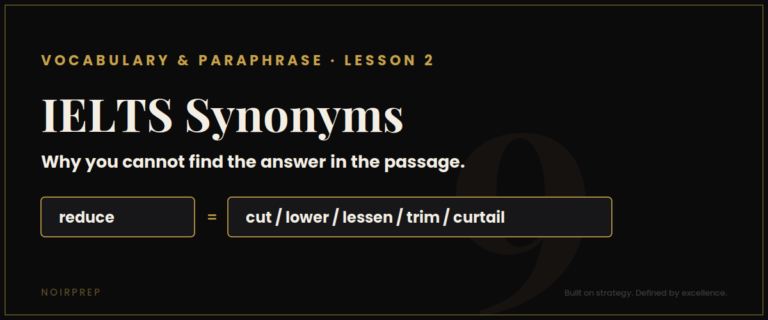
Take money. A passage on that subject might say finance, funding, capital, budget, cost, fee or expenditure, and never once print the word you were scanning for.
That family will help you find the right paragraph. It won’t give you the answer. Those are two completely different jobs, and mixing them up is one of the most expensive habits in IELTS Reading.
Last lesson went through dates, prices and figures, and the small words that quietly change what each one claims.This one asks something bigger: which word in your question sends you to the right place, and which word decides whether you’ve actually found it.
IELTS Keywords Come in Two Kinds
Look at any IELTS question and you’ll find both sitting side by side.
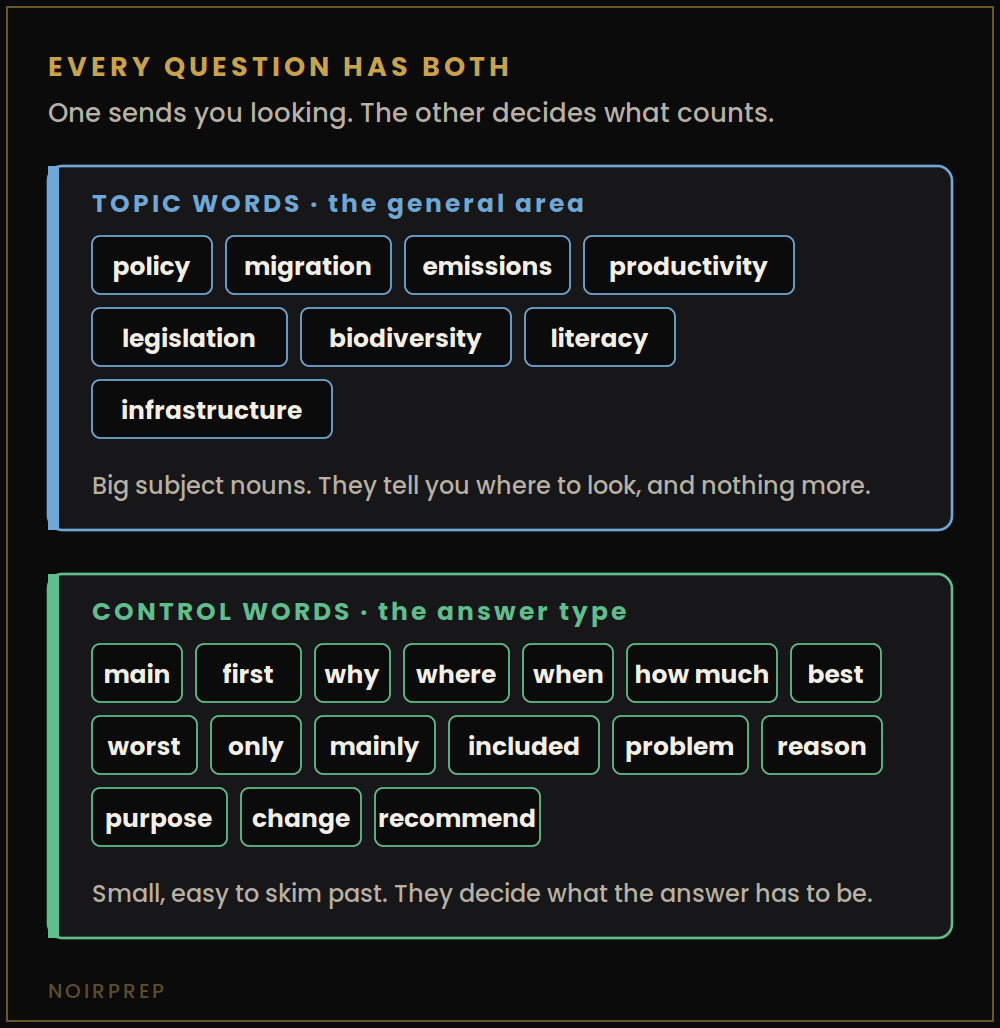
Topic words are the big subject nouns. Policy. Migration. Emissions. Productivity. Legislation. Biodiversity. Literacy. Infrastructure. They carry the weight of the question, which is exactly why your eye goes to them, and they tell you roughly where to look. Nothing more than that.
Control words decide what the answer has to be. Main. First. Why. Where. When. How much. Best. Worst. Only. Mainly. Included. Problem. Reason. Purpose. Change. Recommend. Small words, easy to skim straight past, and every one of them is an instruction.
Most candidates read the topic word and start scanning straight away. That’s the moment the mark goes, because the control word was the one carrying the real instruction.
One Topic, Many Words
Here’s why the topic word can’t be trusted on its own.
Passages rarely repeat a word. Writers vary their language, so one subject turns up wearing several different coats inside a single paragraph.
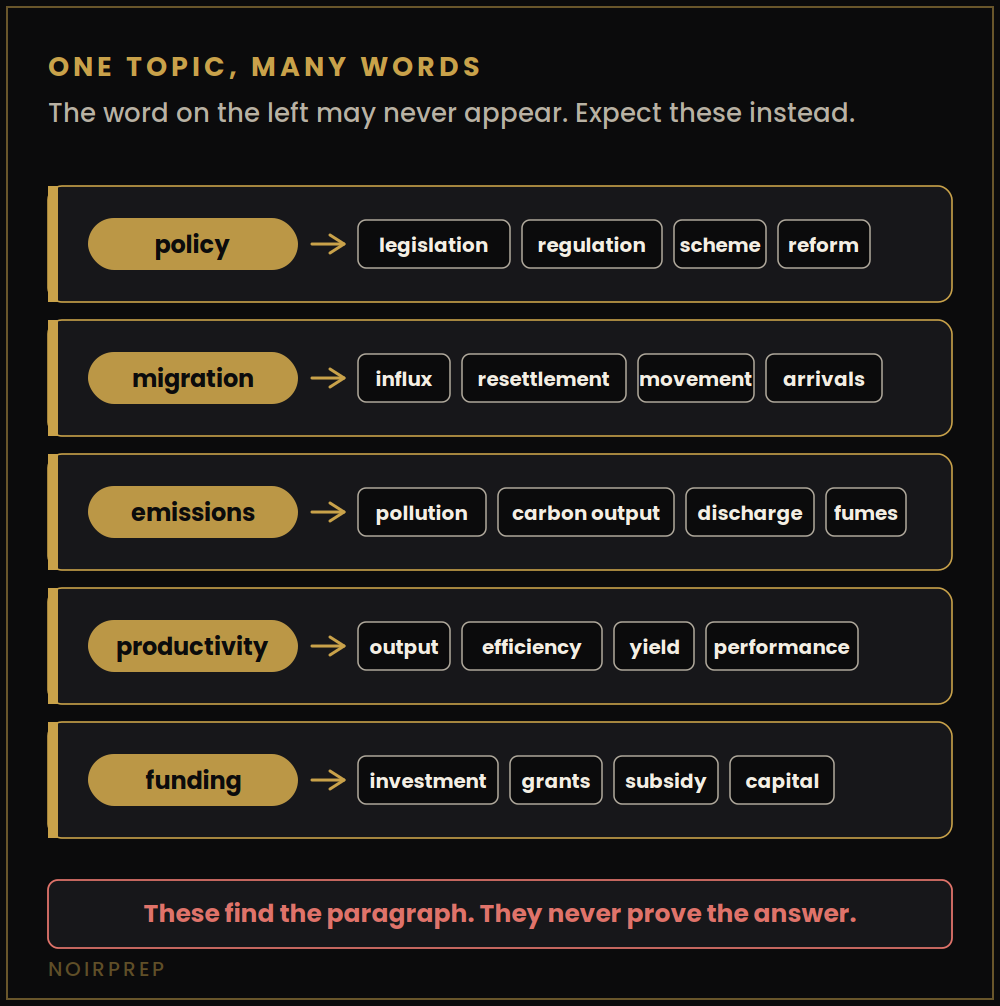
Read that image carefully, though, because there’s a trap folded into it. The words in each row sit in the same area, but they don’t all mean the same thing.
Funding isn’t investment. A fee isn’t a cost. A budget isn’t expenditure.
So the family is good for exactly one thing: getting you to the right part of the passage fast. Once you’re there, you put it down and start checking meaning instead.
The One-Keyword Trap
Now the mistake all this produces, and it’s the most common cause of wrong answers in Matching Information.
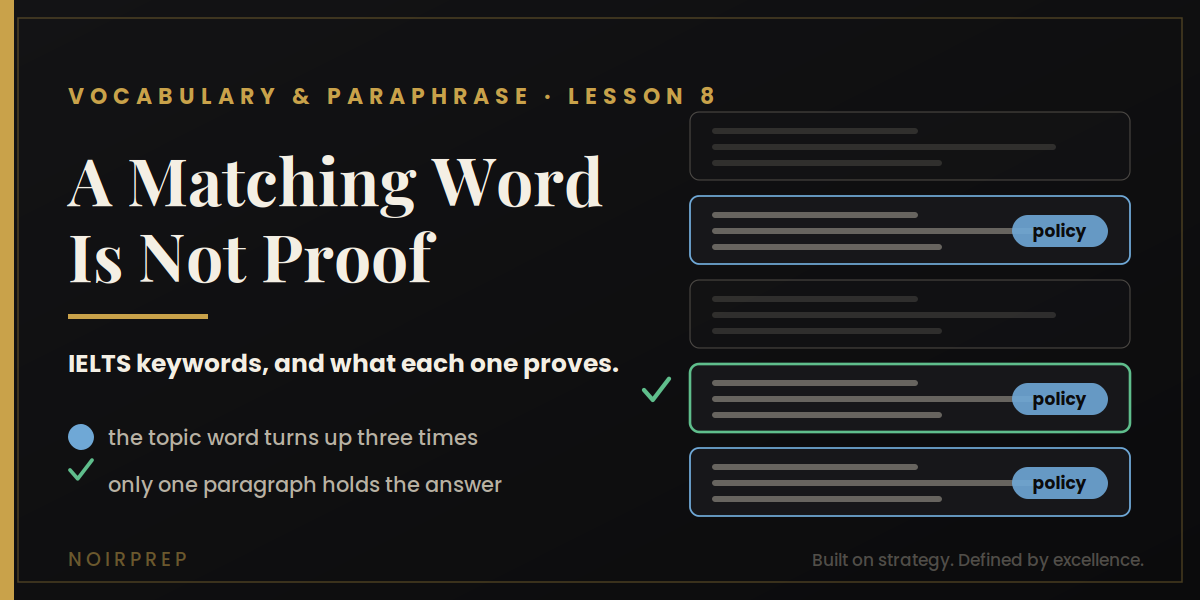
IELTS puts the same topic word in several paragraphs on purpose. So you scan, you find it, you stop, you answer. The paragraph was about your topic, so it felt right.
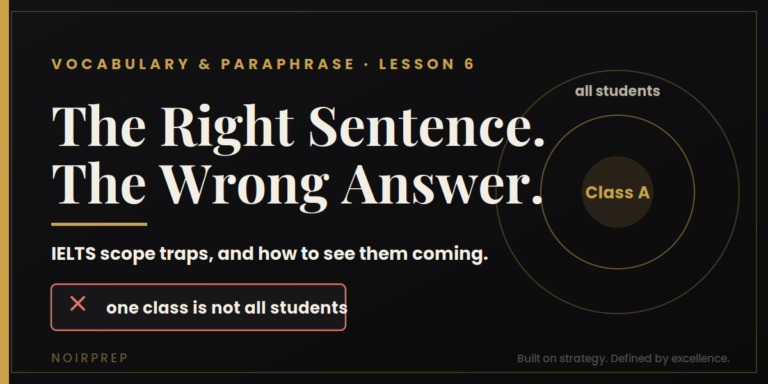
But a paragraph can mention money while discussing something else entirely. It can mention students while making a point about staff. It can mention a policy while describing the year before that policy existed.
Every time, the word is there and the meaning isn’t.
A matching word is not proof. Proof is a matching meaning.
Copy that one down somewhere you’ll see it, because nearly every scanning error in Reading comes from breaking it.
Watch It Happen
Three pairs below. In each one the topic word matches perfectly. Decide before you look at the verdict.
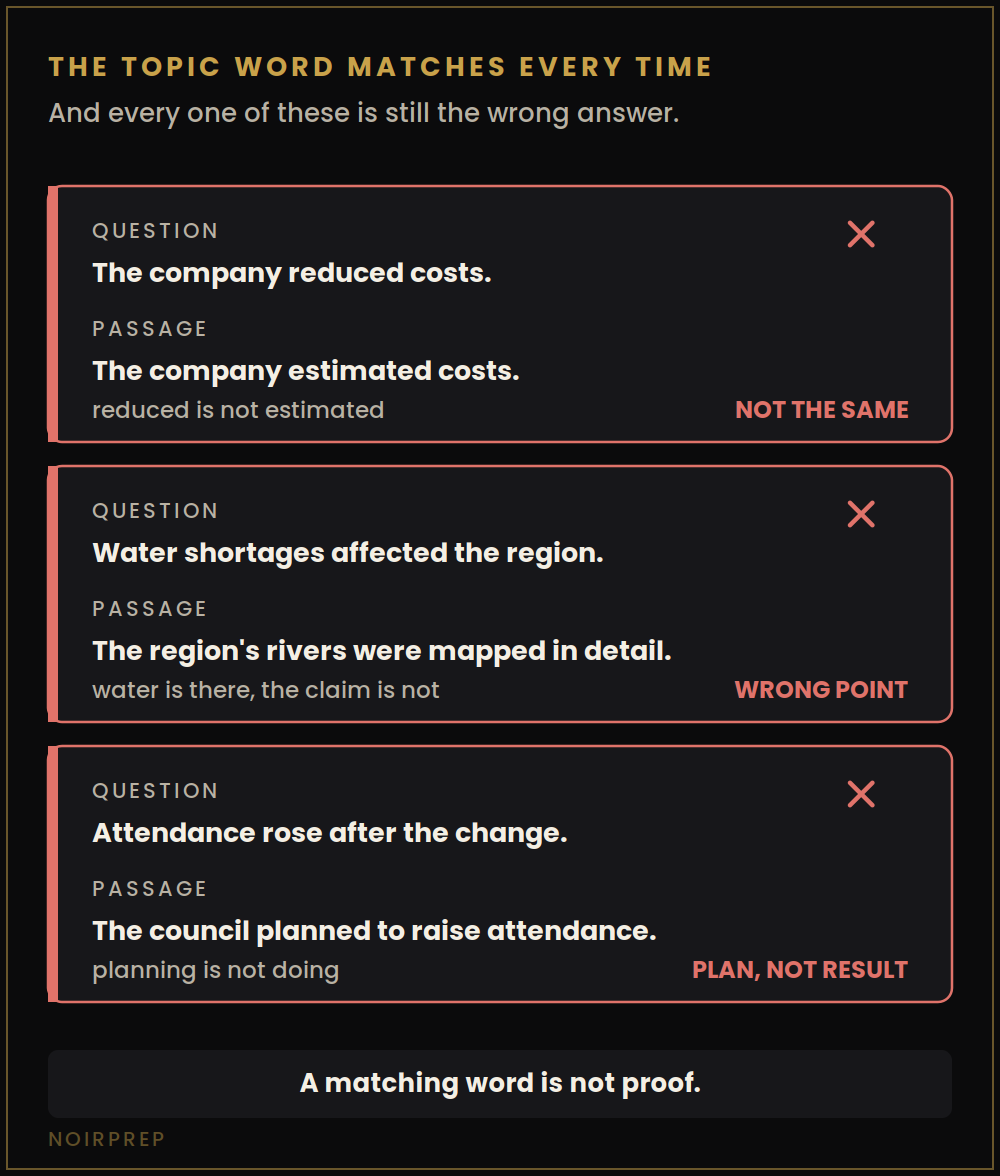
Look at what the first pair does. Both sentences contain costs, so a scanner spots a match immediately. But one company reduced its costs and the other only estimated them, and estimating isn’t reducing. The shared word was never the point.
The second pair is the same problem at paragraph level. Your question asks about water shortages, and the paragraph does mention water — repeatedly. It just happens to mention it while discussing something else.
The third is the one that catches strong readers. Everything matches, meaning included, except the paragraph is describing a plan rather than a result.
Where IELTS Keywords Cost the Most Marks
Some question types punish this much harder than others, so it’s worth knowing which.
Matching Information is the worst by a distance. You’re asked which paragraph holds a piece of information, several paragraphs mention your topic, and only one of them actually makes the claim. All of them look promising while you’re scanning.
Matching Headings goes wrong differently. A heading summarizes a whole paragraph, so a paragraph that mentions your topic three times can still be about something else. Topic words tell you nothing about what a paragraph is for.
Matching Features, where you attribute views to named people, is where stance matters most. Two names, one topic, opposite opinions.
True, False, Not Given is gentler, because you’re usually handed the sentence rather than sent to find it. Even so, that shared word still tempts people into accepting a match the meaning never supported.
Sentence completion is the one exception. There the topic word genuinely helps, since you need to find one place quickly and the grammar around the gap will tell you whether you’re right.
Same Topic, Opposite Views
There’s a harder version of all this, and it turns up in matching questions where you attribute opinions to people.
Two researchers discuss the same subject. Both get quoted, both mention your topic word, and one supports the idea while the other warns against it.
Match by topic alone and you’ll swap them. Every time.
So match by stance instead. Who supports it and who cautions against it? Who sounds confident and who sounds careful? Who’s naming a problem and who’s offering a solution?
The topic tells you both researchers belong in that paragraph. Only the stance tells you which one is yours.
The Control Word System
Now back to the second kind of word, because this is where the answer actually lives.
Reading a question, don’t just ask what it’s about. Ask which control word is shaping the answer, and what that word is telling you to look or listen for.
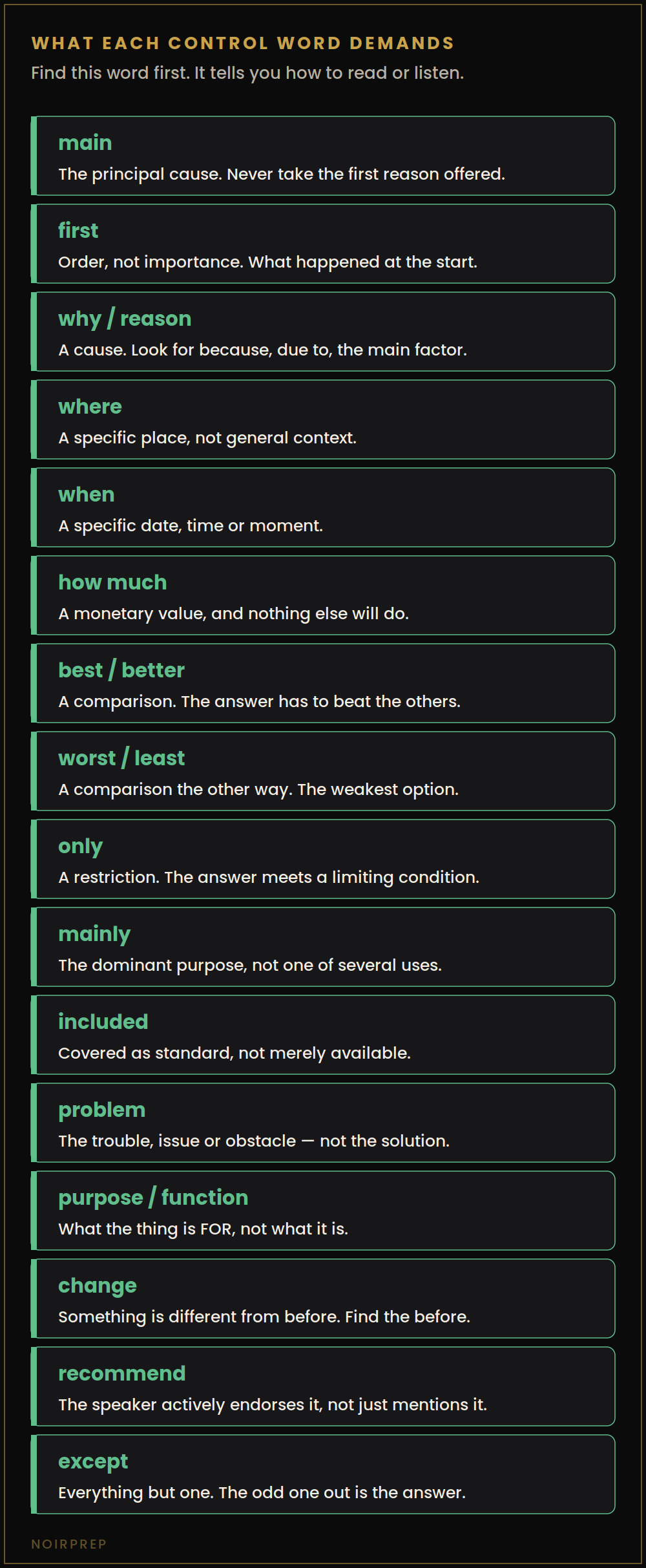
That table is worth learning properly, because each word changes the job completely. Main means waiting for the principal cause instead of grabbing the first reason offered. First is about order, not importance. Why sends you hunting for because, due to or the main factor. How much wants a specific amount and won’t accept anything else.
One word, and your whole approach to the question shifts.
Using IELTS Keywords in Listening
Listening rewards this even more than Reading, because you get to prepare before the audio starts.
In those few seconds, do three things. Predict the answer type, so you know whether you’re after a word, a number, a date, a time or a place. Predict the topic vocabulary, so the family is already sitting in your head. Then predict the likely paraphrases.
This puts your brain in expecting mode. Instead of waiting to hear one word, you’re waiting to hear a meaning and meaning is what the speaker is actually going to give you.
Candidates who skip this spend the recording hunting. Candidates who do it spend the recording confirming.
Try This With Any Practice Paper
Take a paper and don’t answer a single question.
Go through the questions instead and mark every word twice. Circle the topic words, underline the control words.
Then, beside each topic word, write three others that could carry the same idea.
You’ll end up with something like policy — legislation, regulation, scheme, reform. Or productivity — output, efficiency, yield, performance.
Ten minutes of this does more for your eye than an hour of timed practice, because it separates the two jobs your keywords have been quietly doing all along.
Then the Harder Words
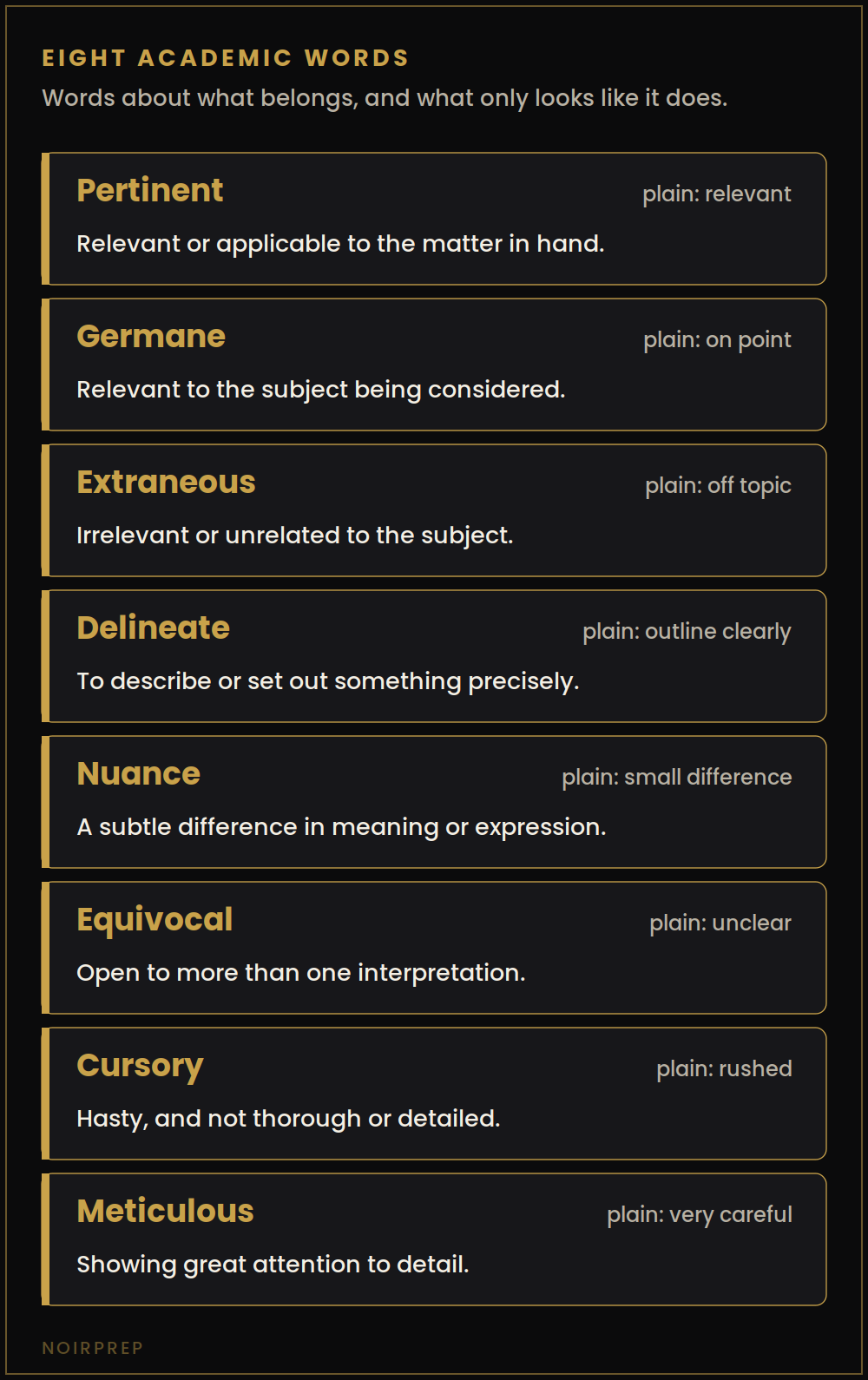
Cover the meanings and recall each one from the word alone. Then, for every word, write down two everyday words that might turn up near it in the same paragraph.
That second task is the one that counts here. You’re building families, not just collecting words.
One Warning
Don’t stretch a family too far.
Doctor, nurse and surgeon all belong to medicine, but a passage about nurses has told you nothing whatsoever about surgeons. Rainfall and flooding turn up together constantly, and rain still isn’t a flood.
A word family helps you arrive. It never confirms. So the moment you’ve found your paragraph, put the family down and read the sentence properly.
The NoirPrep Rule: use the topic word to find the place. Use the control word to find the answer.
Where to Go Next
That’s the patterns and the traps done. One lesson left, and it pulls the whole thing together.
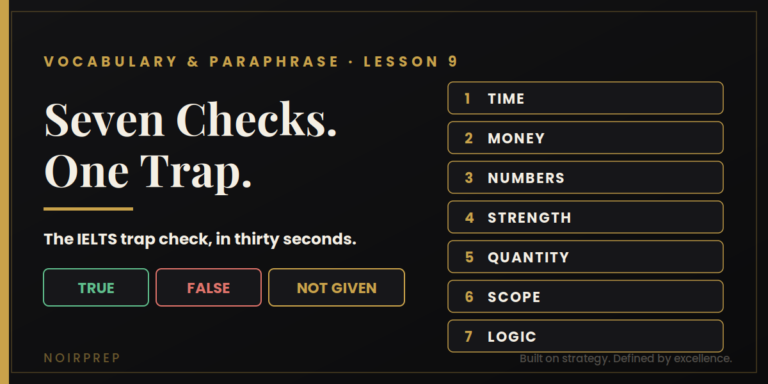
The trap check routine is a thirty-second sequence to run on every True, False and Not Given decision seven checks in order, then a simple chart telling you which of the three answers to choose.
After eight lessons of separate skills, that routine is what turns them into one habit.