IELTS Synonyms: Why You Cannot Find the Answer in the Passage
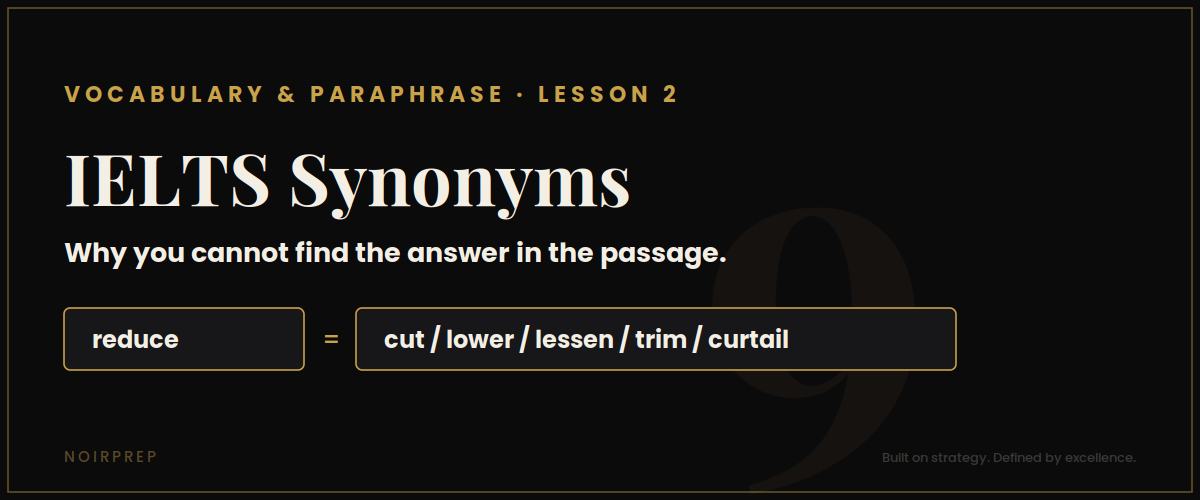
IELTS synonyms are the reason correct answers stay hidden. The passage says the same thing your question said. It just says it in a different word. Your eyes pass over the line and you never know the answer was there.
This is Pattern 1 of the six paraphrase patterns, and it is the most common one in the test. It is also the easiest to fix, because fixing it is mostly a matter of knowing more words.
First, a Quick Recap
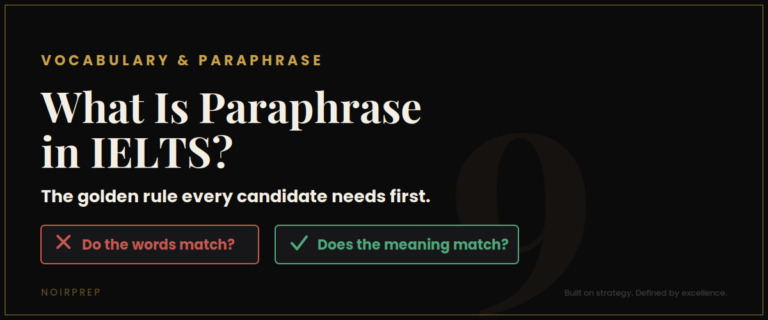
Three pairs before we begin. Read each one and decide whether the meaning matches. Ten seconds each.
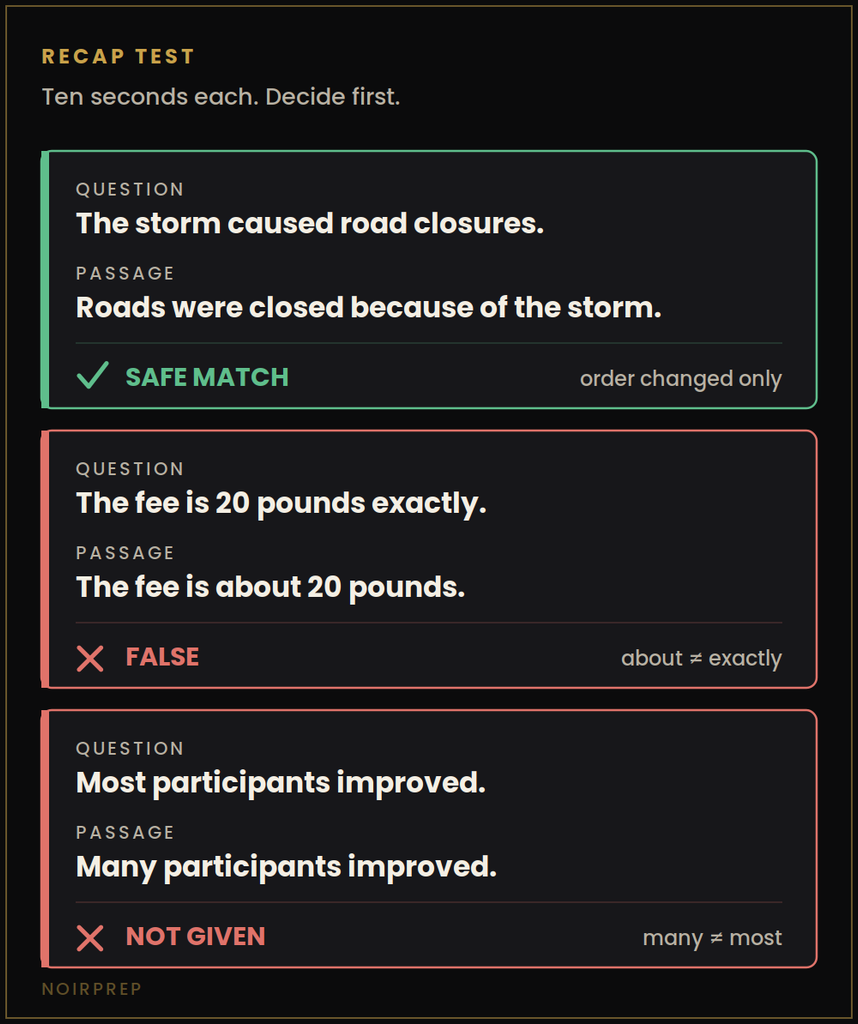
If all three came easily, good. If one caught you, notice which of the five meaning questions you forgot to ask. That is the check to watch in your next practice paper.
What Synonym Change Is
Synonym change is simple. IELTS takes one word from the question and puts a different word with a similar meaning in the passage.
The sentence keeps its shape. The grammar does not move. Only the word changes.
That is all. And it is enough to cost you five or six marks in one paper.
Why IELTS Synonyms Catch Good Candidates
Think about what you do when time is short.
You take a word from the question. You hold it in your head. You run your eyes down the passage looking for it.
The word is not there. It was never going to be there. The test removed it on purpose.
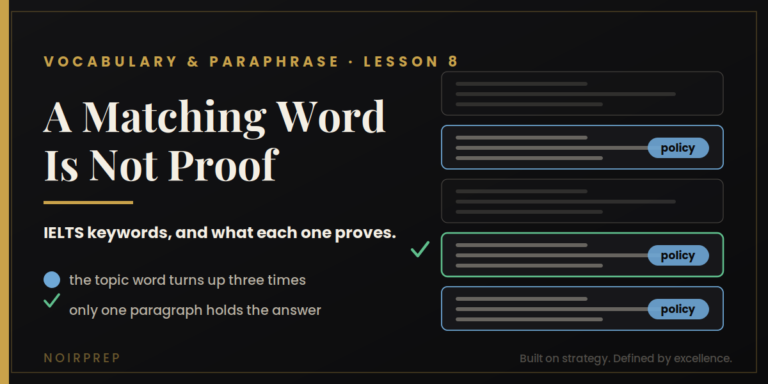
So you reach the bottom of the passage, find nothing, and decide the information is not given. But it was given. It was in the second paragraph, wearing a different word.
This is not a weakness in your English. It is a gap in your word bank, and a gap can be filled.
The Habit That Fixes It
The fix takes about five seconds per question.
Read the question. Find the word carrying the real meaning.
Now stop. Before you look at the passage, ask yourself what else that idea could be called. Two or three words is enough.
Then scan, holding all of them in your head instead of just the original.
Now when any one of those words appears, you slow down and check the meaning around it. You are no longer hunting one word. You are hunting a meaning.
Read, predict, scan. Most candidates skip the middle step, and they pay for it in every section.
Watch It Happen Twice
Here are two lines, taken apart slowly.
One. Question: The council eliminated the parking charge. Passage: The council abolished the parking fee.
Nothing important is shared. A scanner looking for eliminated finds nothing, and a scanner looking for charge finds nothing either.
But eliminate and abolish sit in the same family, and so do charge and fee. Two swaps in one short sentence. Same council, same action, same thing removed.
That is a match.
Two. Question: The study proves a link between diet and memory. Passage: The study suggests a link between diet and memory.
Now look carefully, because this one is different.
Prove and suggest do point in the same direction. They are both about evidence. A candidate building a synonym list in a hurry might even write them side by side.
They are not the same. Suggest is careful. Prove is final. The passage never made the stronger claim.
So this is not a match, and the answer is not True.
Notice what separated the two examples. In the first, the swapped words carried the same weight. In the second, one word was heavier than the other. Synonyms change the wording. They must never change the strength.
The Synonym Families to Learn First
Some words come up in IELTS questions again and again. Each one has a small family of words the passage is likely to use instead.
Learn them as families rather than one word at a time. Below are examples of the kind of swap you will meet. They are not a complete list, and no list could be, but they show you the shape of what to expect.
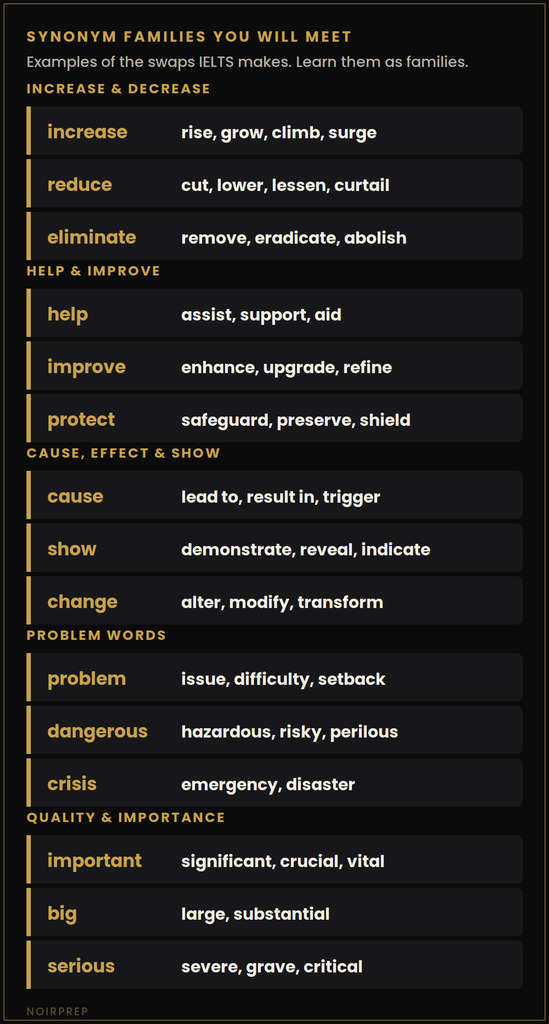
Here is how to use them. Take one group a day. Cover the right-hand side and try to recall the whole family from the word on the left. Keep going until you can do it in under five seconds.
Five seconds matters. In the exam you will not have time to think your way to a synonym. You need it to arrive on its own.
The Harder Words Behind Band 8
Once the everyday families are secure, the next step is academic vocabulary.
IELTS passages are taken from real academic writing, and academic writing does not say reduce when it can say curtail. It does not say make worse when it can say exacerbate.
These words are where Band 7 candidates and Band 9 candidates part company.
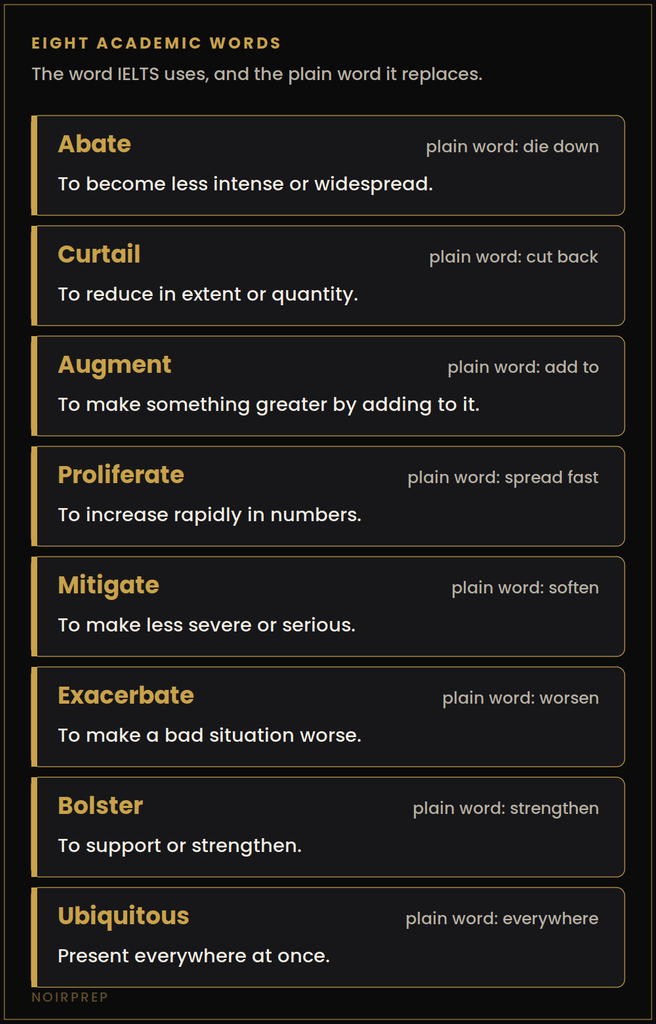
Do not just read those definitions. Cover them and recall the meaning from the word alone. Then write one sentence of your own with it.
A word you have used is a word you will recognize at speed. A word you have only read will vanish the moment you are under pressure.
IELTS Synonyms in Listening
Everything above applies to Reading, where you can go back and look again.
Listening is harder, because the audio rarely repeats the words in the question, and it says the idea once, at speaking speed, then moves on.
So the training shifts. Before the recording starts, read the question, take the key word, and quickly run its family in your head. If the question says main reason, be ready for the real cause, the key factor. If it says increase, be ready for go up, rise, grow, climb.
This puts your brain in expecting mode. You are no longer waiting for a word to arrive. You are waiting for a meaning, and meaning is what the speaker will actually give you.
One Warning About IELTS Synonyms
Words in the same family are not identical twins.
Mitigate and reduce both point downwards, but mitigate means softening something harmful. Proliferate and increase both point upwards, but proliferate means multiplying fast, not growing steadily.
In Reading and Listening this rarely hurts you, because you are matching meaning, not producing it.
In Writing and Speaking it matters a great deal. Reaching for an impressive word you do not fully control is one of the most common ways candidates lose marks while trying to gain them.
Use the word you understand. That is always the stronger choice.
What to Do Before the Next Lesson
Two tasks. Both small.
One. In every practice question this week, predict two synonyms before you scan. It will feel slow at first. Do it anyway, until it stops being a step and becomes the way you read.
Two. Take the eight academic words above and write one sentence with each. Eight sentences. That is the whole task, and it will do more for your band score than another full practice test.
The NoirPrep Rule: you cannot recognize a synonym you have never met. Build the bank first. The speed comes free.
Where to Go Next
Next lesson we take Pattern 2, where the test swaps a single word for a whole phrase, or folds a phrase back into one word.
It is the pattern that makes a decade and ten years look like two different facts to a tired reader. It hides answers just as well as IELTS synonyms do, and it catches even candidates with a strong vocabulary.
One Comment