IELTS Scope Traps: Why the Right Sentence Gives the Wrong Answer
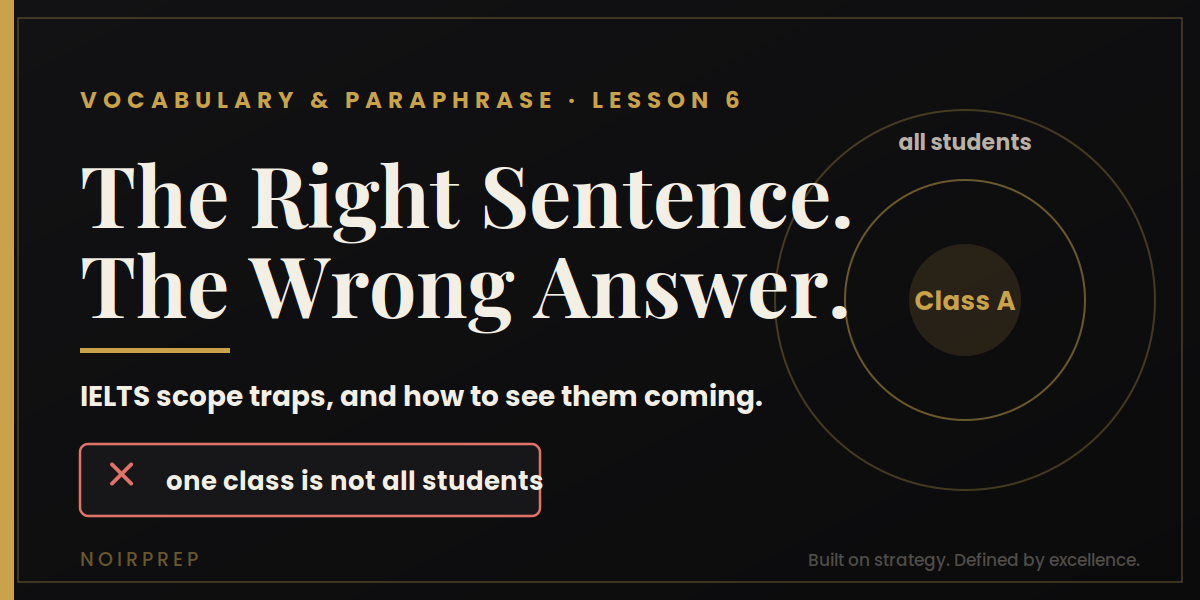
IELTS scope traps are the reason candidates lose marks on sentences they understood perfectly. The topic matches. The action matches. The wording is almost identical. Only the size of the group has changed, and that alone turns a True into a Not Given.
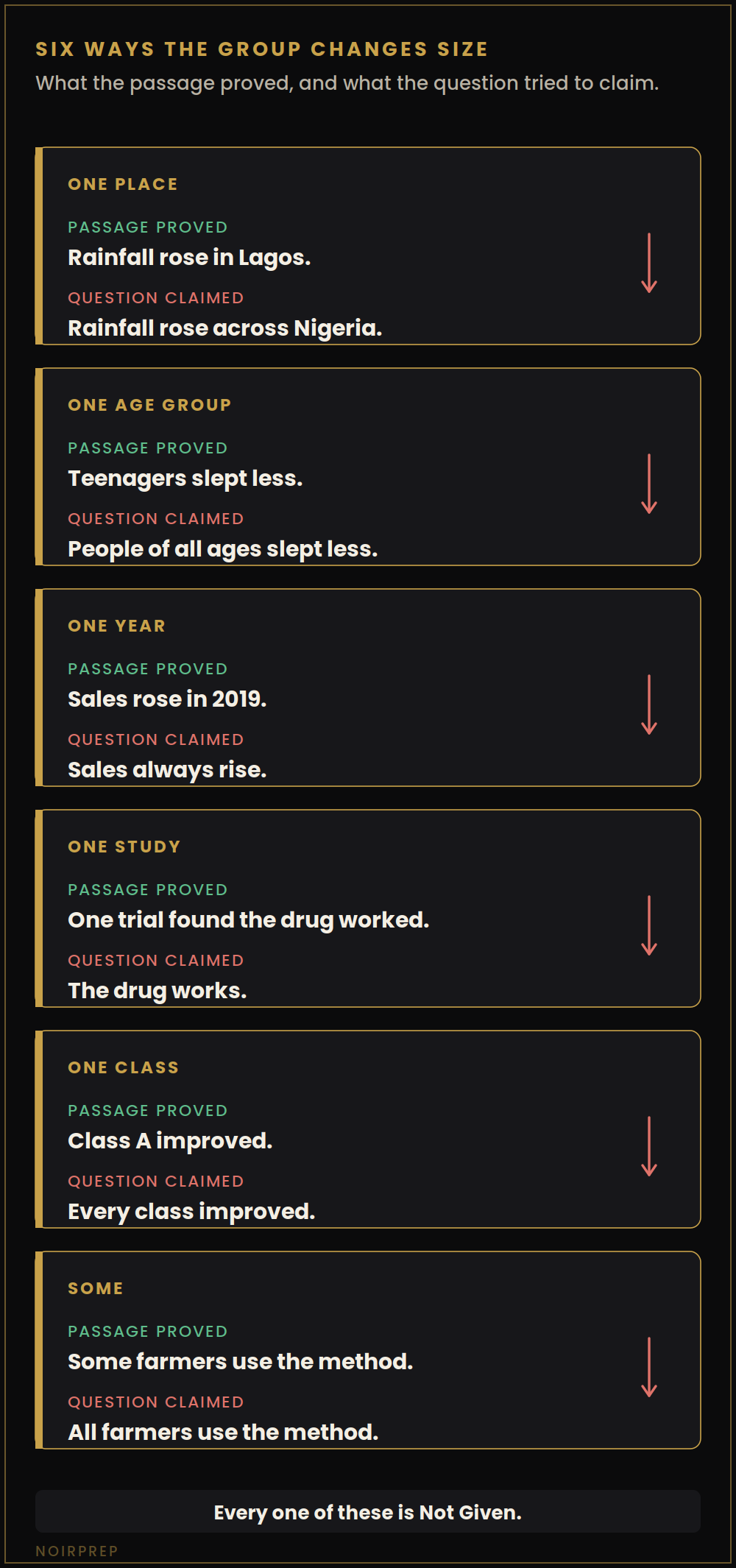
The program helped students sounds like a fair summary of the program helped students in Class A. It is not. One claim covers everybody; the other covers one classroom.
In the last lesson we looked at sentences that rearrange themselves without changing meaning. This one is the opposite. The sentence barely changes at all, and the meaning moves underneath it.
Pattern 6 is the last of the six, and the most dangerous by some distance.
What General and Specific Means
The question and the passage discuss the same subject at different levels of detail.
Your question says birds. The passage says herons and egrets.
Your question says the country. The passage says one city.
Sometimes this is a perfectly safe paraphrase. Sometimes it destroys the claim. Everything depends on which direction the change travels.
The Direction That Matters
Here is the rule the whole lesson rests on.
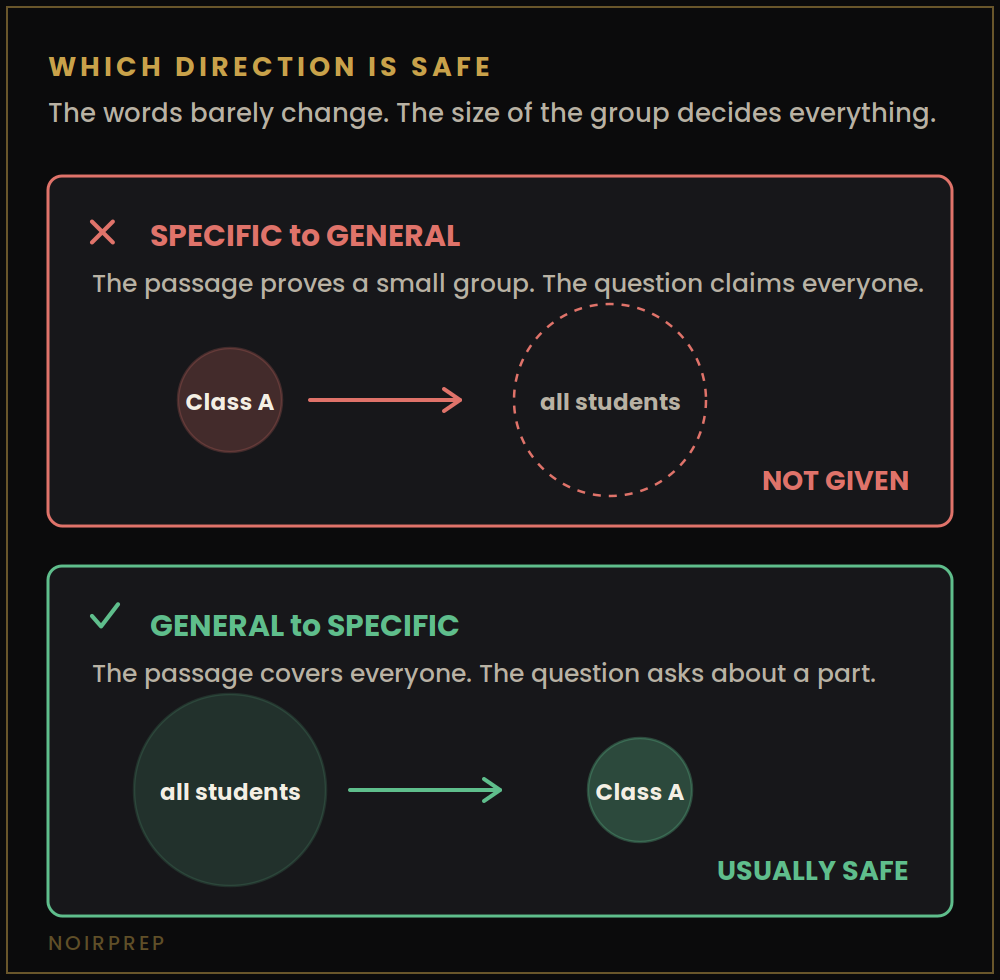
Going from specific to general is dangerous. Going from general to specific is usually fine.
If the passage gives you one study, one region, one age group, one class, and your question turns that into everybody, everywhere, always, the passage has not supported the claim. It has supported a much smaller version of it.
A single example never proves a general statement.
Reverse it and the danger disappears. If the question is narrow and the passage is broad, the broad statement usually covers the narrow one, and you can accept the match.
Why IELTS Scope Traps Are So Effective
Everything else in the sentence agrees with you.
That is the whole mechanism. You find the line, you recognize the topic, the verb matches, the time matches, and every instinct says yes. The only thing standing between you and the mark is one small phrase that narrows the group.
The narrowing is usually done by a short phrase tucked into the sentence: students in Class A, in the region surveyed, among the participants, during the trial period.
Phrases like these look like background detail. They are not. They are the answer.
Candidates skim them precisely because they appear to be decoration, and skimming them is how a confident reader marks True on a statement the passage never made.
The Scope Question
One question defends against all of this.
Ask: is the passage talking about the same group as the statement?
Same group, same place, same time, same conditions. If the passage covers less than the question claims, you are looking at Not Given, almost every time.
Notice that this is not a vocabulary question or a grammar question. You are not comparing words at all. You are comparing the size of two populations.
Watch It Happen
Five pairs follow. Some are safe and some are not, so decide each one before you look at the verdict.
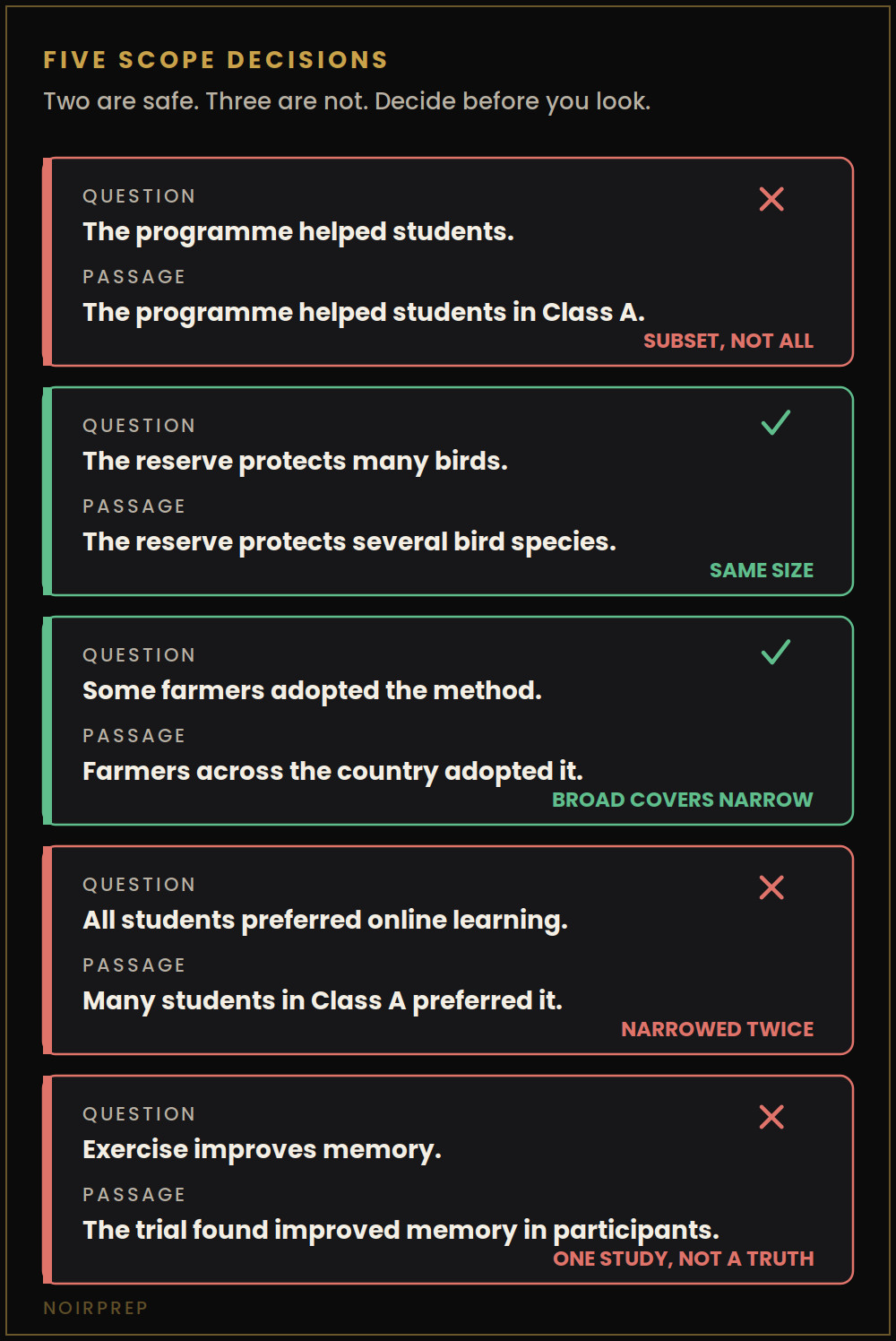
Take the second pair. Many birds against several bird species is a safe match, and this one surprises people who have learned to fear scope. The two phrases describe roughly the same quantity, and neither claims more than the other. Context decides, and here nothing has been widened.
Now compare the fourth. All students against many students in Class A fails twice over. Many is not all, and Class A is not the student body. Two separate narrowings stacked in one short sentence.
The fifth is the one candidates argue about. The passage reports a single study; the question states a general truth. Everything the study found may well be accurate, and the general statement may even be true in the real world. The passage still has not proven it, and IELTS marks the passage, not the world.
Where Scope Hides
Certain phrases do this work quietly, and it pays to know them by sight.
Watch for in the study, among those surveyed, in the sample, at the site, during the period examined. Each one fences off a small area and tells you that whatever follows applies inside that fence only.
Watch also for the reverse: generally, as a rule, typically, in most cases. These widen a claim, and if your question demands something absolute, a typical case will not deliver it.
The Words That Break Scope Completely
Three words in a question should make you slow down every time you meet them.
All. Always. Every.
They admit no exceptions, which means the passage must confirm them without exception. A passage that says most, usually or in many cases has already fallen short.
The reverse holds too. Where a question says some or many and the passage says all, the match is usually safe, because all of something includes many of it.
Absolute claims are fragile. Modest claims are durable. IELTS knows this and builds questions accordingly.
Why This Pattern Produces Most Not Given Answers
Not Given is the answer candidates fear, and scope is the reason it exists so often.
Think about what Not Given actually means. It does not mean the statement is false. It does not mean the passage is silent on the topic. It means the passage does not confirm this particular claim.
A narrowed passage does exactly that. It speaks about the topic at length, it agrees with the spirit of your statement, and it never once makes the claim in the size the question demands.
So the passage feels relevant, which is why False tempts people. Nothing contradicts the statement, though, and False requires contradiction.
Learn to recognize the feeling. When a sentence looks right and you cannot point to the words that prove it in full, you are almost certainly in Not Given territory, and the missing part is usually the size of the group.
Where IELTS Scope Traps Cost the Most Marks
True, False, Not Given is the obvious one, and it punishes scope errors more than any other question type.
Matching Information is quietly worse. You are asked which paragraph contains a piece of information, and several paragraphs will discuss the same topic at different levels. Only one of them makes the claim at the size the question asks for.
Multiple choice uses scope for its distractors constantly. Two options will be broadly correct and one will be correct at the right size. Candidates who compare topics rather than scopes pick the wrong one and never understand why.
Summary completion is gentler, but a summary that overstates a limited finding is still wrong, even when every individual word came from the passage.
Scope in Listening
Speakers narrow their statements constantly, and they do it casually, which makes the limit easy to miss.
It works well, at least for the beginners’ group. We’ve had no problems, on the Tuesday sessions anyway.
Those trailing phrases arrive after the main statement, often in a lower tone, and by then your pen is already moving. The limit is the part you need.
Train yourself to keep listening after you think you have heard the answer. The qualification usually comes second.
Then the Harder Words
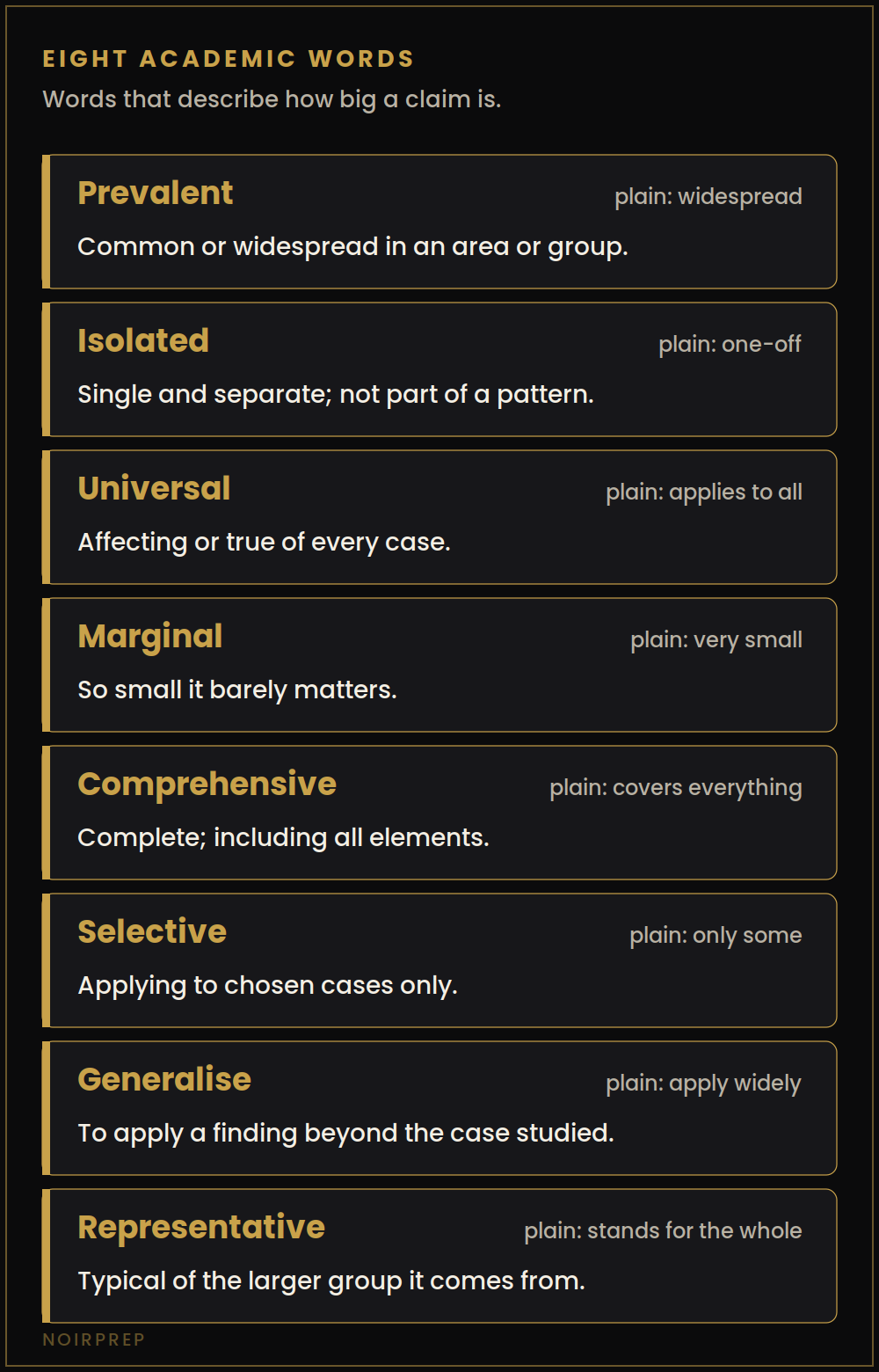
Cover the meanings and recall each from the word alone. Then write one sentence using it about a whole group, and one about a subset.
Sixteen sentences, and the second half of each pair will train exactly the distinction this lesson depends on.
A Five-Minute Drill
Take any practice passage and hunt for limiting phrases rather than answers.
Underline every phrase that fences off a group: in this region, among the students surveyed, during the first year. Do not answer anything. Just mark them.
You will find more than you expect, and you will begin noticing them in the exam, which is the entire point.
The NoirPrep Rule: a specific example never proves a general claim. A general claim usually covers a specific one.
Where to Go Next
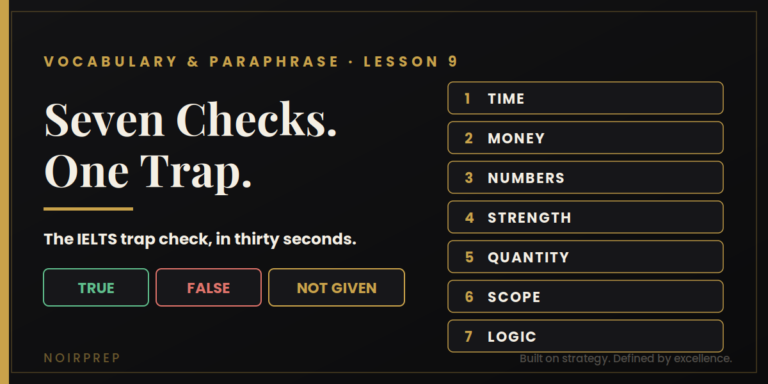
That completes the six patterns. Next comes the part that ties them together: the trap check routine, a thirty-second sequence to run on every True, False and Not Given decision you make.
Seven checks, in order, then a decision tree. By the end of it you will have a repeatable process rather than a set of separate skills.