IELTS Sentence Structure Changes: When the Words Move but the Meaning Does Not
IELTS sentence structure changes are the paraphrase that hides nothing at all. Every word you need is sitting there in plain view. They have simply been rearranged, and that is enough to make a candidate certain she has found the wrong sentence.
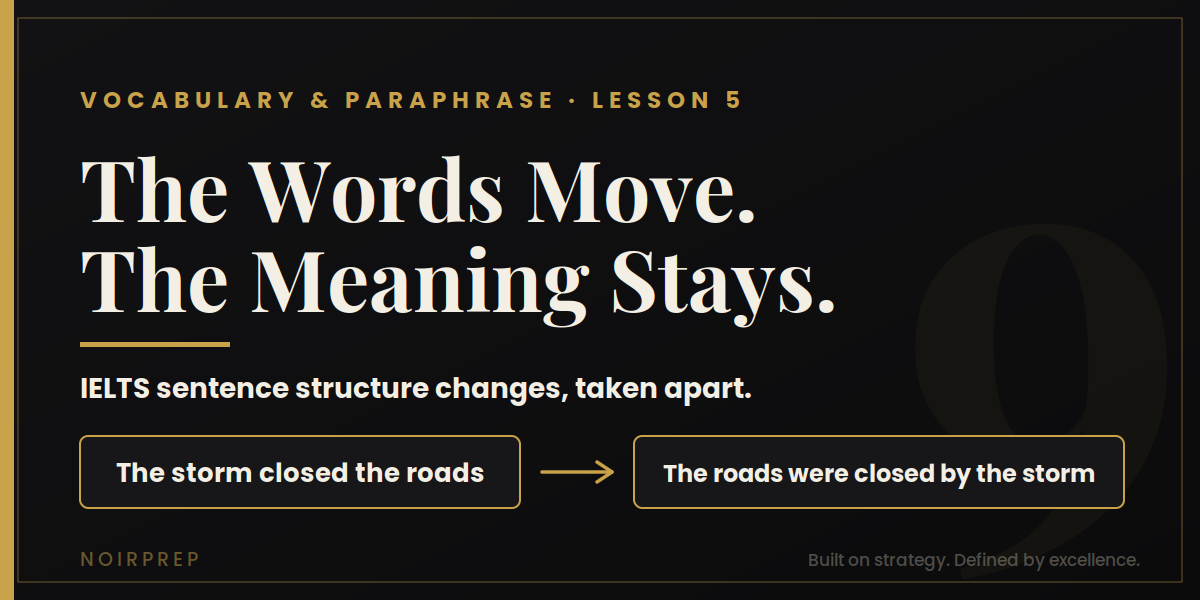
The storm caused road closures becomes roads were closed because of the storm. Same storm. Same roads. Same cause and the same effect. Only the order has moved.
In the last lesson we looked at how the grammar of a single word can change while the meaning stays put. Today the whole sentence rearranges itself, and two patterns are doing it.
Two Patterns, One Skill
Pattern 4 reorders ideas inside a sentence. Cause and effect swap ends.
Pattern 5 flips active into passive. The doer moves from the front to the back, or disappears entirely.
They are separated in the Paraphrase Bank because they work differently, but you defend against both the same way, which is why they share a lesson.
Why IELTS Sentence Structure Changes Work So Well
Most candidates read left to right and match shapes as they go.
You hold the question in your head: subject, then verb, then object. Your eye runs down the passage looking for that same run of pieces in that same sequence.
The passage puts the pieces in a different order, and nothing matches. You read straight past a sentence carrying the exact information you needed, because it arrived back to front.
Think about how ordinary this is in real writing. Nobody writes the storm caused road closures twice in one article. They vary it, because varied sentences read better. IELTS simply does deliberately what every competent writer does by instinct.
Break the Sentence into Four Pieces
Here is the habit that defeats Pattern 4.
Stop reading the question as a sentence. Read it as four separate pieces: the actor, the action, the cause, the effect.
Who did it. What was done. What brought it about. What resulted.
Now go into the passage looking for those four pieces rather than that sentence shape. If all four turn up, in any arrangement, the meaning matches.
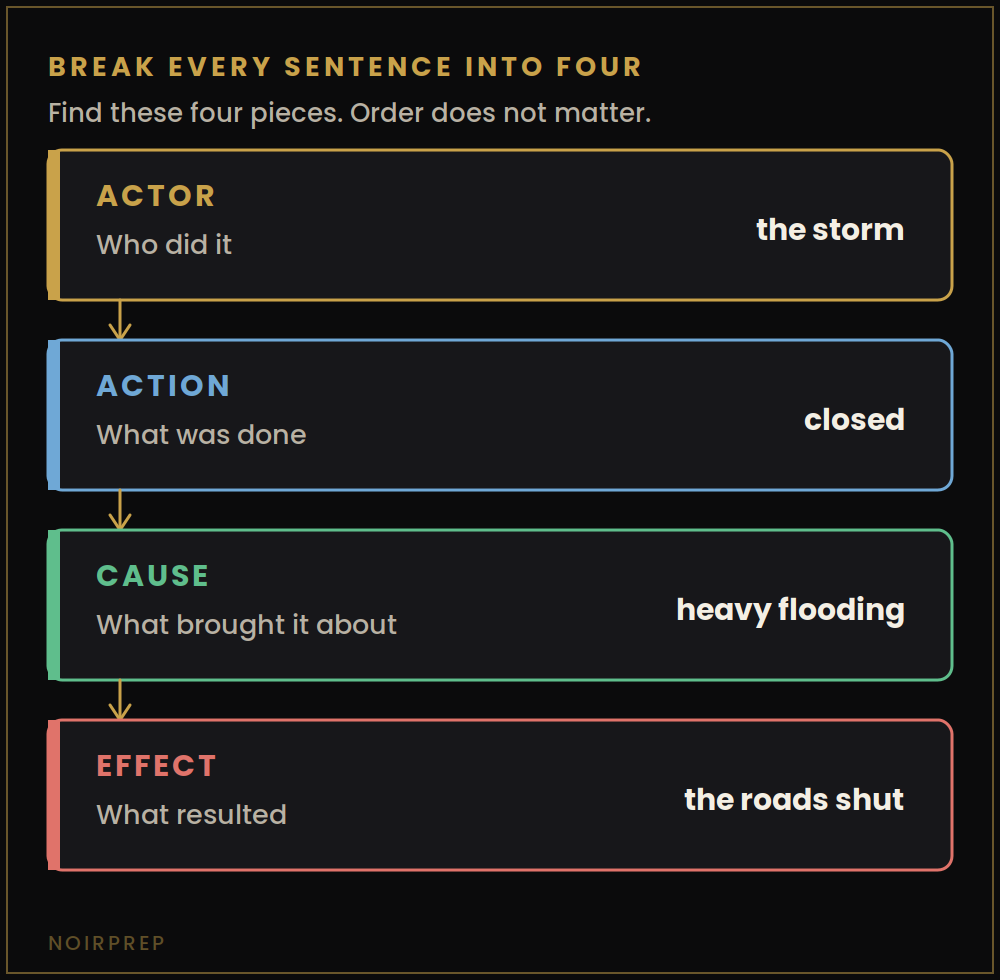
Order is presentation. Meaning is content. Pattern 4 changes only the first.
Watch Reordering Happen
Five pairs follow. Three survive the reorder and two do not, so decide each one before you look at the verdict.
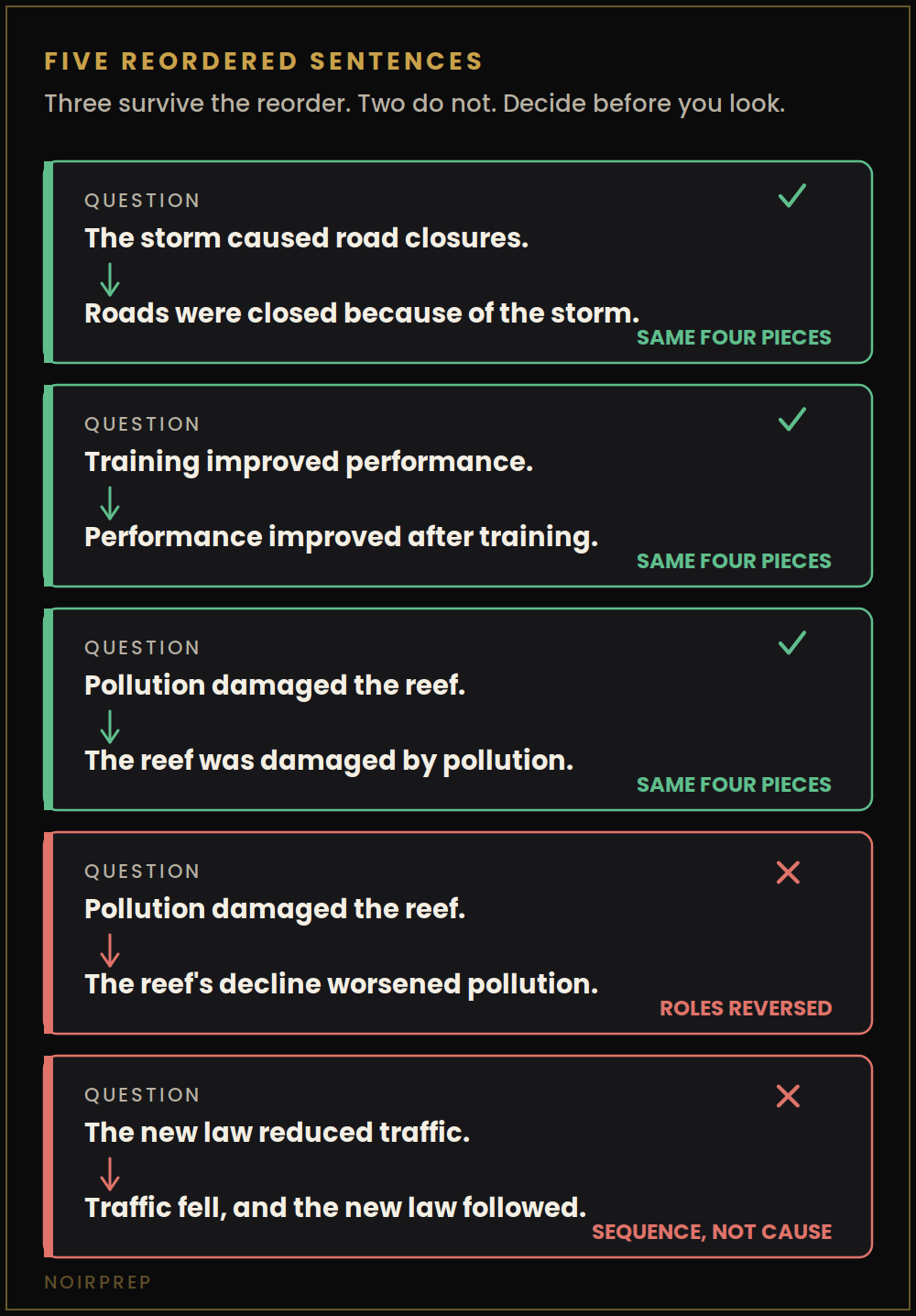
Notice what separates them.
In the first three, the cause is still the cause and the effect is still the effect. The storm still closed the roads. The roads never closed the storm.
The fourth pair looks similar and is not. Pollution damaging the reef and the reef’s decline worsening pollution point in opposite directions. Same two nouns, same general topic, arrow reversed. That is a different claim entirely.
The fifth is quieter and catches more people. Traffic falling and a law following it is a sequence. Your question claimed a cause. Nothing in the passage says the law did anything, only that it came afterwards, and afterwards is not because.
That is the test. If the four pieces survive intact, the reordering is harmless. If the arrow turns round, or a cause quietly becomes a sequence, you are looking at a trap rather than a paraphrase.
Now the Passive
Pattern 5 is narrower and easier to spot once you know the signal.
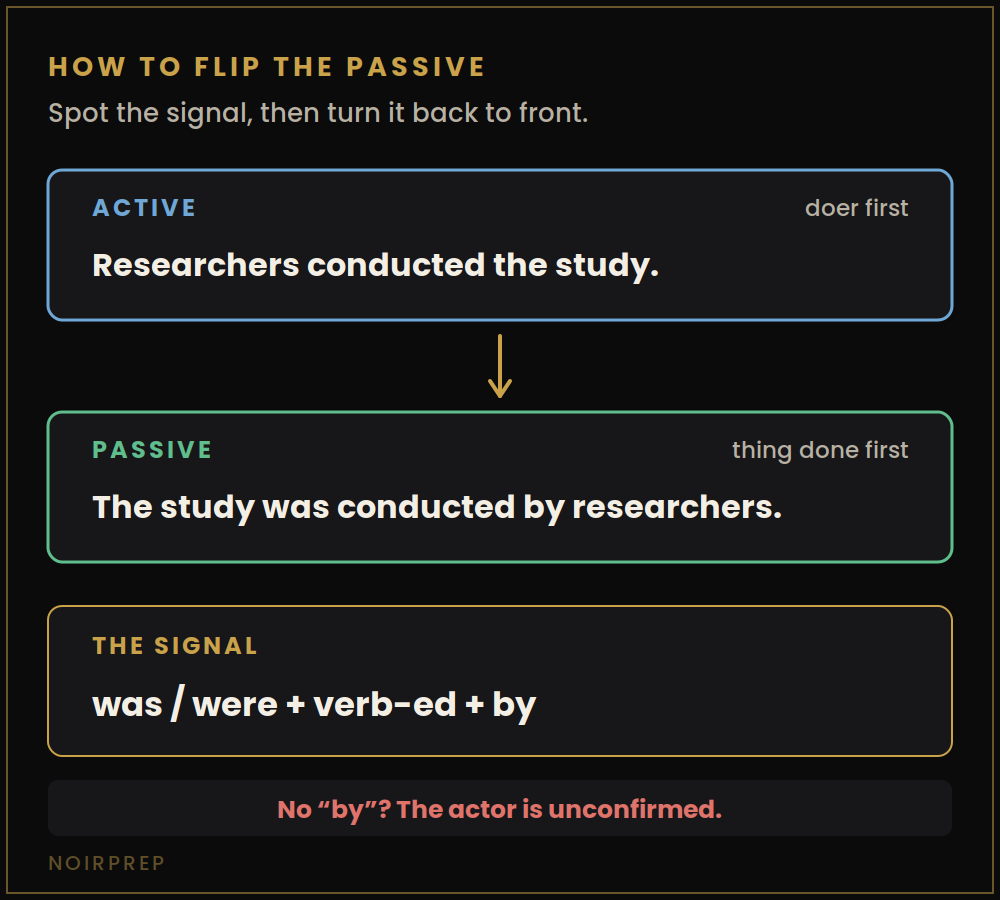
Active voice puts the doer first: researchers conducted the study. Passive voice puts the thing done first: the study was conducted by researchers.
Identical event. Different emphasis. Very different appearance on the page.
The signal is mechanical, and this is what makes Pattern 5 more manageable than Pattern 4. Look for a form of was or were, followed by a verb usually ending in -ed, followed by the word by.
Whenever you see that combination, flip the sentence back to active in your head before you compare it with the question.
The Passive That Hides the Actor
Academic writing does something with the passive that trips up careful readers.
It drops the doer entirely.
The policy was introduced in 2019. Introduced by whom? The sentence does not say, and in academic prose that is completely normal, because the writer cares about the policy rather than the person who signed it.
Now imagine your question reads: The school introduced the policy in 2019.
The passage confirms the policy and the year. It says nothing whatsoever about the school. Everything matches except the one thing the question actually claimed.
That answer is Not Given, and candidates get it wrong constantly, because four fifths of the sentence lines up perfectly.
The NoirPrep Rule: when the passive hides the actor, the actor is unconfirmed. Do not supply it yourself.
The Words That Mark the Joins
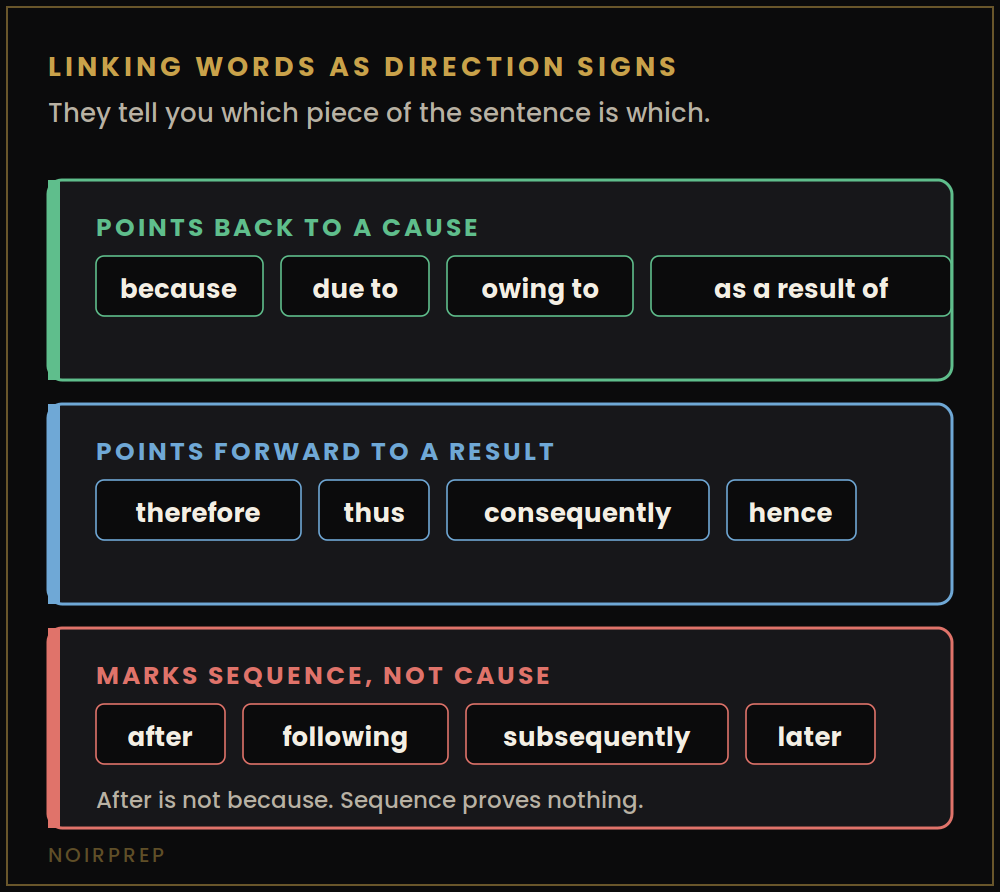
Reordered sentences are held together by small linking words, and those words tell you which piece is which.
Because, due to, owing to and as a result of point backwards to a cause. Therefore, thus, consequently and hence point forwards to a result. After and following mark sequence rather than cause, which is a distinction worth holding on to, since something happening after something else is not proof that it happened because of it.
Learning to read these words as direction signs rather than filler is what lets you take a rearranged sentence apart in a few seconds.
IELTS Sentence Structure Changes in Listening
Listening deserves its own note here, because the passive behaves differently when spoken.
Speakers use it far less. In conversation people say we changed the timetable, not the timetable was changed by us. So if your question is phrased passively, expect the recording to hand it to you the other way round, with the doer out in front.
The exception is announcements and formal instructions, where the passive is everywhere. Students are advised to arrive early. The session has been moved to Room 12. Notice that both of those drop the actor completely, exactly as academic writing does.
Reordering behaves differently too. A speaker often gives the effect first and the cause afterwards, as an afterthought: we cancelled the trip, because the weather turned. Your question may well present those two halves the other way around.
Prediction covers both cases. Before the audio starts, break the question into its four pieces and hold the pieces rather than the sentence.
Where These Patterns Cost Most
True, False, Not Given punishes both patterns harder than any other question type.
The reason is that TFNG requires you to compare two claims precisely, and both of these patterns disguise a claim without altering it. A candidate who cannot take the sentence apart ends up guessing between False and Not Given on a statement the passage has already confirmed clearly.
Matching Information suffers too. You are hunting for a specific fact inside a long paragraph, and passives make facts look like background description rather than answers.
Two Drills
Take any practice passage and find five passive sentences. The signal makes them easy to spot: was or were, a verb, then by. Rewrite each as active. Five minutes.
Then take five questions and, without reading the passage at all, break each one into the four pieces. Actor, action, cause, effect. Write them out separately.
The second drill feels strange the first time. After a week it becomes the way you read a question, and reordered sentences stop being able to hide from you.
Then the Harder Words
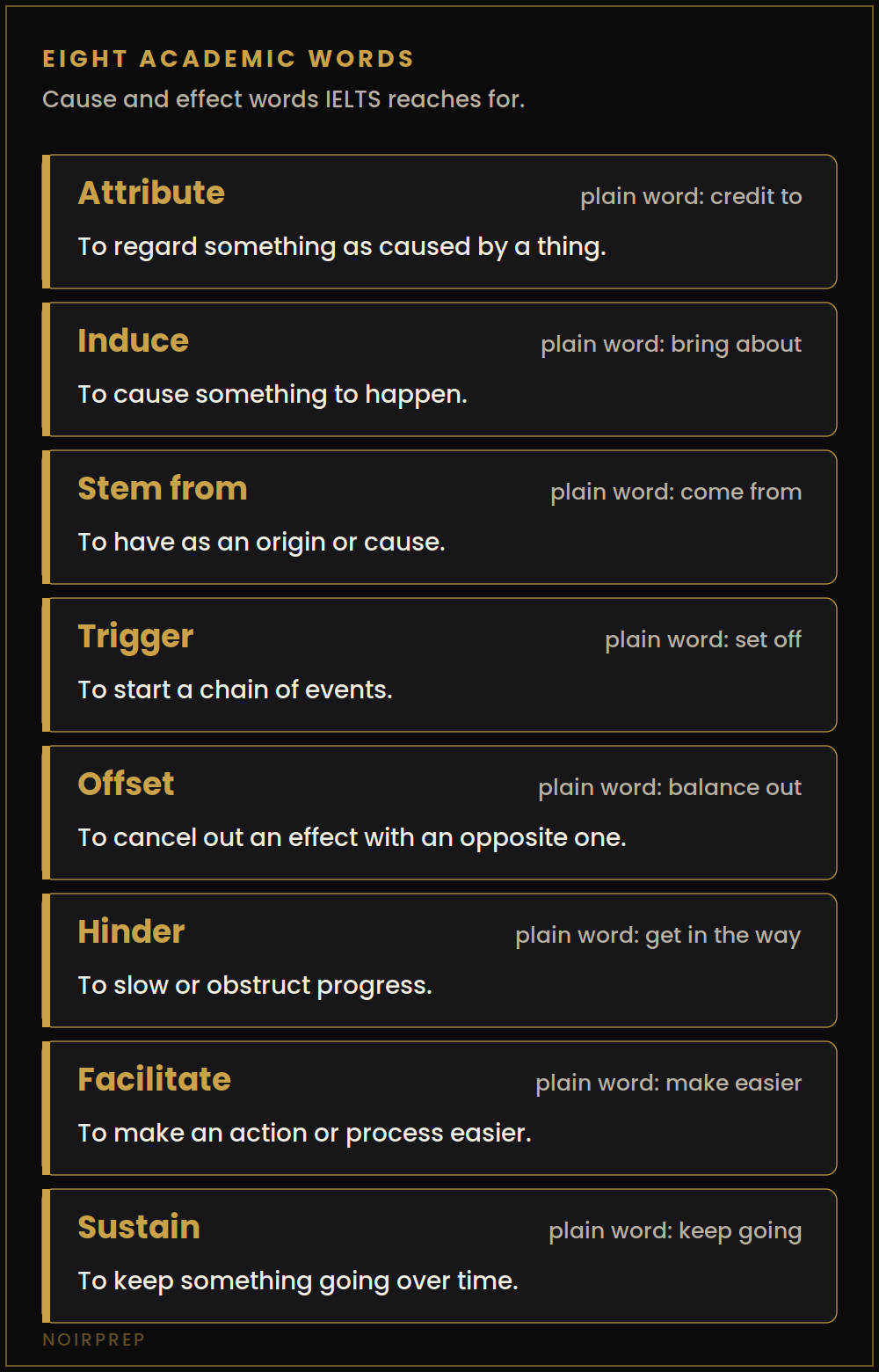
Cover the meanings and recall each word from the word alone. Then write two sentences with it, one active and one passive.
Sixteen sentences. The passive practice matters as much as the vocabulary here.
One Warning
Reordering is safe. Role-swapping is not.
Pollution damaged the reef and the reef was damaged by pollution are the same claim. But pollution damaged the reef and the reef’s decline worsened pollution are opposites wearing similar clothes.
Before you accept a rearranged sentence, confirm the direction of the arrow. Who acted on whom, and which thing came first.
Where to Go Next
Pattern 6 is the last of the six, and the most dangerous: general against specific.
The passage says herons and egrets. Your question says birds. One of those directions is safe and the other loses marks, and knowing which is which decides a great many Not Given answers.