IELTS Word Class Changes: The Paraphrase Nobody Notices

IELTS word class changes are the quietest paraphrase of them all.
No new vocabulary arrives. No phrase stretches out. The same idea simply changes its grammatical clothing, and candidates walk straight past it.
The population increased becomes there was an increase in the population. Nothing is hidden. Every word is one you already know. Yet under timed conditions, thousands of candidates read that second sentence and feel certain they have not found the answer yet.
In the last lesson we looked at how one word stretches into a whole phrase. Today the change is smaller and far harder to see, because nothing about the sentence grows or shrinks. Only the grammar moves.
Pattern 3 is the third of the six paraphrase patterns, and in Academic Reading it appears more often than anything except synonyms.
What a Word-Class Shift Is
The whole pattern fits in one line: the meaning stays, the part of speech moves.
A verb in your question turns into a noun in the passage. An adjective becomes a noun phrase. A noun becomes a verb.
Take a reduction in costs against costs were reduced. Identical information, expressed once as a noun and once as a verb.
Or cheap housing against low-cost housing. One adjective replaced by a compound describing exactly the same thing.
Nothing clever is happening. That is precisely why it works.
Why IELTS Word Class Changes Are So Easy to Miss
Something specific happens in your head while you scan.
You are not really reading. You are pattern-matching against a shape held in memory, and that shape includes the ending of the word.
So when you hold increased in your mind and the page offers an increase, the ending has changed. The shape no longer fits. Your eye moves on before your brain can object.
Here is the painful part. You knew the answer. Ask any candidate afterwards whether an increase means the same as increased, and they will look at you as though the question were foolish.
They knew. They simply never stopped.
That gap between knowing and noticing is where marks disappear.
Focus on the Root, Not the Ending
The fix is a change of attention.
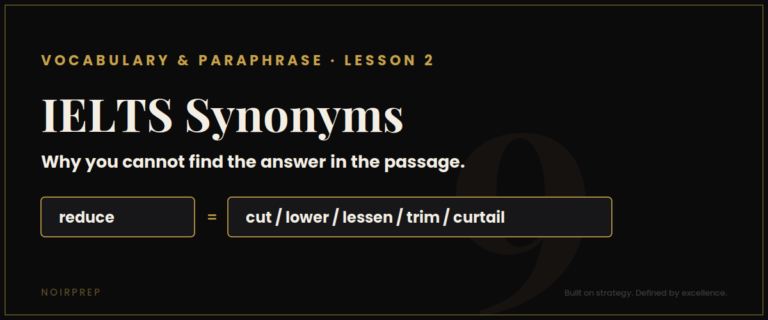
Reduce, reduction, reduced and reducing are four costumes worn by one idea. Train yourself to see the root, reduc-, and treat every ending as decoration.
When you carry a keyword into the passage, carry the root instead of the whole word. Hunting for analys- rather than analysis means analysed, analysing and analytical all register as hits.
The hyphen in analys- is doing a job. It marks the point where the word stops being fixed and starts changing, and everything before that hyphen stays the same no matter which form appears. Reduc- covers reduce, reduction, reduced and reducing. Increas- covers increase, increased, increasing and an increase. Scan for the part that never moves.
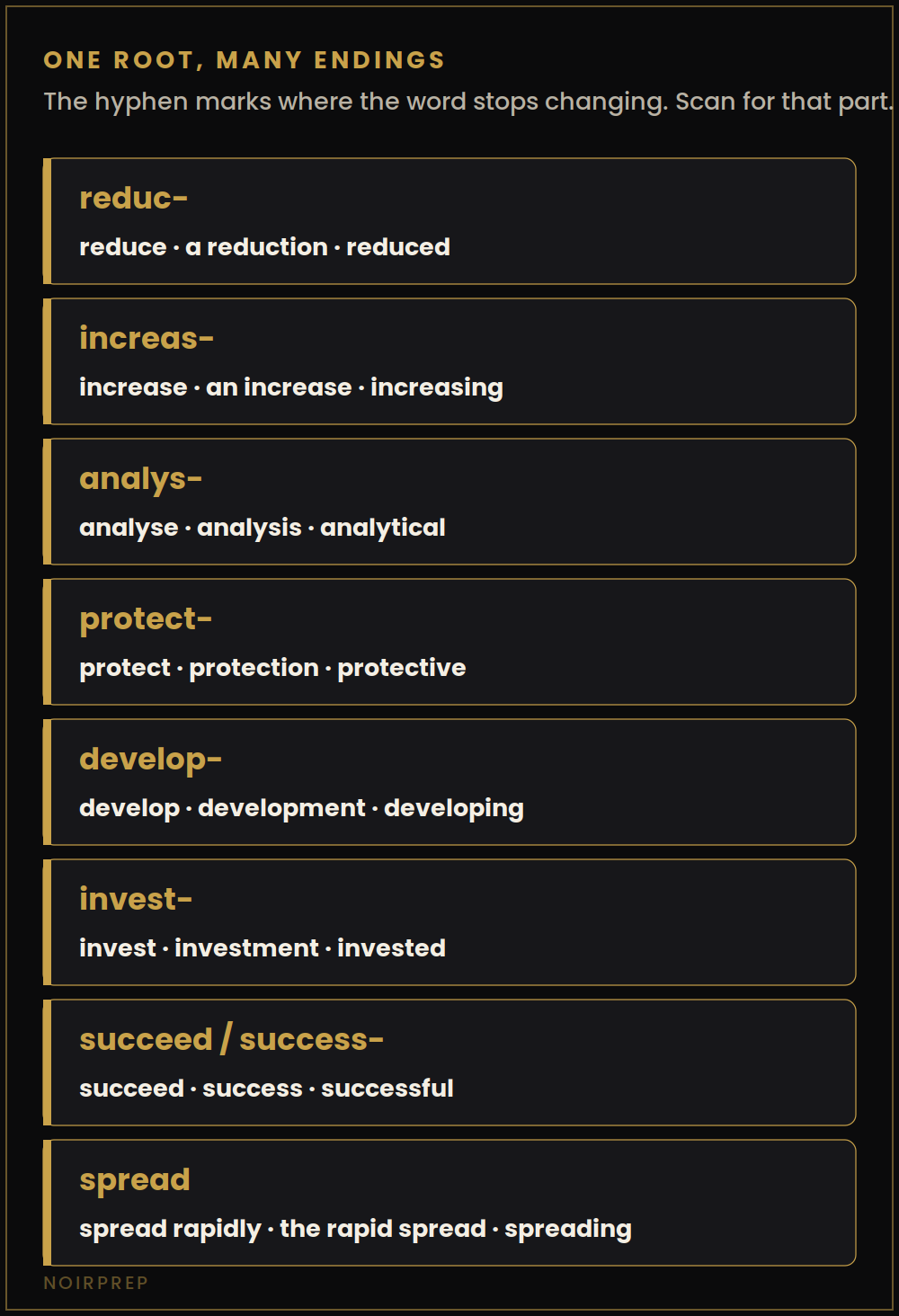
Read that list in both directions. IELTS moves from noun to verb roughly as often as it moves the other way, so your eye needs to travel comfortably either route.
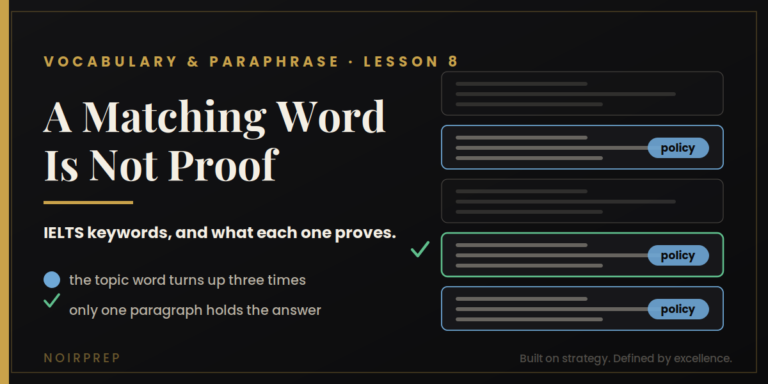
One caution while you build these families. Words that sit near a root are not the same as forms of it. A passage about investment will also mention funding, capital and finance, and those words help you find the right paragraph quickly. They will not give you the answer. Funding is not investment, and treating the two as equal is how a confident reader lands on a wrong answer in exactly the right place.
Watch It Happen
Three lines follow. Decide each one before you look at the verdict.
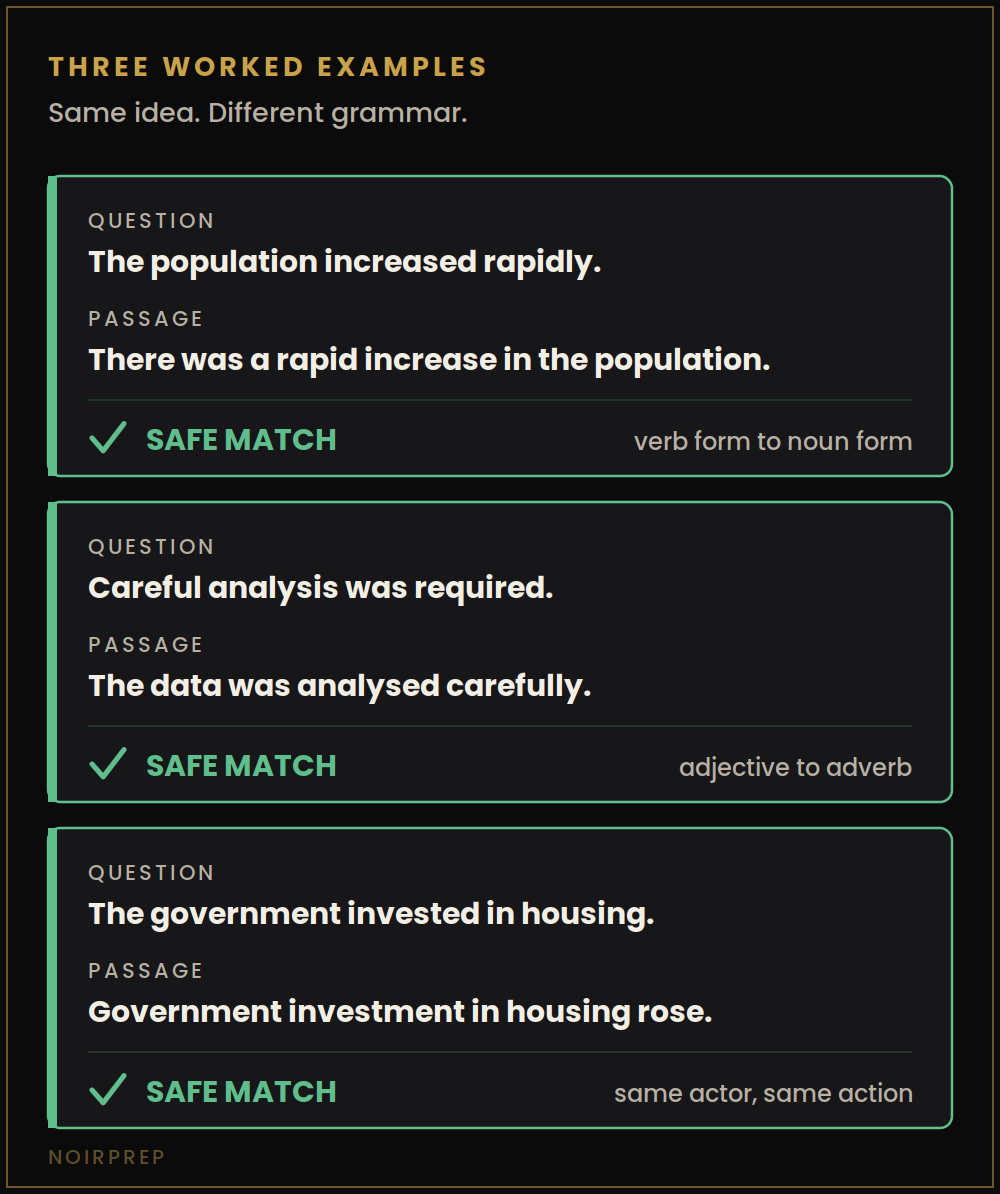
Notice what the first pair does. The question puts the action in a verb; the passage buries it in a noun and props the sentence up with there was at the front.
Those two words are worth learning as a signal. Very often they mark a noun doing the work a verb did in your question.
The second pair moves an adjective into a compound. Careful analysis and analysed carefully make the same claim, and only the word carrying the care has changed.
The third looks like grammar but is really a scope check. Government investment and the government invested do match. Watch what surrounds them, though. A shift in word class never changes who did what, and once the actor changes, the match is gone however familiar the root looks.
The Verb Is Doing Three Jobs at Once
This is where word-class work becomes genuinely dangerous, and where most candidates lose marks without ever realising why.
Every verb carries three pieces of information at the same time.
Action: what happened. Increased, reduced, caused, prevented, reported.
Time: when it happened. Increases is present. Increased is past. Has increased runs from past into present. Will increase has not happened yet.
Strength: how certain the writer is. May and might mean possible. Shows and indicates sit in the middle. Proves, must and always are definite.
Now think about what happens when a verb turns into a noun. The action survives the journey. Tense and strength can quietly vanish.
The study proved the theory and the study suggested the theory share a topic and share a shape. They are not the same claim, and they do not have the same answer.
Same topic does not mean same answer. Not if the verb has changed.
Where This Pattern Costs Most
Gap-fill questions punish word-class errors harder than anything else, because they ask you to produce the correct form rather than simply recognise it.
You find the right idea. You write it in. You lose the mark because the passage said investment and the sentence needed invest.
Your meaning was right. Your grammar was not, and gap-fill marks grammar too.
This is why the signals around a gap matter so much. An article before the gap points to a singular noun. A quantifier such as many or several points to a plural. Words like much, little or a great deal of point to an uncountable noun, and IELTS leans on a small set of these: information, research, evidence, advice, equipment, traffic, luggage.
Those seven catch confident candidates every day. Informations and traffics are not words, yet they appear on answer sheets constantly.
The Five Steps for Gap-Fill
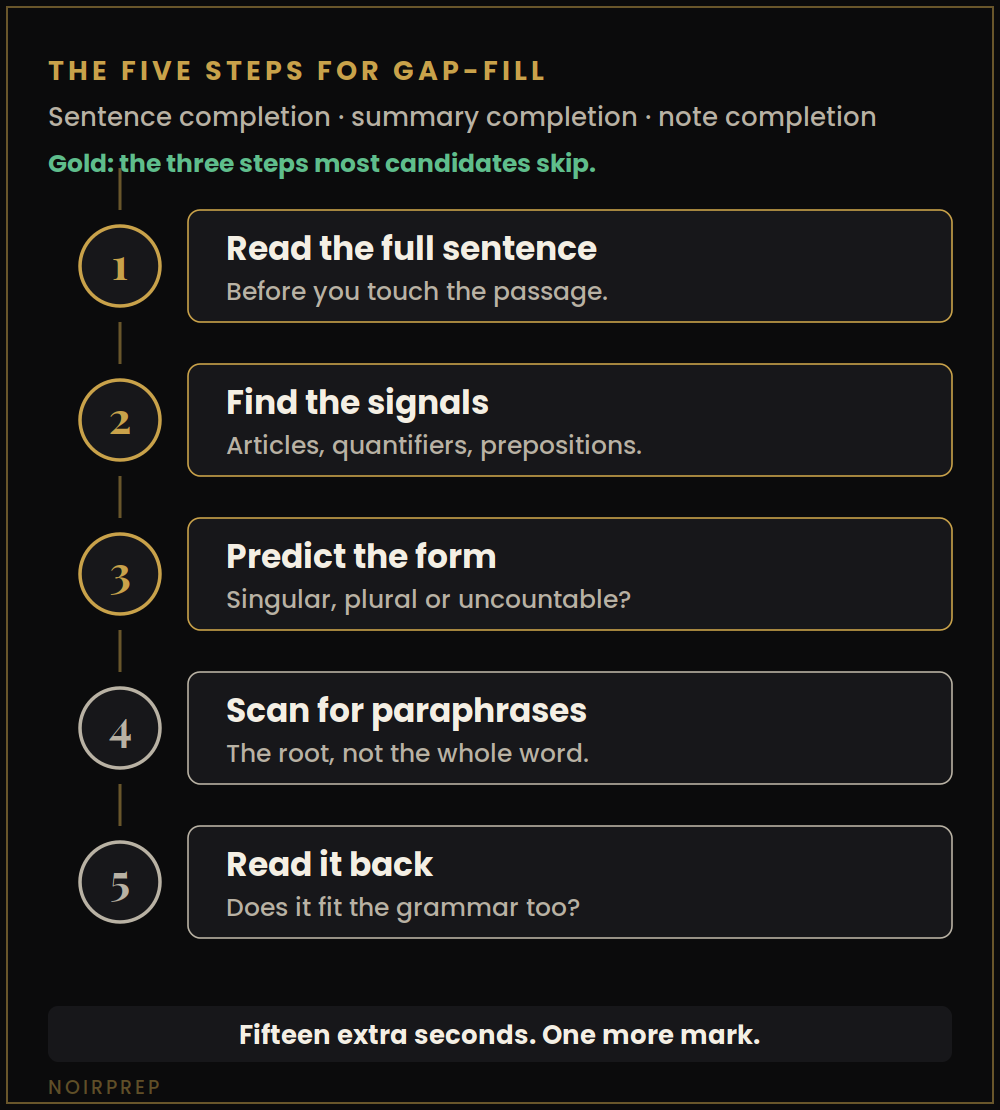
Use this sequence every time you meet a gap, in sentence completion, summary completion or note completion.
Read the full sentence first, before touching the passage. Identify the signals around the gap: articles, adjectives, prepositions, quantifiers. Predict the word class and the form you need. Scan for your keywords and their paraphrases. Finally, read the completed sentence back to yourself and check that it fits grammatically as well as logically.
Most candidates do steps four and five only.
Adding the first three costs around fifteen seconds a question and prevents the most common lost mark in the entire Reading paper.
IELTS Word Class Changes Outside Reading
Reading is where this shift is easiest to see. It does not stay there.
Listening speakers prefer verbs, almost without exception. A recording says they expanded the service where your question says the expansion of the service. Conversation runs on verbs; academic writing runs on nouns. That single fact tells you which direction the shift will travel, and lets you predict before the audio begins.
Writing Task 1 rewards the same flexibility. A candidate who can only produce the number increased writes that structure eight times in one report. A candidate comfortable with IELTS word class changes reaches for a sharp increase, the figure rose, growth continued, and the examiner sees range instead of repetition.
Speaking benefits more quietly. Moving between forms lets you rephrase mid-sentence when you get stuck, rather than stopping dead.
A Ten-Minute Drill
Open any practice passage and answer nothing at all.
Instead, find ten nouns that were built from verbs. Increase, reduction, development, analysis, protection, and their like. Write the verb beside each. Then add the adjective, if one exists.
You will end up with rows such as: protect, protection, protective. Or analyse, analysis, analytical.
Fifteen roots treated this way beat fifty isolated vocabulary items, because every root hands you three or four forms and IELTS will use whichever one suits its sentence.
Then the Harder Words
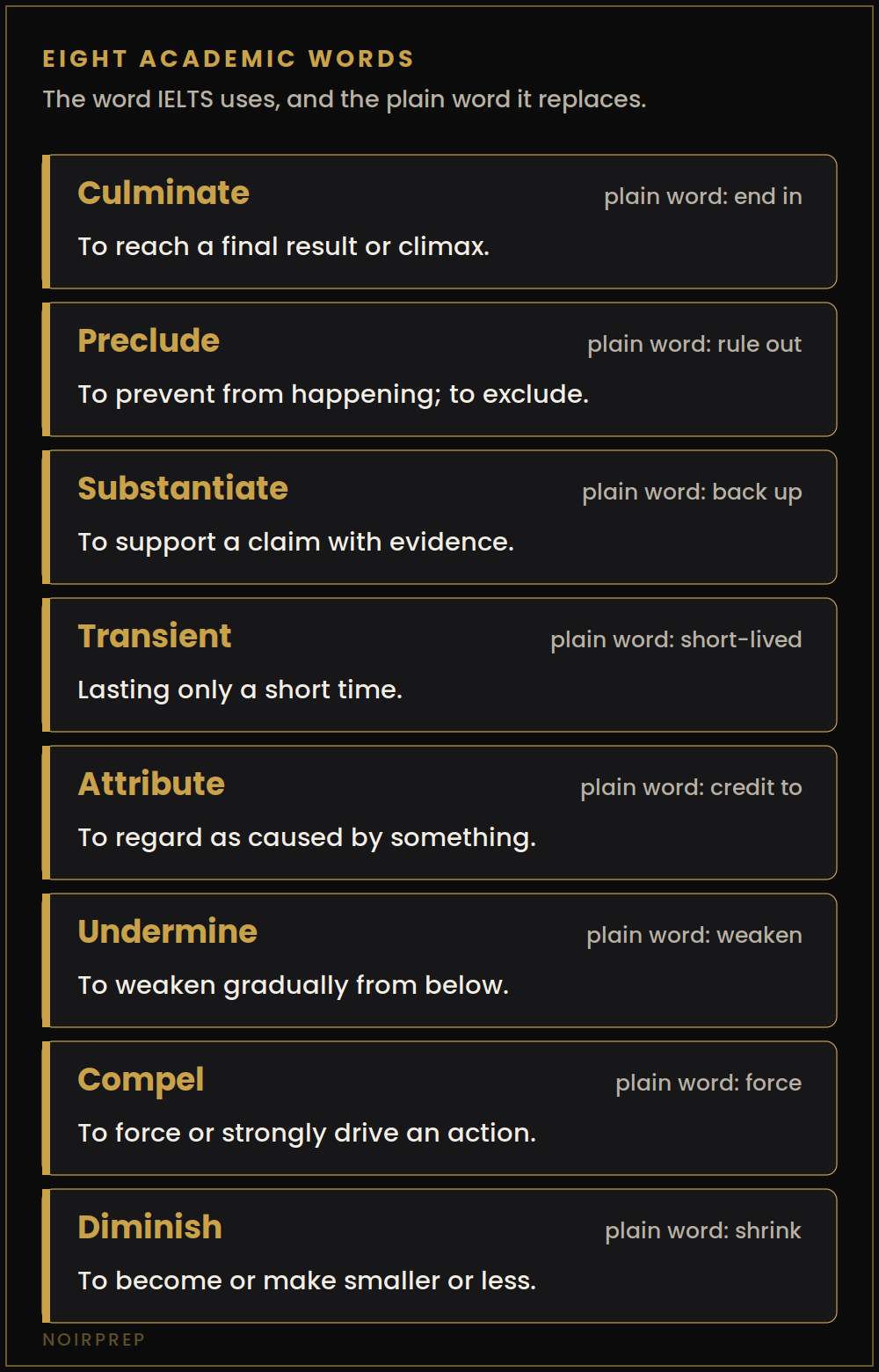
Cover the meanings and recall each word from the word alone. Then write one sentence using it, and a second using a different form of the same root.
Sixteen short sentences. Your eye will begin catching these shifts on its own.
One Warning
Not every change of form is a safe match.
An increase in unemployment and unemployment increased are the same claim. But the failure of the policy and the policy failed can differ, if the passage pins that failure to something narrower, such as one part of the policy or one region.
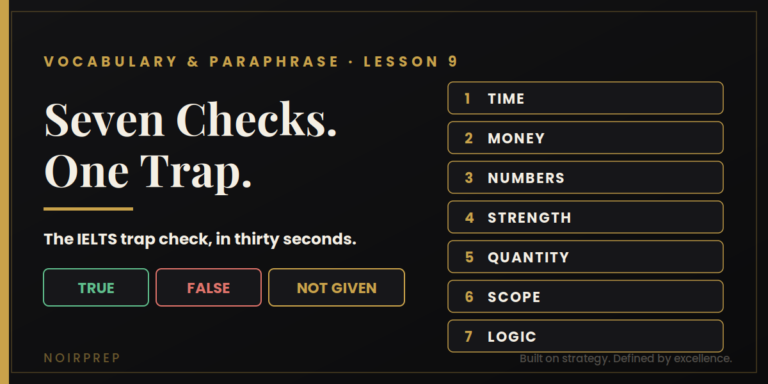
A word-class shift never changes the actor, the time, the quantity or the strength. Where any of those move, you are not looking at Pattern 3 any more.
The NoirPrep Rule: the ending can change freely. The root, the actor and the claim cannot.
Where to Go Next
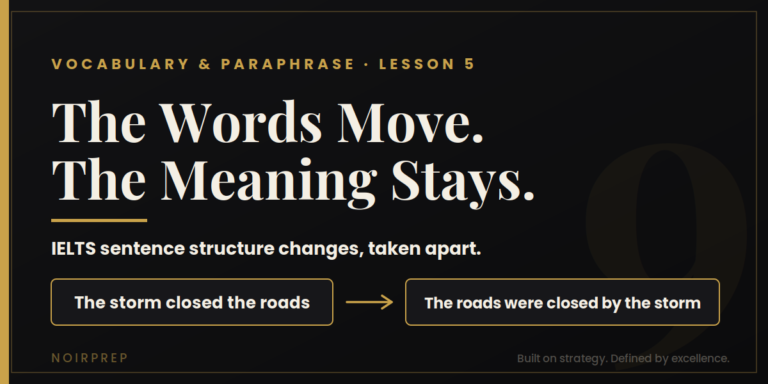
Pattern 4 reorders the sentence entirely. The storm caused road closures becomes roads were closed because of the storm.
Cause and effect swap places. The grammar rearranges itself. The meaning stays exactly where it was.
Candidates who read left to right, matching sentence shapes as they go, find that pattern harder than anything we have met so far.