IELTS Speaking Topics: What to Say When You Know Nothing

Should governments invest in space exploration?
The question lands, and for a second there is nothing in your head at all. You have never thought about space exploration, you could not name a single space program, and the silence has already begun.
Almost every candidate meets a moment like that one, and almost every one of them draws the wrong conclusion from it. They decide the problem is that they did not know enough, so they go home and start reading about museums, the environment and the news, trying to become informed on everything an examiner might raise.
That preparation is wasted, because IELTS speaking topics are not a knowledge test. The examiner is not checking what you know. What is being checked is whether your English stays clear, organized and flexible when you are put under pressure, which is an entirely different thing.
Why IELTS Speaking Topics Are Not a Knowledge Test

Four questions run through an examiner’s mind while you speak, and not one of them is about your facts.
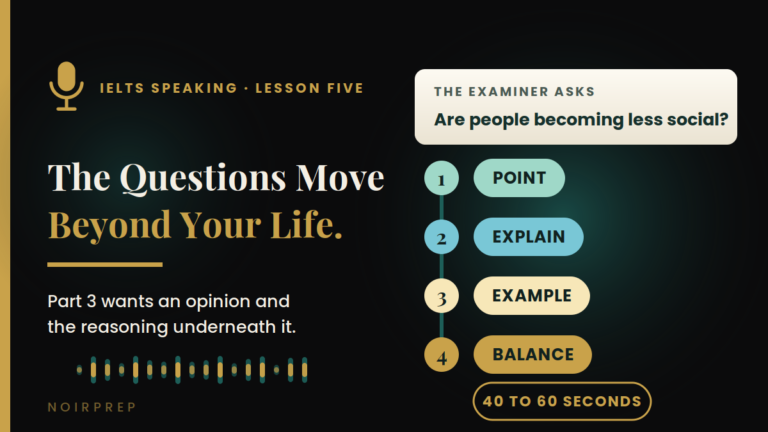
The first is whether you can think logically rather than simply react. The second is whether you support an opinion with a reason instead of merely asserting it. The third is whether you can generalize beyond yourself and talk about people and society rather than only your own life. The fourth is whether you can balance an idea instead of taking an extreme position and defending it.
Here is the part most candidates never hear. Your answers are allowed to be creative. As long as what you say is believable, realistic, consistent and logically built, it does not matter whether it happened. You can reach a high band having never visited a museum and never followed the news in your life.
That should take a great deal of pressure off you. Nobody is asking you to be informed about the IELTS speaking topics that come up, only to be coherent about them.
Never Say “I Do Not Know”

Those four words end an answer before it has started, and there is no way back from them. The examiner cannot help you, cannot rephrase the question into something easier, and has no choice but to move on to the next one. A Part 3 answer is worth forty to sixty seconds of assessable speech, and saying you do not know throws all of it away on a question that was never about knowledge in the first place.
Four openers solve the problem, and each one buys you a few seconds of thinking time while sounding thoughtful rather than lost. Use one line only, then move straight into your answer.
“I am not an expert on this, but in my opinion…”
“I do not know a great deal about it, however I think…”
“That is an interesting question. I have not thought about it deeply, but…”
“I am not completely sure, but I would say…”
Notice what each of those does. It admits the gap honestly, which costs you nothing, and then it commits to a position anyway. Admitting uncertainty is not a weakness in this test, provided you follow it with something.
Five Steps for IELTS Speaking Topics You Know Nothing About
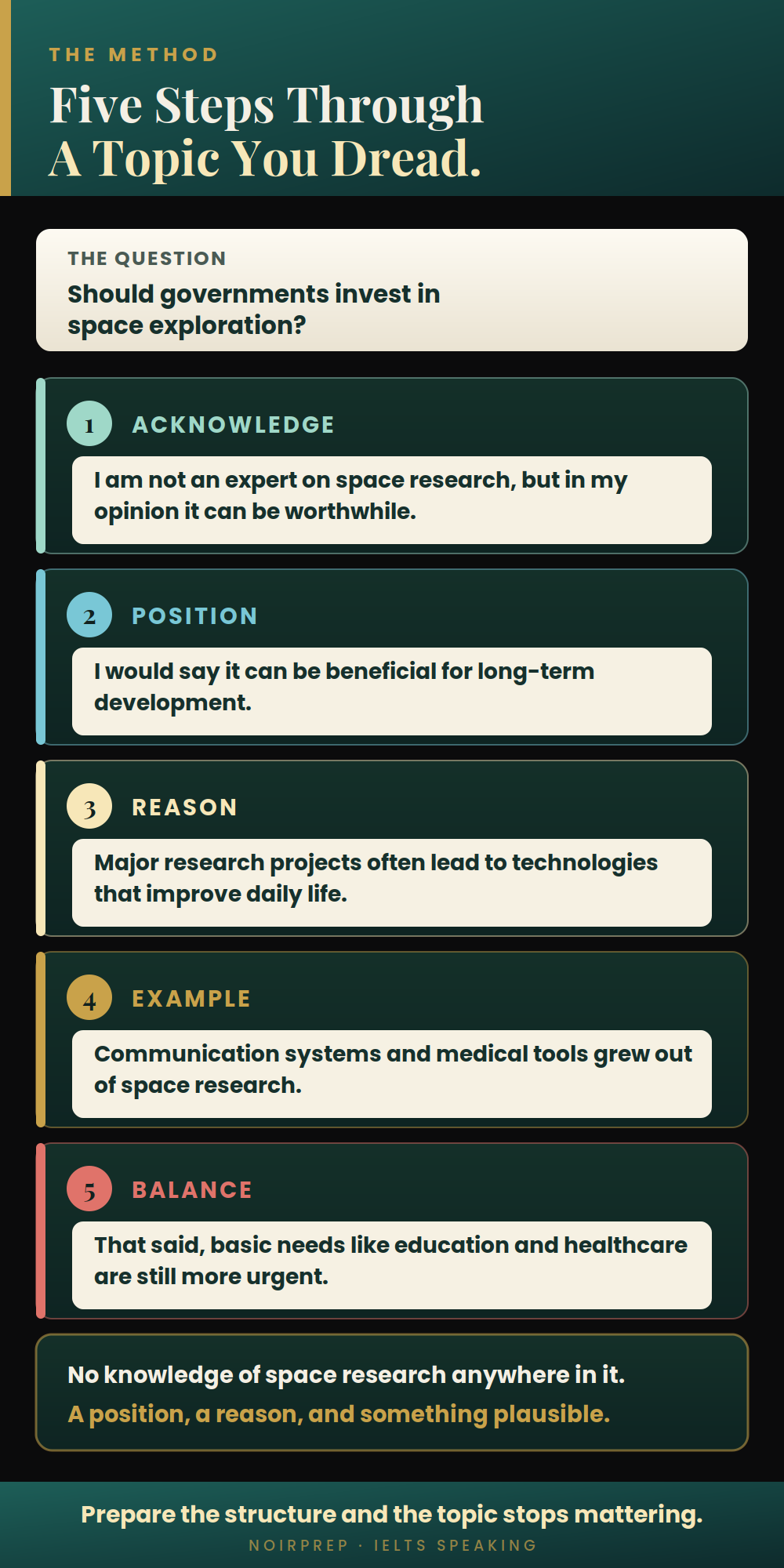
When a question catches you out, five steps will carry you through it, and the first of them is the one that makes the other four possible.
Acknowledge comes first, and it is one line only. Use any of the four openers above.
Position follows immediately. State your view, even a cautious one, because an answer without a position has nowhere to go.
Reason comes third, and one strong reason is worth more than three weak ones.
Example is fourth. Keep it realistic and brief, and remember that a plausible everyday situation works better than a statistic you cannot support.
Balance closes the answer with the other side, an exception or a condition.
Those five steps turn a question you were dreading into an ordinary answer. Here is one of the hardest questions in circulation, answered by somebody who knows nothing about the subject.
Question: Should governments invest in space exploration?
Acknowledge: “I am not an expert on space research, but in my opinion it can be worthwhile.”
Position: “I would say it can be beneficial for long-term development.”
Reason: “Major research projects often lead to technologies that improve daily life.”
Example: “Communication systems and medical tools we use today grew directly out of space research.”
Balance: “That said, it has to be balanced. In many countries, basic needs like education and healthcare are still more urgent.”
Nothing in that answer required knowledge of space exploration. It required a position, a reason, something plausible, and an acknowledgment that the money could go elsewhere.
Five Ways to Add Depth to Hard IELTS Speaking Topics
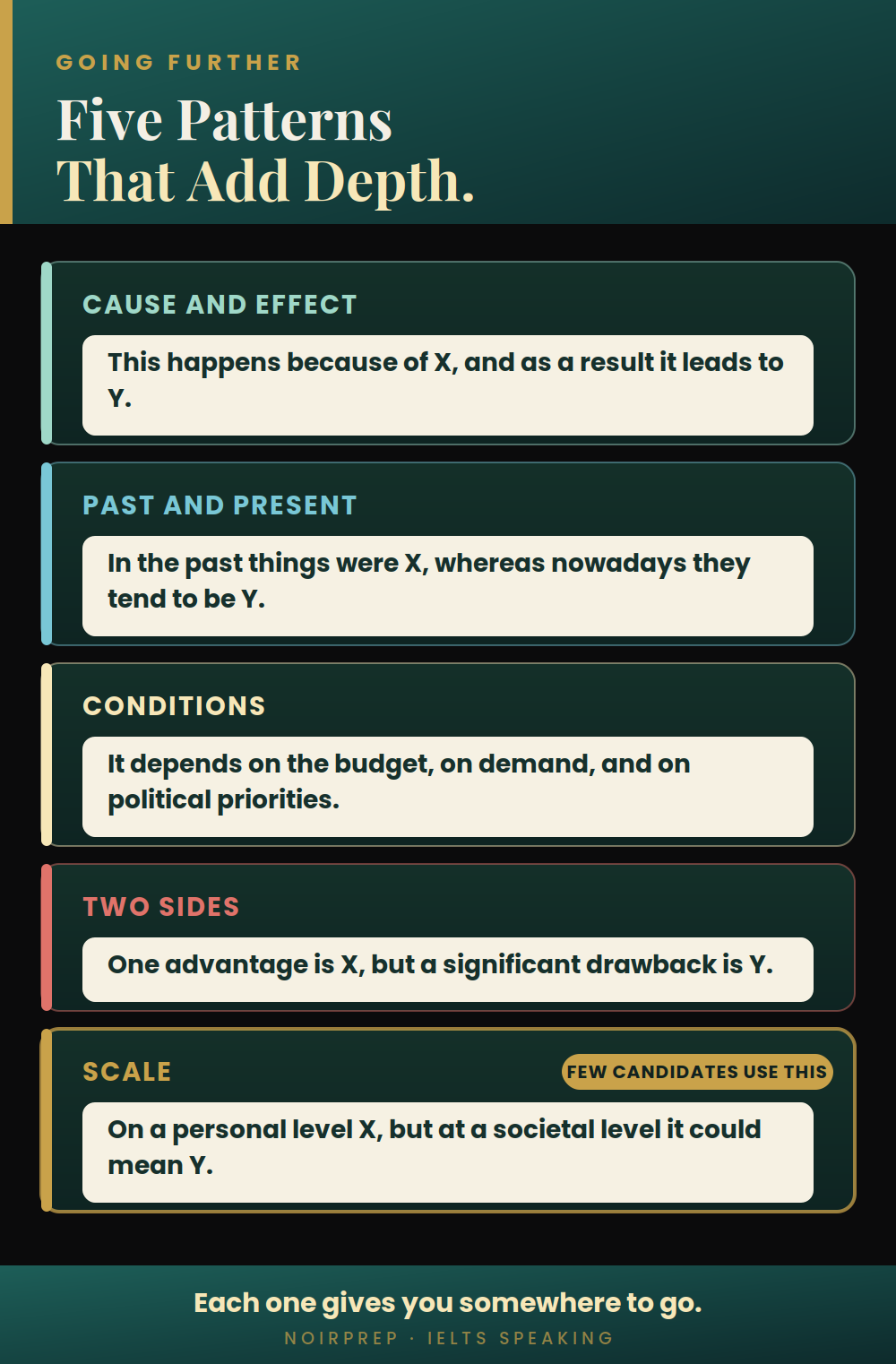
Once the five steps are familiar, these patterns are what lift an answer from adequate to advanced, and they work on any of the IELTS speaking topics you are likely to meet. Each one gives you somewhere to go when you feel an answer closing too early.
Cause and effect is the first. This happens because of one thing, and as a result it can lead to another.
Past against present is the second, and it suits any question about change. In the past things were one way, whereas nowadays they tend to be different.
Conditions make the third, and they are useful when the honest answer is that it varies. It depends on the country’s budget, on public demand, and on political priorities.
The two-sided pattern is the fourth. One advantage is this, but a significant drawback is that.
Scale is the fifth and the most impressive of them, because it separates the individual from the society. On a personal level something saves time, but at a societal level it could reduce human connection.
That last pattern is worth practicing on its own. Very few candidates use it, and an examiner notices immediately when somebody can move between the personal and the general inside a single answer.
A Second Example, With Less Hedging

Not every unfamiliar question needs an acknowledgment at the front. When you have some sense of the subject, start at the position instead and keep the other four steps.
Question: Is online learning better than classroom learning?
Position: “I think both can be effective, but it depends on the learner.”
Reason: “Online learning is flexible, which helps adults with busy work schedules.”
Example: “Someone working full-time might prefer short online lessons to attending classes in person.”
Balance: “However, classroom learning can be better for discipline and motivation, because real-time feedback and structure are difficult to replicate digitally.”
That answer takes about forty-five seconds and contains no specialist knowledge whatsoever. It has a position, a reason, a believable example and a genuine counterpoint, which is all that was ever being asked for.
What to Practice This Week
Take these five questions, all of them on subjects most candidates have never considered.
- Should governments spend money on space exploration?
- Do museums still matter in the age of the internet?
- Is tourism good for a country’s culture?
- Should companies be responsible for their employees’ health?
- Will printed books disappear in the next fifty years?
Work through them out loud with the five steps, recording as you go, and hold each answer to sixty seconds at most.
Play the recording back and check three things. Did you acknowledge the gap in one line and then stop apologizing? Did a clear position arrive within the first ten seconds? And did you reach a balance at the end, or did the answer simply run out?
Then take the weakest answer and record it again, adding one depth pattern from the five above. Scale is the one to try first, because it is the one that will be missing.
The point of all this is to stop preparing topics. There are thousands of them and you will never cover enough. Prepare the structure instead, and the topic stops mattering.