The IELTS Reading Format: What the Test Is Actually Measuring
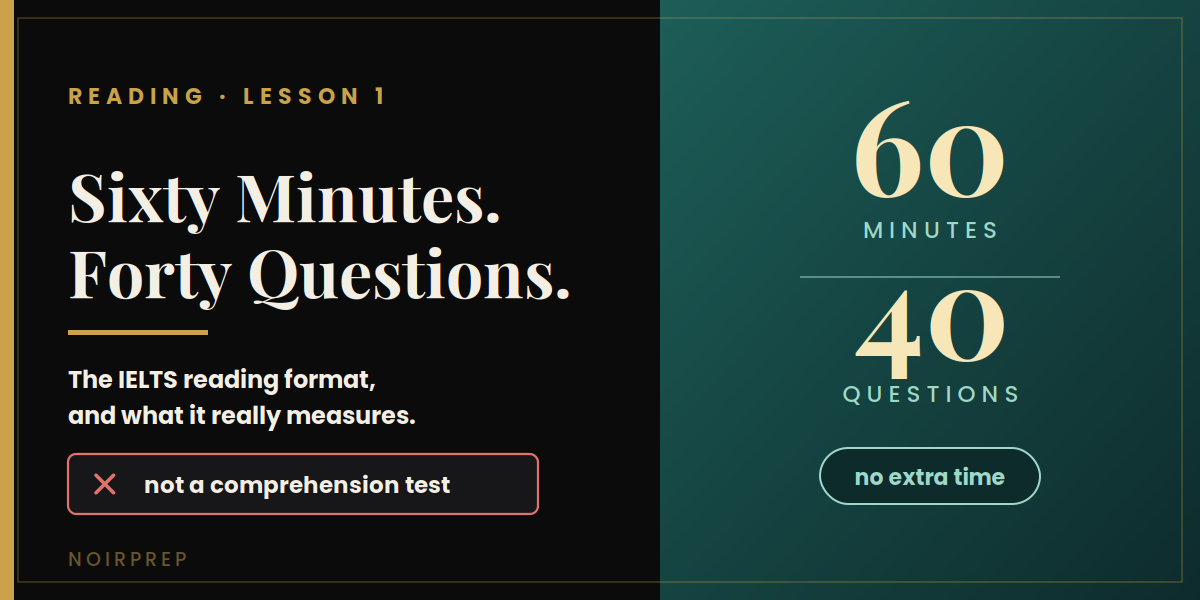
The IELTS reading format gives you sixty minutes to answer forty questions, and no extra time at the end to copy your answers onto a separate sheet. Those numbers matter more than they first appear, because they tell you what is really being measured. You are not being asked whether you understood three passages. You are being asked how many correct answers you can produce inside a fixed hour, and those are two very different things.
Most candidates prepare for the first one and then sit the second one.
What the IELTS Reading Format Gives You
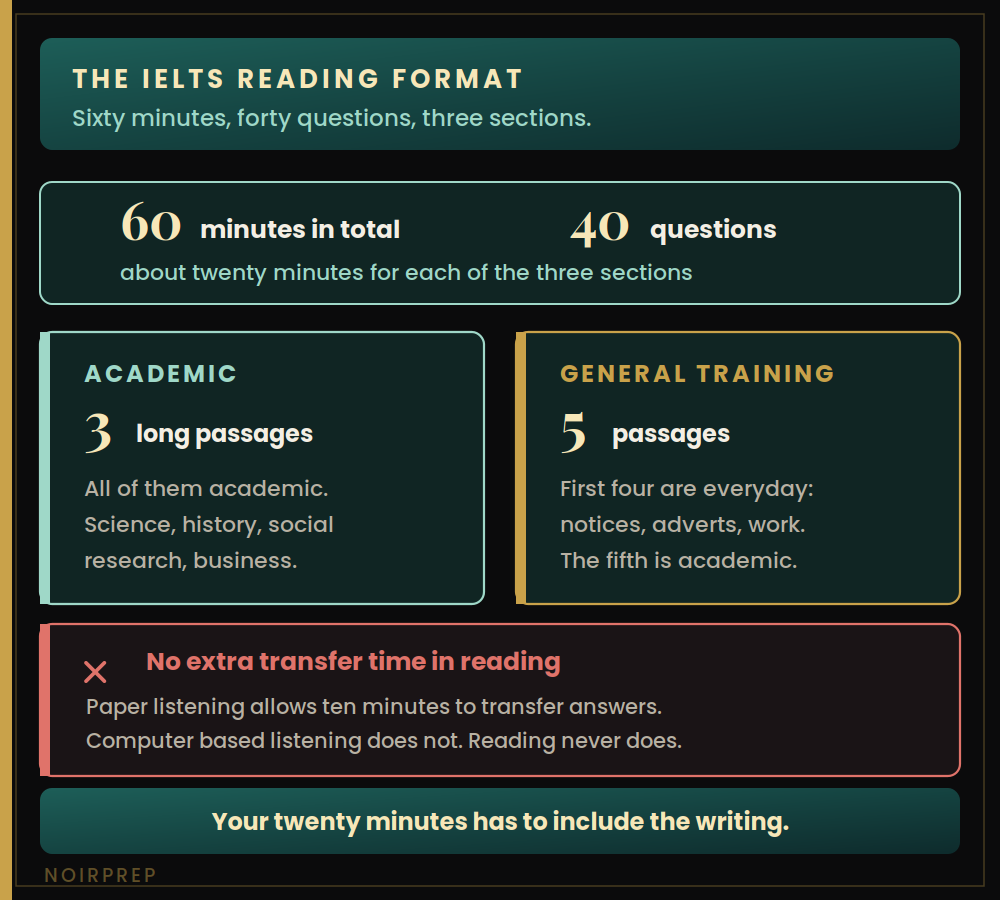
The test runs for sixty minutes and contains forty questions. What you actually receive depends on which version of the test you registered for.
Academic candidates are given three long passages, and all of them deal with academic subject matter. You might find science, history, social research or business writing, the kind of material that would appear in a serious magazine or a university reader.
General Training candidates are given five passages instead. The first four deal with everyday social issues such as notices, advertisements and workplace documents, while the fifth is long and academic, much like the passages in the Academic test.
In both versions the paper is divided into three sections, and each section should take you about twenty minutes. Nobody announces when your twenty minutes are finished, so you have to manage that yourself. This is the reason the clock defeats so many candidates who would have answered every question correctly if you had given them an afternoon to do it.
It Is Not a Comprehension Test
This is the single most important thing to understand before you go any further, because almost everything else in this series follows from it.
IELTS Reading is not a reading comprehension test.
You already know what a comprehension test looks like, because you met them in school. You read a passage, you understood it, and then you answered questions about what you had understood. The reading came first, the questions came second, and the reading was thorough.
IELTS turns that around completely. The questions come first. You read with a target already in your head, you locate the small section that holds your answer, and then you read that section properly. Everything else in the passage can remain unread and it will not cost you a single mark.
Candidates who treat the test as comprehension read all three passages slowly and carefully before they look at anything else. By the time they reach the questions they are tired, the details have started to fade, and the final section gets rushed. This is not a vocabulary problem. It is a method problem, and it is completely fixable.
What the Test Is Really Measuring
There are two things being measured at the same time, and you need both of them.
Accuracy is the number of answers you get right. Speed is the number of questions you actually reach inside the hour. A candidate with perfect accuracy who only gets to question thirty finishes in the same place as a candidate who rushed through all forty and got ten of them wrong.
Underneath both of those sits something more specific. Your accuracy and your speed depend almost entirely on three things, which are your grammar, your vocabulary and your power of interpretation.
Your grammar tells you what kind of word is allowed to fill a gap. Your vocabulary allows you to recognize an idea when the passage has worded it differently. Your interpretation allows you to work out what a paragraph is doing, rather than simply what it says. If any one of those three is weak, the weakness will show up as lost marks, and it will usually show up in one particular question type rather than spread evenly across the paper.
Why Candidates Lose Marks in IELTS Reading
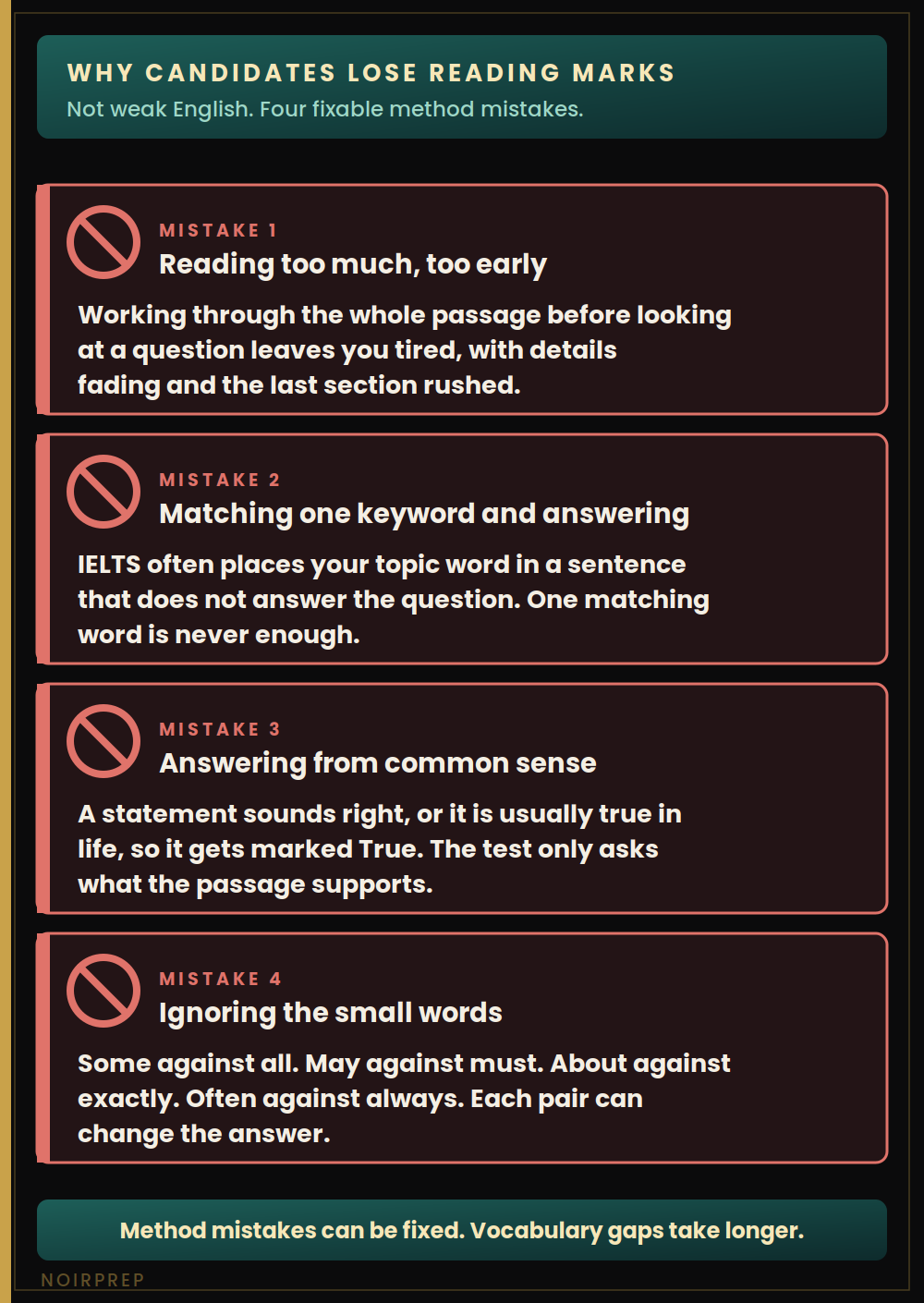
This is the part worth studying carefully. Most students who score below their target are not failing because their English is weak. They lose marks because of specific method mistakes, and method mistakes can be corrected in a way that vocabulary gaps cannot.
The first mistake is reading too much, too early. Some students work slowly through the entire passage before they look at a single question, which leaves them tired, with the details already fading and the last section rushed. The correct approach is to read with a purpose. Know the question first, locate the likely area, and then read that section carefully.
The second mistake is matching one keyword and answering. Seeing one familiar word and choosing an answer immediately feels efficient, but it is dangerous. IELTS regularly places your topic word inside a sentence that does not answer the question at all. One matching word is never enough, and you should always compare the full meaning of the statement against the full meaning of the passage.
The third mistake is answering from common sense. This one is most common in True, False and Not Given. Students think that a statement sounds right, or that it is usually true in real life, so they mark it True. But IELTS never asks what is true in real life. It asks only what the passage supports.
The fourth mistake is ignoring the small words. Consider the difference between some and all, between may and must, between about and exactly, between often and always, or between however and therefore. Each of those pairs can change an answer completely, and each one is easy to read straight past while your eyes are busy hunting for the big topic nouns.
One Rule That Saves You Minutes
There is something the IELTS reading format does consistently that almost nobody explains in a first lesson.
For most question types, the answers appear in the passage in the same order as the questions.
True, False and Not Given follows this rule. So do sentence completion, note completion, summary completion and multiple choice. If you found the answer to question four in paragraph C, then the answer to question five will be in paragraph C or somewhere after it. It will never be back at the beginning.
That single fact cuts your search area roughly in half on every question after the first one, and it puts an end to the most wasteful habit in the test, which is re-scanning the passage from the top each time you start a new question.
One question type breaks the rule, however, and you need to know which one it is. Matching information to paragraphs does not follow sequence, because the questions are taken from the paragraphs at random. The answer to question one might sit in paragraph E while the answer to question two sits in paragraph A. Treat that question type as a separate job with its own method, which we will cover later in this series.
Everywhere else, work forwards, and never search backwards unless you know you have made a mistake.
The Four Techniques That Replace Ordinary Reading
Because the test rewards reading the right part at the right depth, strong candidates do not read in one single way. They switch between four techniques depending on what the question in front of them actually needs.
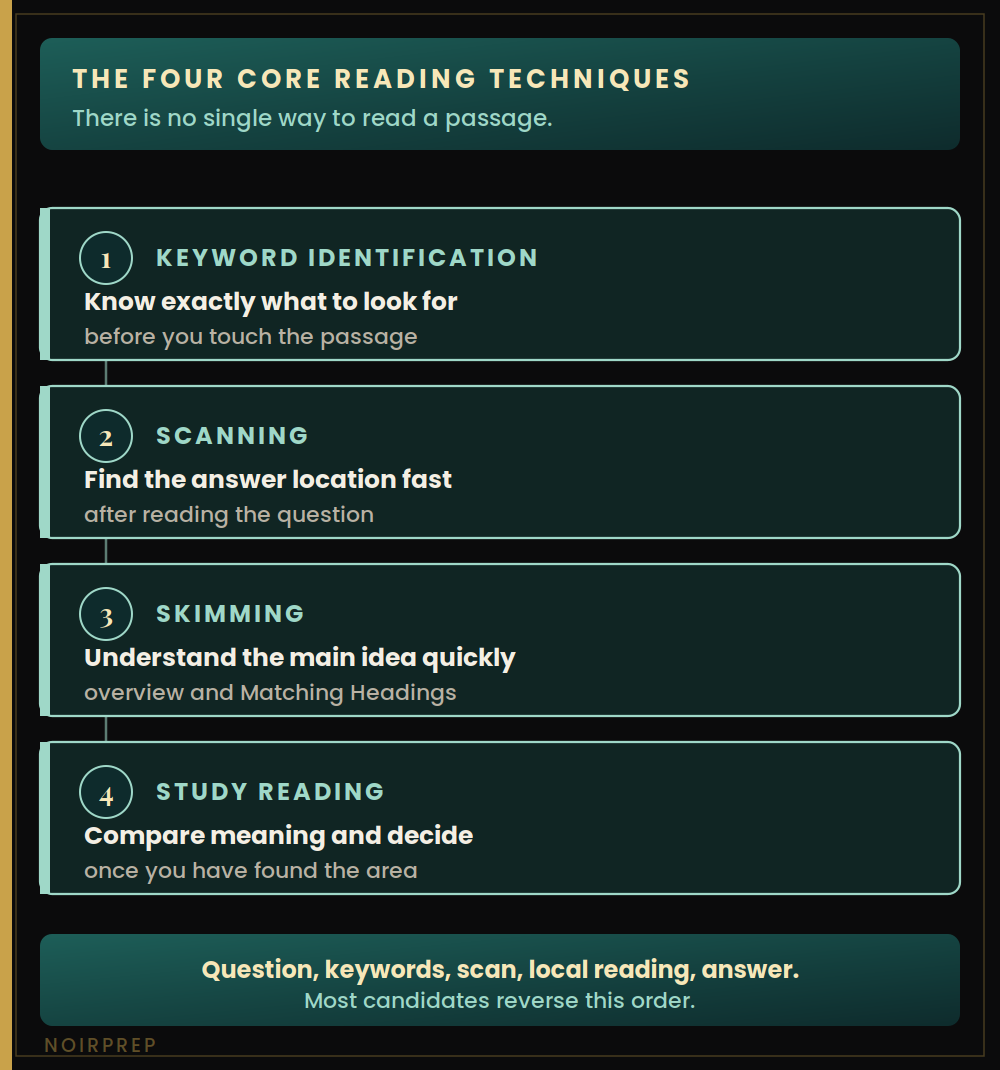
Keyword identification happens inside the question, before you look at the passage at all. You pick out the words that carry the real information, which are usually words whose meaning you already know. In practice this becomes your first vocabulary test of the hour.
Skimming moves quickly across the passage to pick up its structure and the general shape of each paragraph. It tells you roughly where things live, and it will never hand you an answer.
Scanning is the search. You hunt for your keywords, or more often for their synonyms, and your eyes move quickly and deliberately because you are looking for one thing rather than reading sentences.
Study reading is the slow one. Once scanning has placed you in the right area, you read those few lines properly and compare them against the question. Every answer you choose should come from here, and if you cannot point to the lines that gave you the answer, you have not finished the question.
Most candidates own only two of these techniques, which are skimming and ordinary reading, and this is why their timing collapses. The technique that gets skipped most often is keyword identification, and skipping it means that everything afterwards becomes a hunt without a target.
What a Good Question Looks Like
When you put all of this together, a well managed question follows the same shape every single time.
You read the question first. You pull out the keywords. You predict what kind of answer you need and what other words might carry the same idea. You scan for those words or their synonyms, and you stop as soon as you find the area. You read that area slowly. You compare the full meaning of the passage against the full meaning of the question, small words included. Only then do you answer.
That whole sequence takes less than a minute once it becomes a habit. It will feel slow and laborious for the first week or so, which is exactly why most candidates give up on it and return to reading everything from the beginning.
Where This Series Goes Next
Understanding the IELTS reading format is the easy part. Everything that follows is about the question types, because each one needs a slightly different version of the sequence above.
The next lesson takes the three techniques in detail, since keyword identification, scanning and study reading are the engine of the entire test and most candidates are running them badly without realizing it.
After that we work through the question types one at a time, starting with True, False and Not Given, then matching information, matching headings, sentence and note completion, summary completion, multiple choice and finally inference.
For now, take one thing into your next practice paper. Do not read the passage first. Read a question, find its area, and read only that part. It will feel wrong for a while, and your score will go up.