IELTS Gap Fill: How to Know the Answer Before You Read the Passage
IELTS gap fill is the family name for every question that asks you to complete something using words taken from the passage. Sentence completion, note completion, summary completion and table completion all belong to it, and they all follow the same rules.
Most candidates answer them in the same way. They read the sentence with the missing word, they go to the passage, and they look for something that seems to fit.
There is a step missing before that, and it is the step that makes every IELTS gap fill question easier.
The previous lesson covered skimming and deep reading. This one covers the grammar that tells you what you are searching for before the search begins.
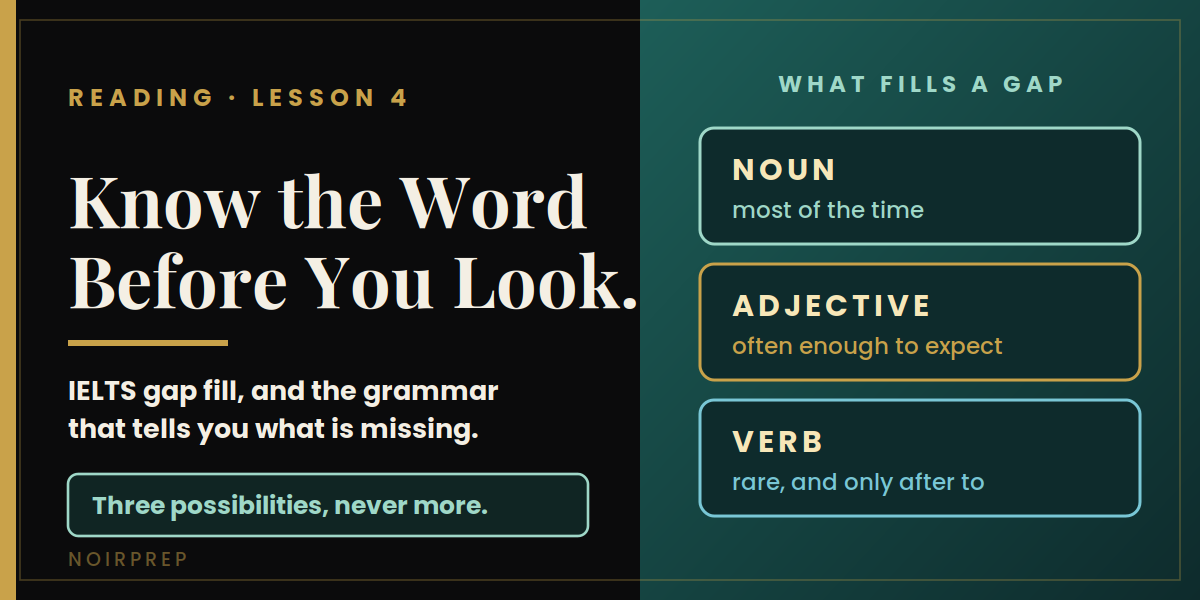
The grammar of the sentence around the gap already tells you what kind of word is missing. Once you know whether you need a noun, an adjective or a verb, you are looking for one particular kind of word rather than anything that might work. This is what turns completion tasks from guesswork into a controlled process.
Why Most IELTS Gap Fill Answers Are Nouns
Across all the completion question types in IELTS Reading, the majority of missing answers are nouns. There is a reason for this, and understanding it makes the strategy obvious.
A noun is the name of anything. It names a person, a place, a thing, a concept or a process. In academic writing, which is the language of IELTS passages, nouns carry the key information. Verbs supply the action, but nouns supply the substance. The examiner wants to test whether you located the right piece of information, and that piece of information is usually a noun.
Answers can also be adjectives. On rare occasions they can be verbs in the infinitive form. Those three possibilities cover nearly everything you will meet, which means your prediction is a choice between three options rather than a guess from the whole language.
Four Signals That an IELTS Gap Fill Answer Is a Noun
Before you go to the passage, read the sentence around the gap carefully. The grammar will tell you what is missing, and it does so through a small number of signals that appear again and again.
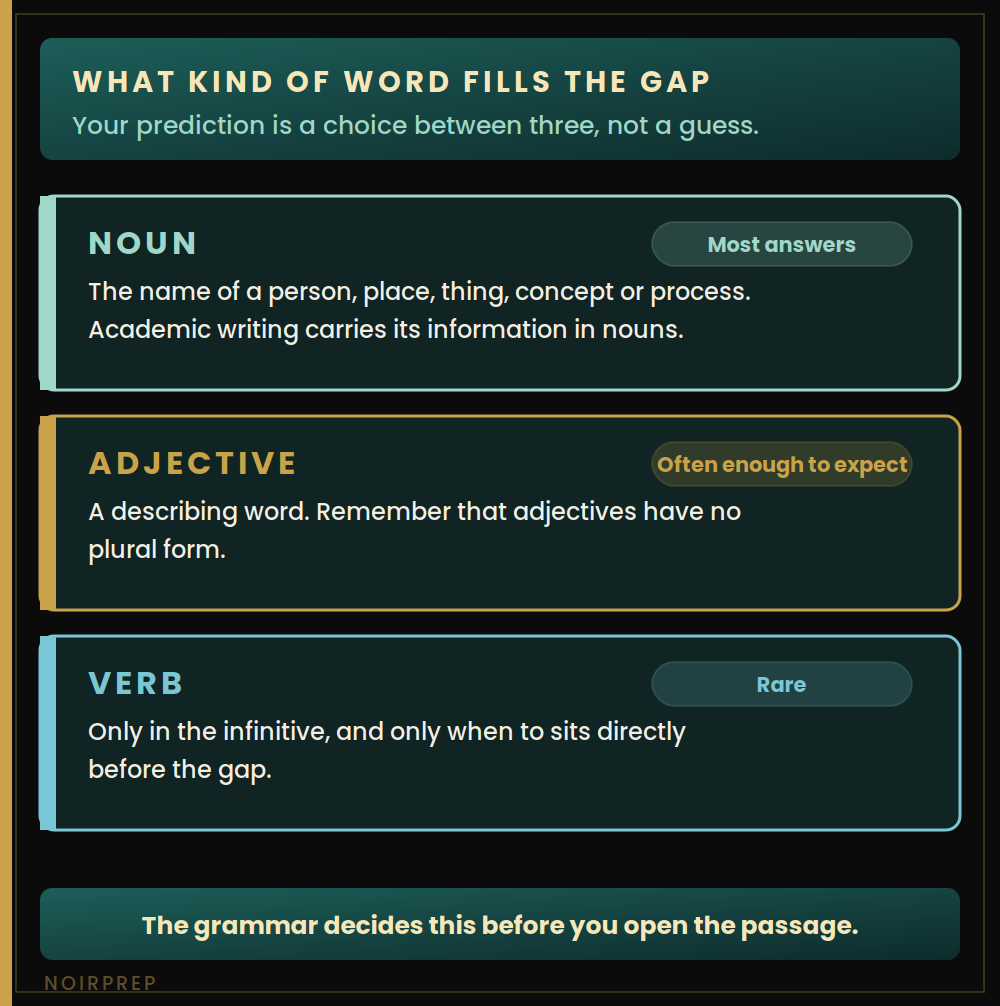
The first signal is an article or a determiner directly before the gap. Words such as a, an and the almost always introduce a noun. If a sentence reads that passengers must report to the blank, the answer is a noun, and probably a place.
The second signal is an adjective before the gap. Adjectives describe nouns, so an adjective sitting in front of a space is pointing directly at one. In the sentence two sensitive blank were presented during the meeting, the word sensitive is describing whatever is missing.
The third signal is a preposition. Nouns often follow prepositions such as in, at, with, by, over, across, beside, behind and opposite. Consider the sentence the keys are under the blank, or the passport was found inside the blank. An article usually appears after the preposition as well, which is a further sign that a noun is coming.
The fourth signal is the word of. When of connects two things, especially to show that one belongs to the other, both sides of it are nouns. The roof of the blank was damaged tells you immediately what kind of word you need.
The Three Jobs a Noun Does
Recognising the signal is enough to answer most questions. Understanding what the noun is doing in the sentence helps you check the answer afterwards.
A noun can be the subject of a sentence. This happens when the noun is the topic of the sentence or the performer of the action. Paris is the capital of France is an example. A subject noun answers the question what or who, and it can usually be replaced by a subject pronoun such as it, he, they or we.
A noun can be the object of the verb. Here the noun receives the action, as in the sentence the mechanic repaired the car. An object noun answers the question what or whom, and it can be replaced by an object pronoun such as it, us, them or him.
A noun can also work as an adjective and describe another noun. In the sentence the book cover was damaged during shipping, the word book is describing cover in the way an adjective would. A pronoun cannot replace a noun used like this, but the noun still answers the question what.
Notice that nouns take premodifiers such as articles, determiners and adjectives. This matters because those premodifiers are the signals themselves. When you see a terrible blank is born, the article and the adjective are both telling you the same thing.
When the Answer Is an Adjective
Adjectives describe nouns, and they appear as answers often enough that you need to recognize when one is required.
An adjective can sit in two positions, and its position changes the question it answers.
An attributive adjective comes before the noun it describes. In the sentence the committee announced new policies, the word new comes before policies. An attributive adjective answers the question which. Ask which policies, and the answer is the new ones.
A predicative adjective comes after the noun, usually joined to it by a verb such as is, was or seems. In the sentence the proposal was controversial, the word controversial comes after proposal. A predicative adjective answers the question what. Ask what the proposal was, and the answer is controversial.
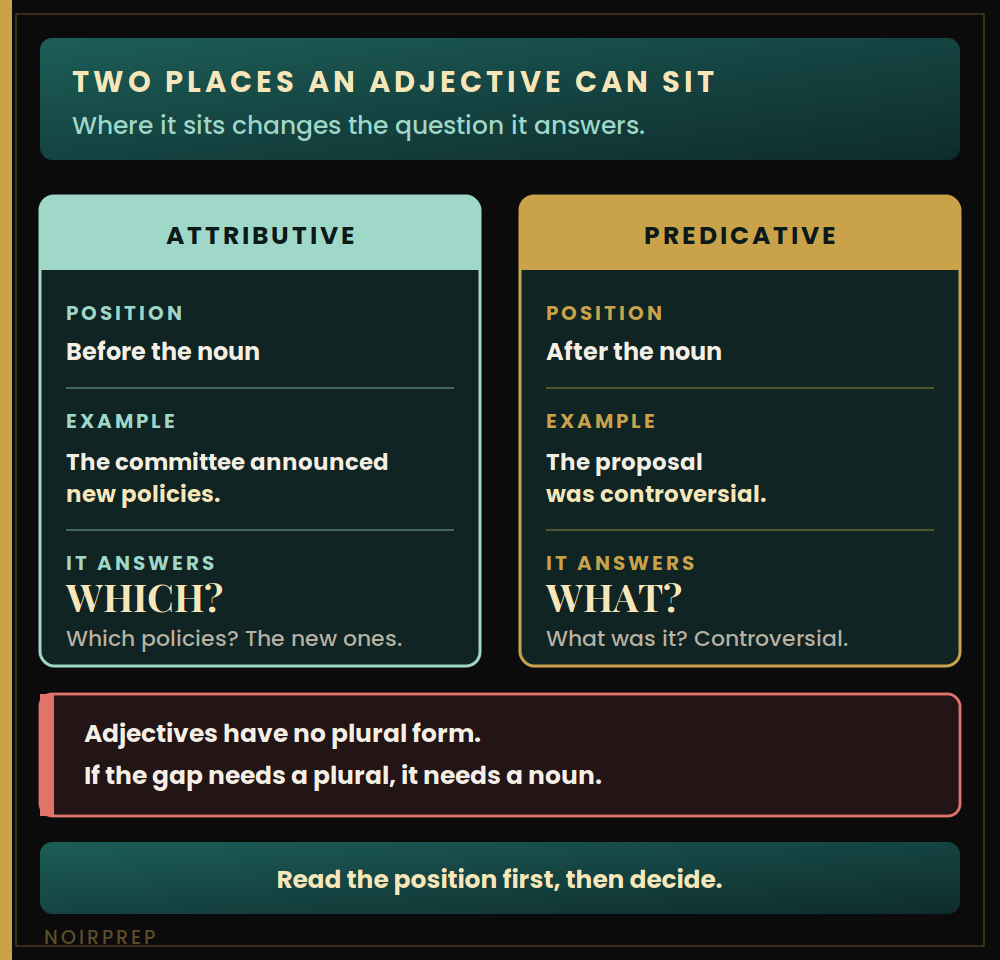
There is one more detail worth remembering. Unlike nouns, adjectives do not have plural forms. If the sentence structure shows that the answer must be plural, then you are looking for a noun and not an adjective. That single fact can remove a wrong answer you were about to write.
The IELTS Gap Fill Rule for Infinitive Verbs
On rare occasions the answer is a verb in the infinitive form, which means the base form of the verb, the version you would find in a dictionary.
An infinitive can only be the answer when the word to comes directly before the gap. Most candidates know this much. Fewer candidates know the second half of the rule, and the second half is the part that prevents the mistake.
The word to must be pointing at an action, not at a direction.
Compare these two sentences and notice the difference.
Passengers need to blank at least two hours before departure. Here the word to is pointing at an action, so the answer is a verb such as arrive.
Passengers must report to the blank. Here the word to is pointing at a place, so the answer is a noun.
Both sentences contain the word to, and only one of them wants a verb. A candidate who has learned only the first half of the rule sees to before a gap and writes a verb, which produces a wrong answer about half the time.
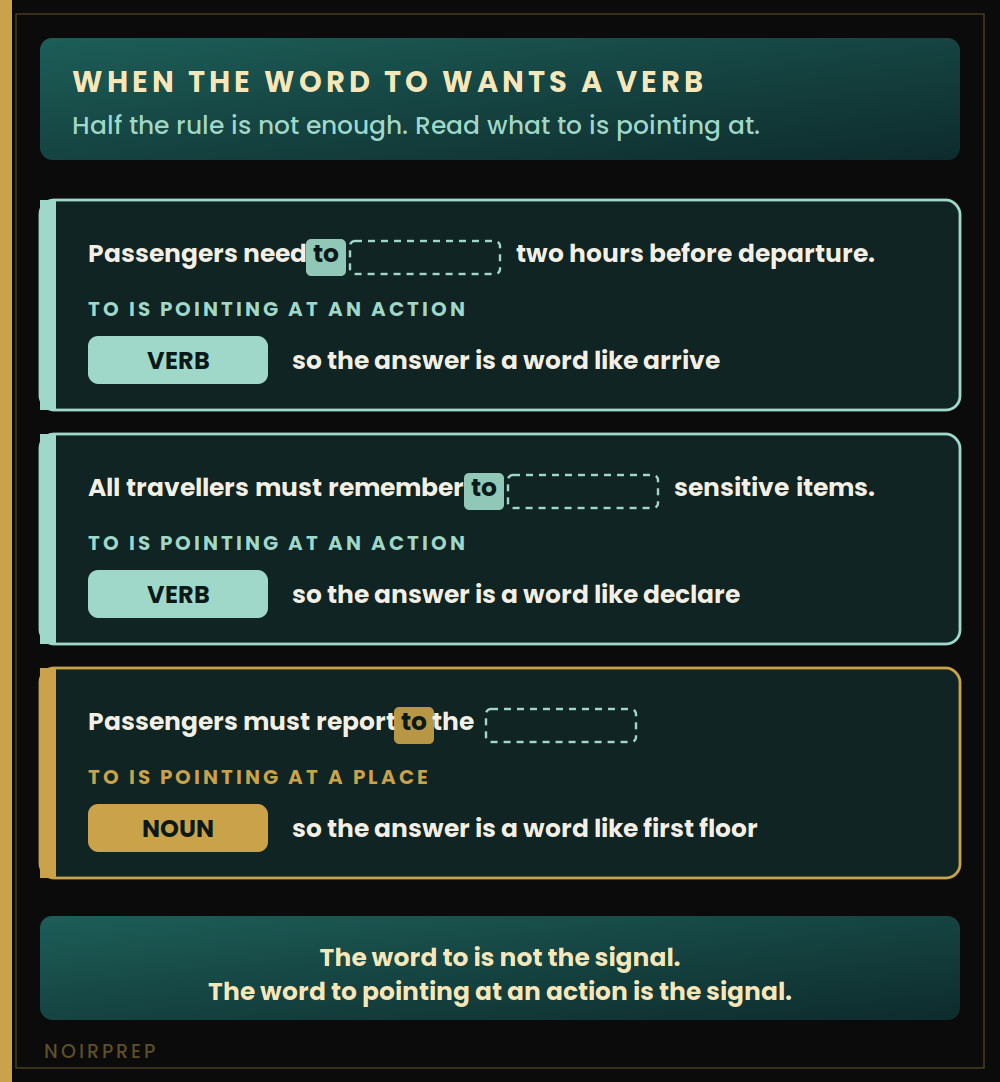
Here is one more example. All travelers must remember to blank sensitive items. The word to is pointing at an action again, so the answer is a verb such as declare. Reading which job the word to is doing takes about a second, and it saves you the mark.
Why Adjectives Matter Beyond IELTS Gap Fill
Adjectives deserve one more paragraph, because they matter well outside completion questions.
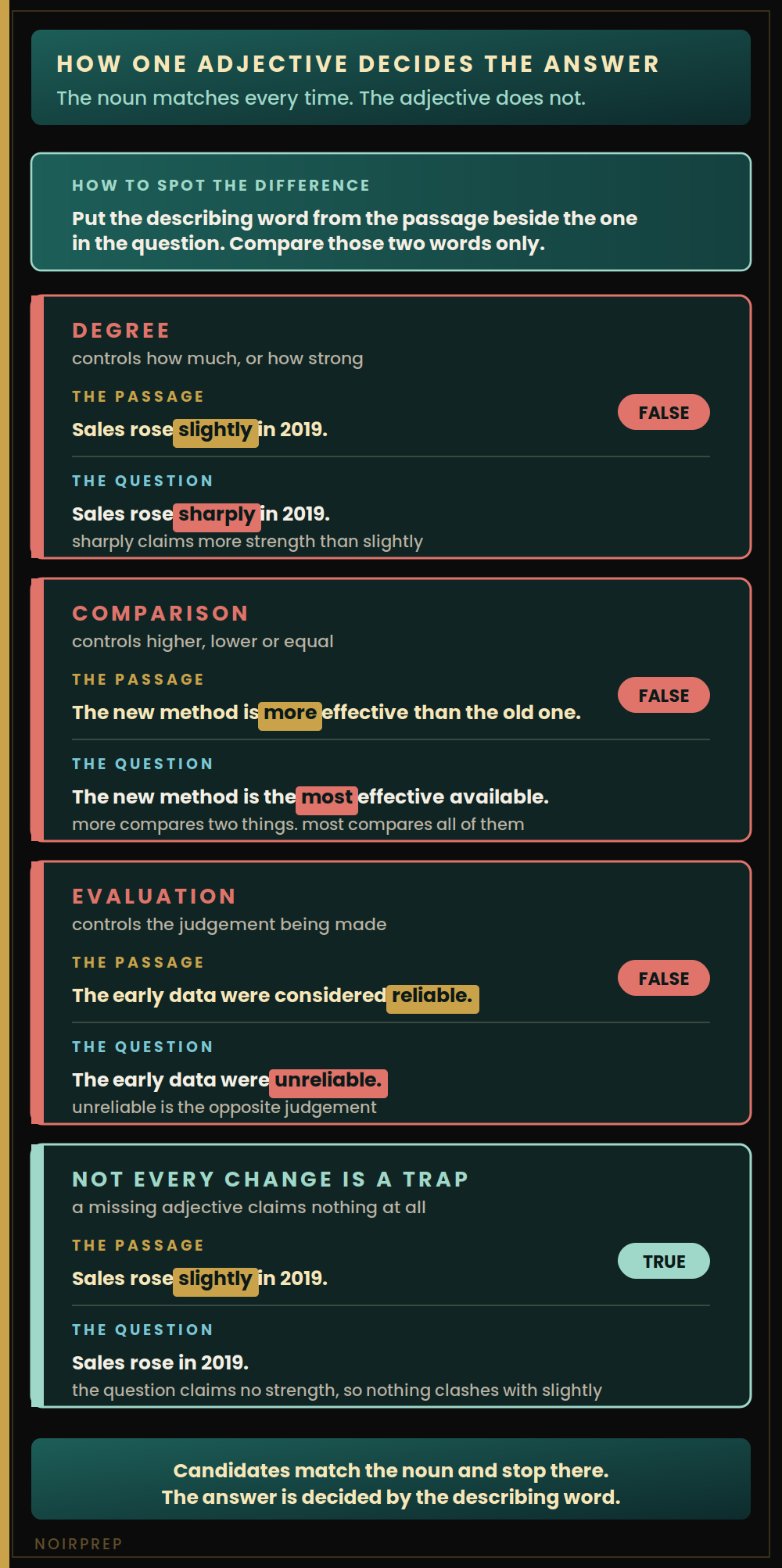
In IELTS Reading, adjectives control the degree, the comparison and the evaluation of a claim, and a single adjective can change whether a statement is True, False or Not Given. A slight increase and a substantial increase point the same way but make different claims. More effective and most effective are two different statements. Reliable and unreliable reverse each other completely.
Many candidates recognize the main noun in a statement and assume the statement matches the passage. The real difference is very often sitting in the describing word instead.
Putting IELTS Gap Fill Prediction Into Practice
When this becomes a habit, the first ten seconds of every completion question look the same.
Read the whole sentence containing the gap, not only the words beside it. Look at what sits immediately before the space and ask whether it is an article, an adjective, a preposition, the word of, or the word to. Decide from that whether you need a noun, an adjective or an infinitive verb. Decide as well whether a noun would be singular, plural or uncountable, using the determiners and the verb in the sentence as your guide.
Only then do you go to the passage, and you go there looking for one kind of word rather than for anything that seems relevant.
What to Do Before the Next Lesson
Take a practice paper, find a set of completion questions, and do not answer them.
Go through each gap instead and write beside it what kind of word must be missing, together with the reason. You might write noun, article before the gap. You might write noun, preposition before the gap. You might write adjective. You should only write verb where the word to is genuinely pointing at an action.
You will find that you can predict the word class correctly on almost every question without having read the passage at all. That is the whole point. The passage supplies the word, but the grammar has already told you what kind of word to accept.
The next lesson takes this into True, False and Not Given, where the same small words decide the answer, and where the difference between a statement that is contradicted and one that is never mentioned is worth more marks than anything else in the paper.