IELTS Essay Structure: The 9 Parts of a Band 8 Task 2 Essay
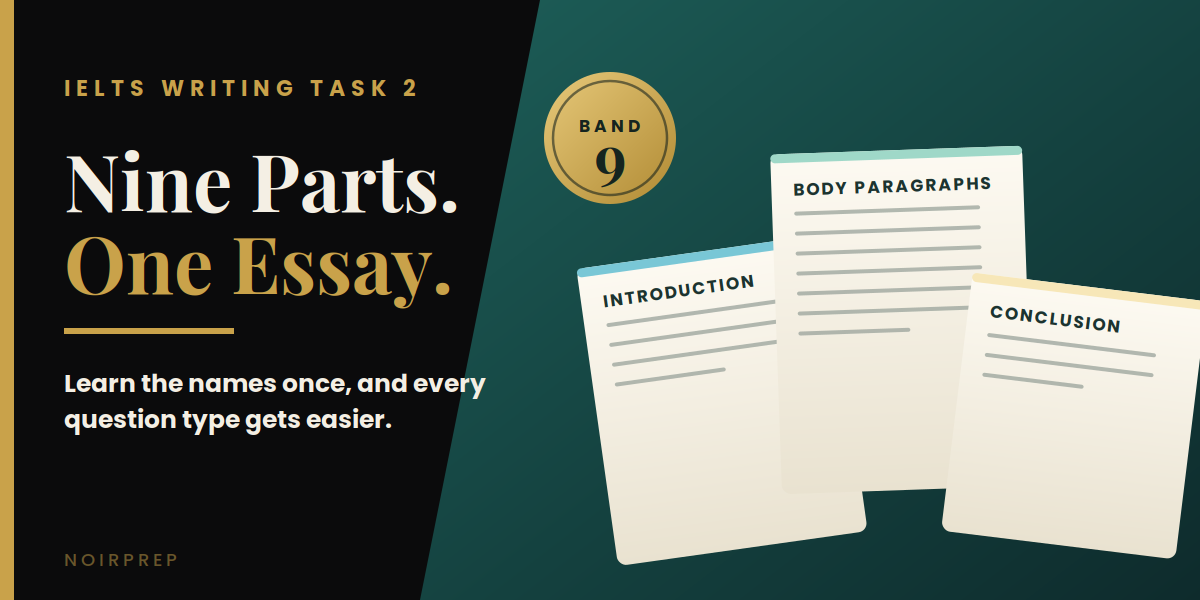
Task 2 is the same for Academic and General Training candidates, and every IELTS essay structure is built from the same nine parts. Every later lesson uses their names, so learn them once here.
The nine parts are the background, paraphrasing, the thesis, the introduction, topic paragraphs, the topic sentence, support sentences, the illustrative example and the conclusion.
We will use one question throughout, so you can watch a complete essay being built part by part.
Sample question Many companies are introducing machines in their operations, and some believe that this is a good thing. To what extent do you agree or disagree?
The Background
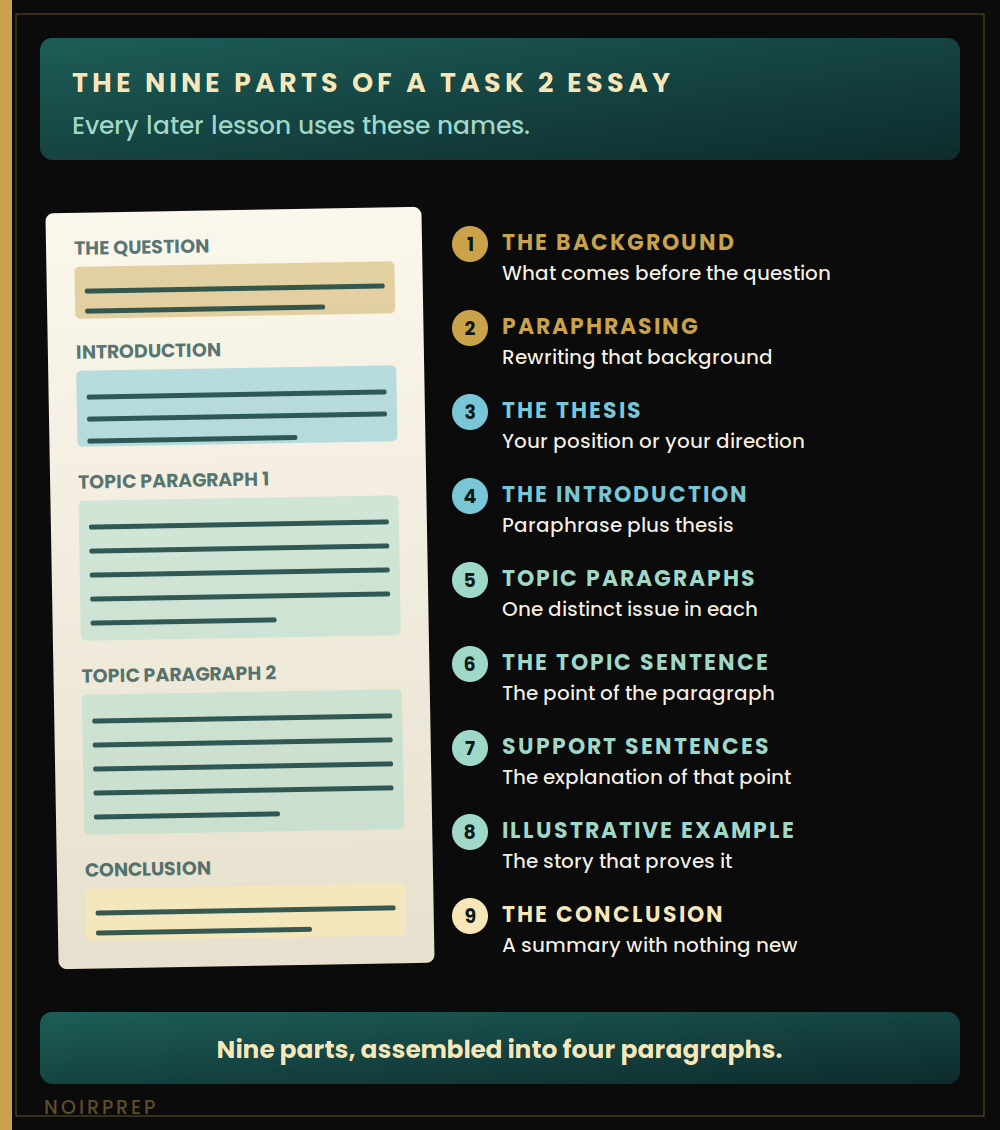
The background is the information that comes before the questions. In the sample above, the background is the first sentence, and the question follows it.
Read it carefully, because everything in your introduction is built from it.
Paraphrasing
In this part of the writing, we are expected to paraphrase the background. In other words, we are to rewrite it, and to do this well we must first understand the information in it. Thereafter we rewrite it by changing some of the keywords and attempting to change the structure. The quality of your paraphrase depends on the quality of your vocabulary and grammar.
Sample paraphrase Several organizations are automating their operations, and there are individuals who think this is a positive development.
Notice what changed. Companies became organizations, introducing machines became automating, and a good thing became a positive development. The structure of the sentence changed as well.
The Thesis
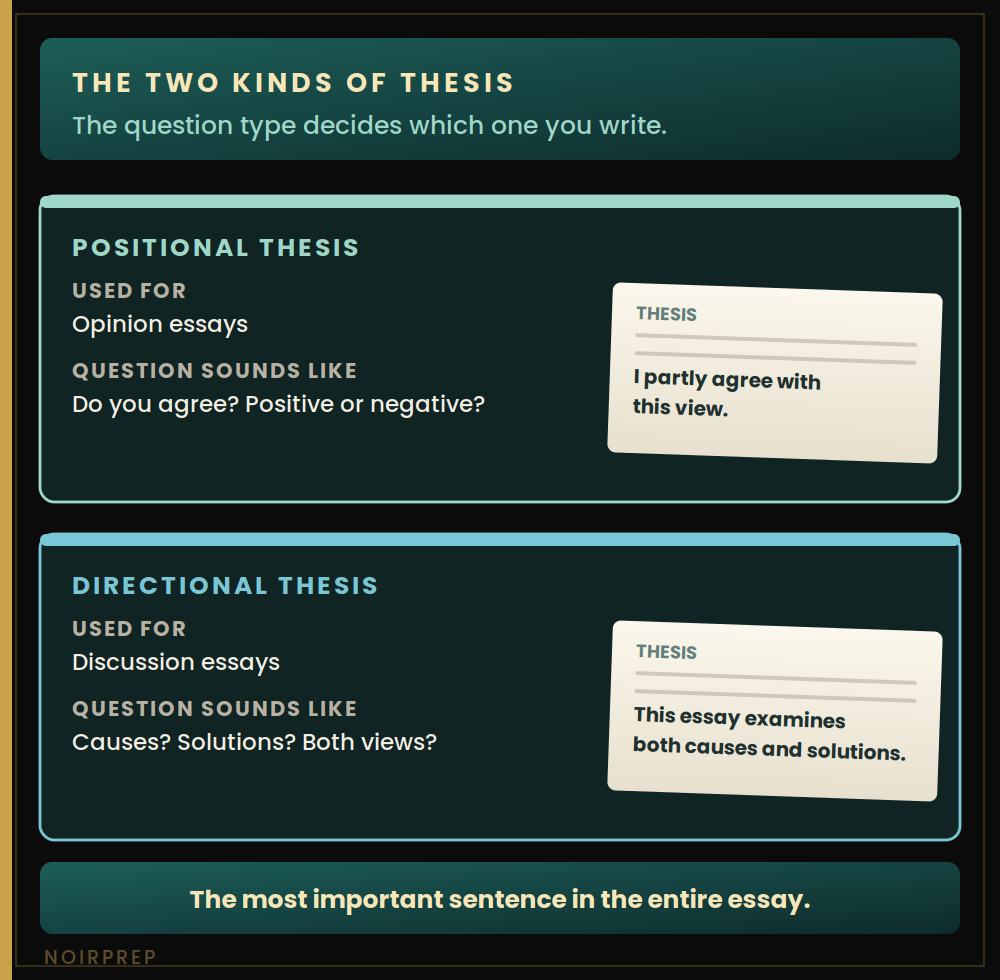
This is the most important sentence in the entire essay. Writers use it to indicate their position on a subject, or to outline the areas they intend to cover in their work.
The first of those is the positional thesis, and it applies to opinion essays. It is used when the question asks whether you agree, or whether something is a positive or a negative development.
The second is the directional thesis, and it applies to discussion essays. It is used when the question asks what causes something, what the solutions are, or asks you to discuss both views.
The question type usually determines which thesis you need.
The Introduction
The introduction contains a paraphrase of the question background and ends with a thesis statement. It needs nothing else.
Sample introduction Several organizations are automating their operations, and there are individuals who think this is a positive development. I partly agree with this view.
Two sentences are enough. The first shows you understood the background, and the second tells the examiner what your essay will do.
Topic Paragraphs in the IELTS Essay Structure
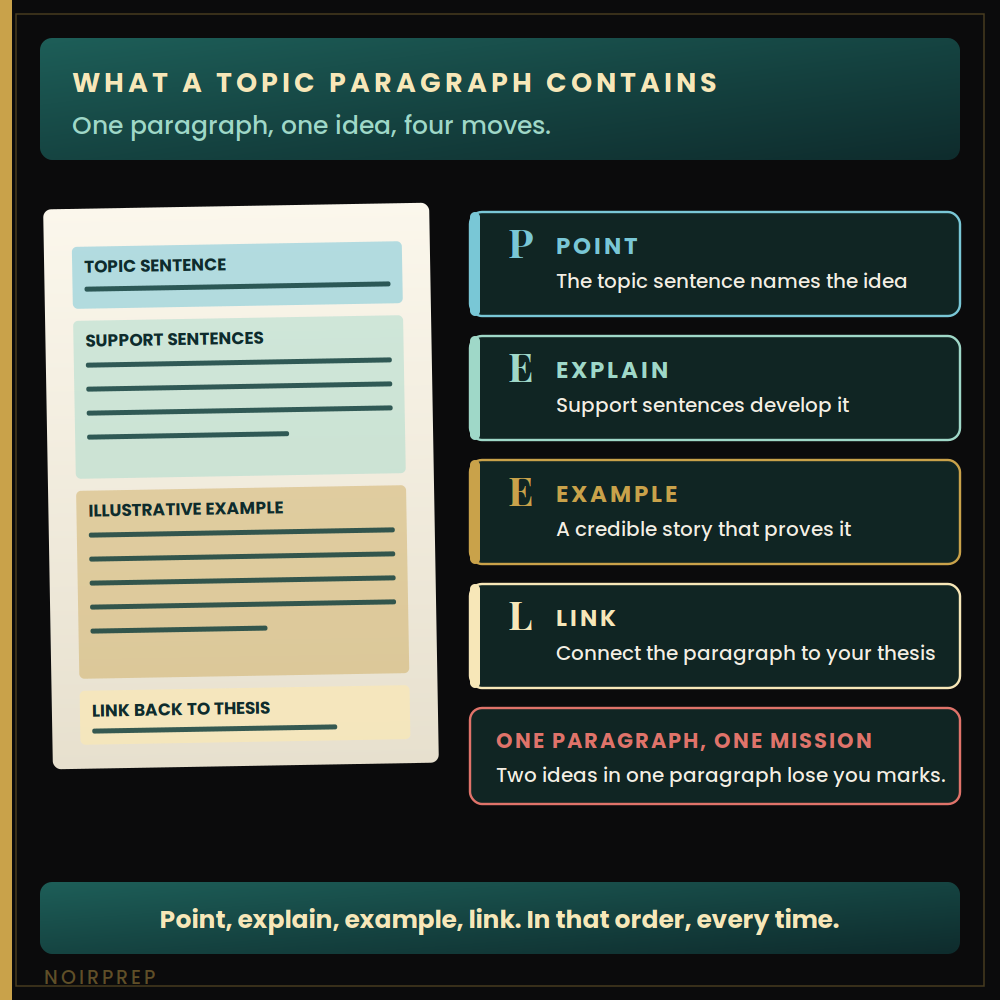
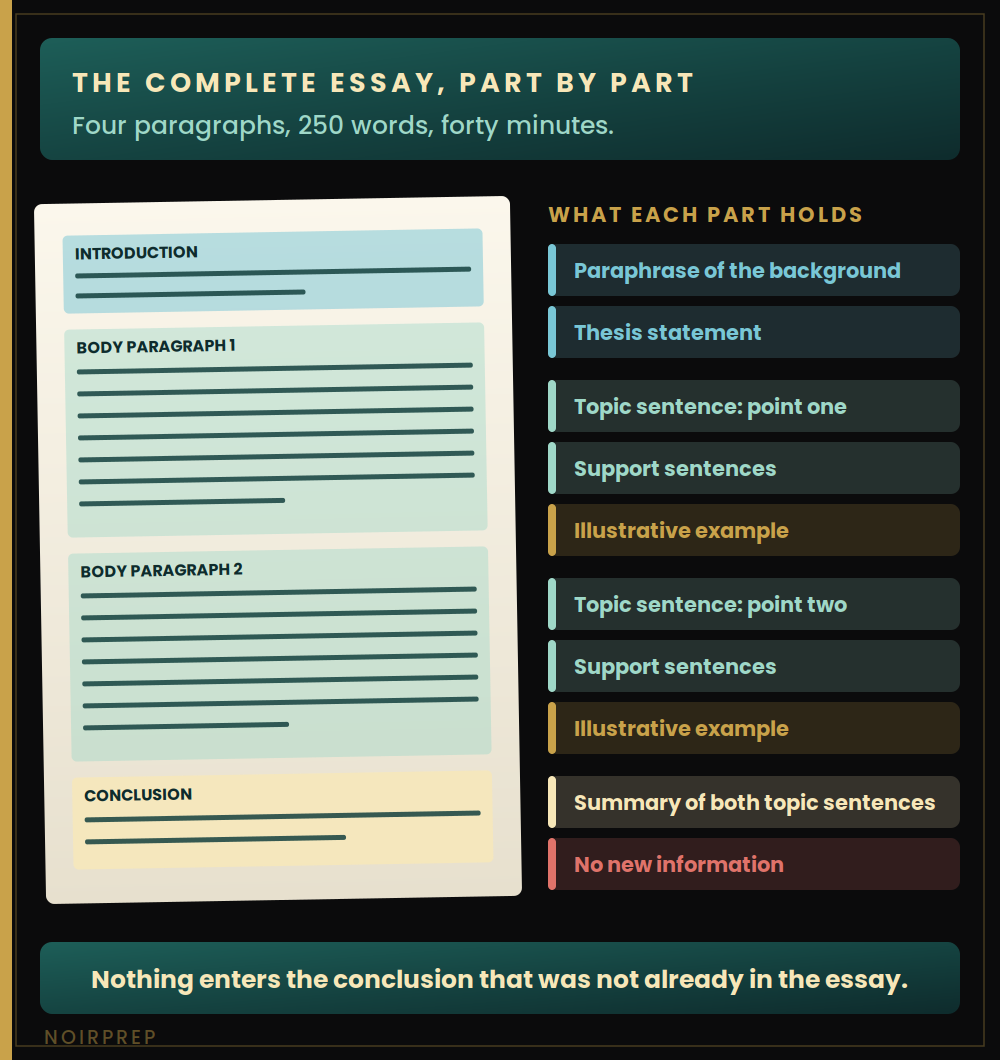
These are the paragraphs in the body, and each one discusses a distinct issue. Each topic paragraph contains a topic sentence, support sentences and an illustrative example.
You may also see this pattern written as PEEL, which stands for point, explain, example and link. The point is your topic sentence, the explanation is your support sentences, the example is your illustration, and the link connects the paragraph back to your thesis.
One rule governs all of this. Every body paragraph concentrates on a single main idea, because a paragraph that carries two ideas becomes confusing to read and difficult to mark.
The Topic Sentence
The topic sentence is the first sentence in a topic paragraph. Writers use it to introduce the point they will discuss in that paragraph, so that readers know what to expect. The topic sentence is either simple or complex.
Samples To start with, companies can increase their production capacity when they mechanize labor. However, it could lead to unemployment.
Each names one idea, and the rest of the paragraph develops only that idea.
Support Sentences
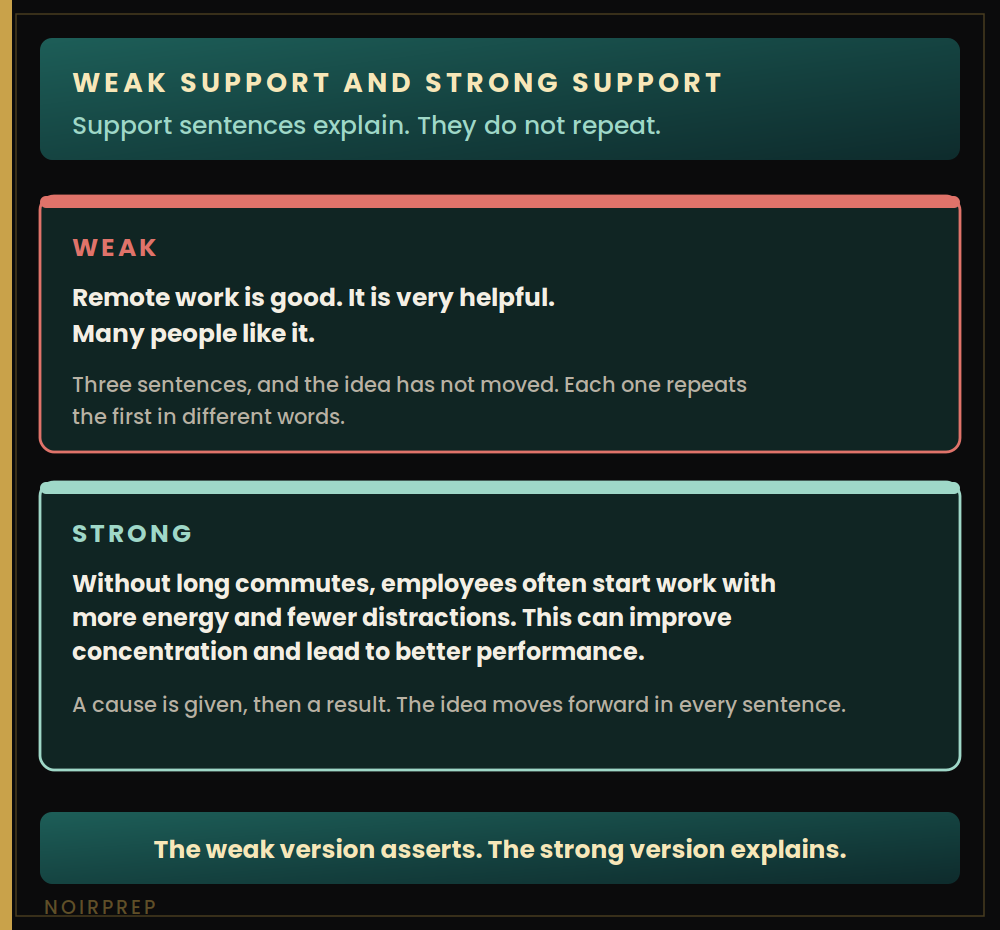
These are the sentences writers use to explain the point in their topic sentence.
Sample To start with, companies can increase their production capacity when they mechanize labor. Machines can do the work that would have required lots of people, and they can do it in a short time. The fact that, unlike humans, they are not affected by emotional issues means they can work non-stop. Consequently, the longer they work, the more goods they produce.
Read those support sentences again and notice that each one takes the idea a step further. The first says what machines replace, the second says why they can continue working, and the third states the result.
Compare that with a weaker candidate supporting a point. Remote work is good. It is very helpful. Many people like it. Three sentences, and the idea has not moved, because each one repeats the first in different words.
A stronger version of the same point reads differently. Without long commutes, employees often start work with more energy and fewer distractions. This can improve concentration and lead to better performance, especially for tasks that require deep focus. The weaker version asserts, and the stronger version explains.
The Illustrative Example
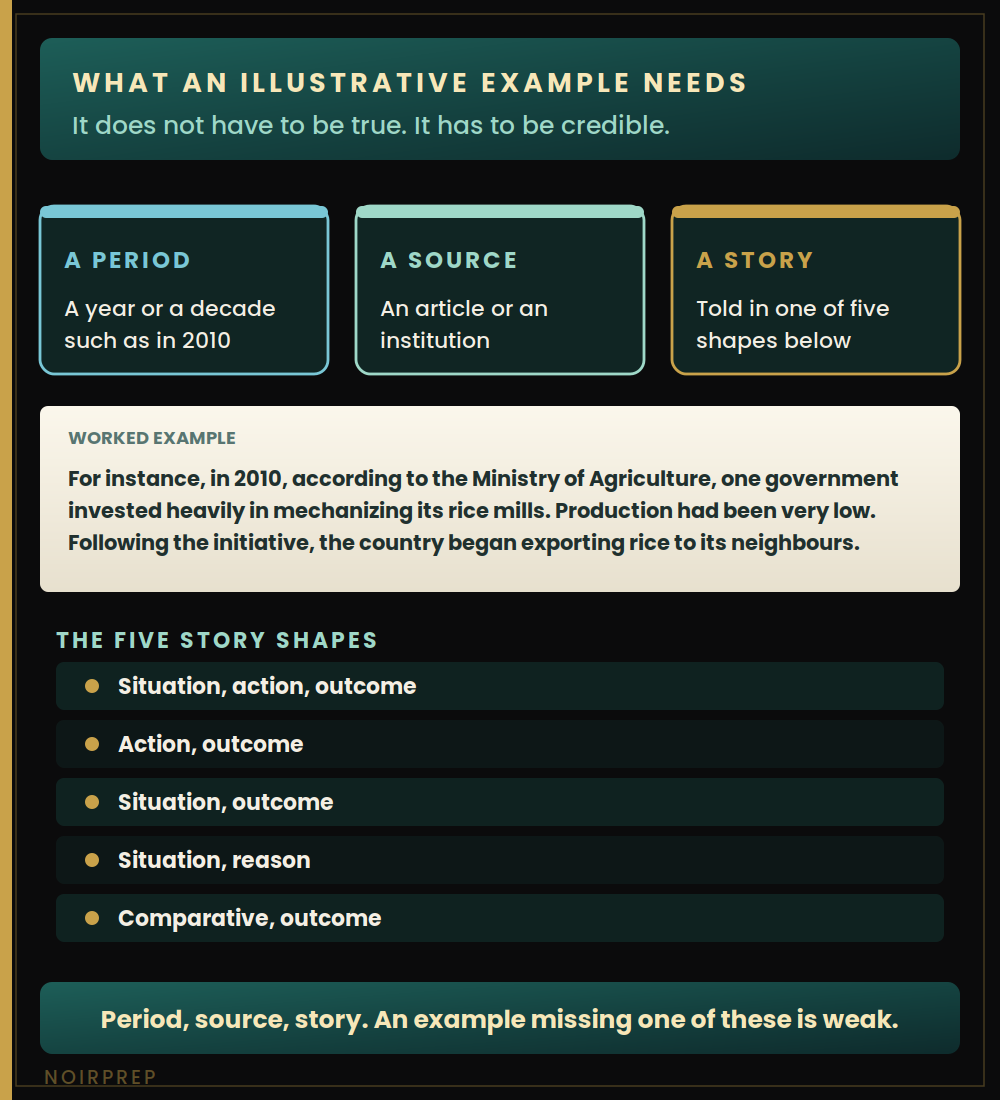
This is a story writers use to support the explanation they have provided. It does not have to be true, but it must be credible, and the quality of your example reflects the quality of your explanation.
The example contains a period, a source such as an article or an institution, and a story. The story takes one of the following shapes.
Situation, action, outcome Action, outcome Situation, outcome Situation, reason Comparative, outcome
Sample example For instance, in 2010, according to the Ministry of Agriculture, the government of one South American country invested heavily in mechanizing several rice mills. Before then, national rice production was very low and the country still depended on imports. Following the initiative, the country became self-sufficient in rice and began exporting to its neighbours.
That example contains a period, 2010, a source, the Ministry of Agriculture, and a story in the situation, action and outcome shape.
The Conclusion
This is a summary of the essay, made using the points in your topic sentences, and its structure will vary from question to question. Whatever form it takes, the conclusion must answer the question using information already provided in the work. There must be no new information.
Sample conclusion In conclusion, I partly agree that the ongoing automation of the operations of many companies is a positive development, because it could lead to an increase in their production capacity. However, it could also lead to job losses.
Compare that with the two topic sentences. Production capacity came from the first and unemployment from the second, so nothing new has entered the essay.
The Complete Essay, Using the Whole IELTS Essay Structure
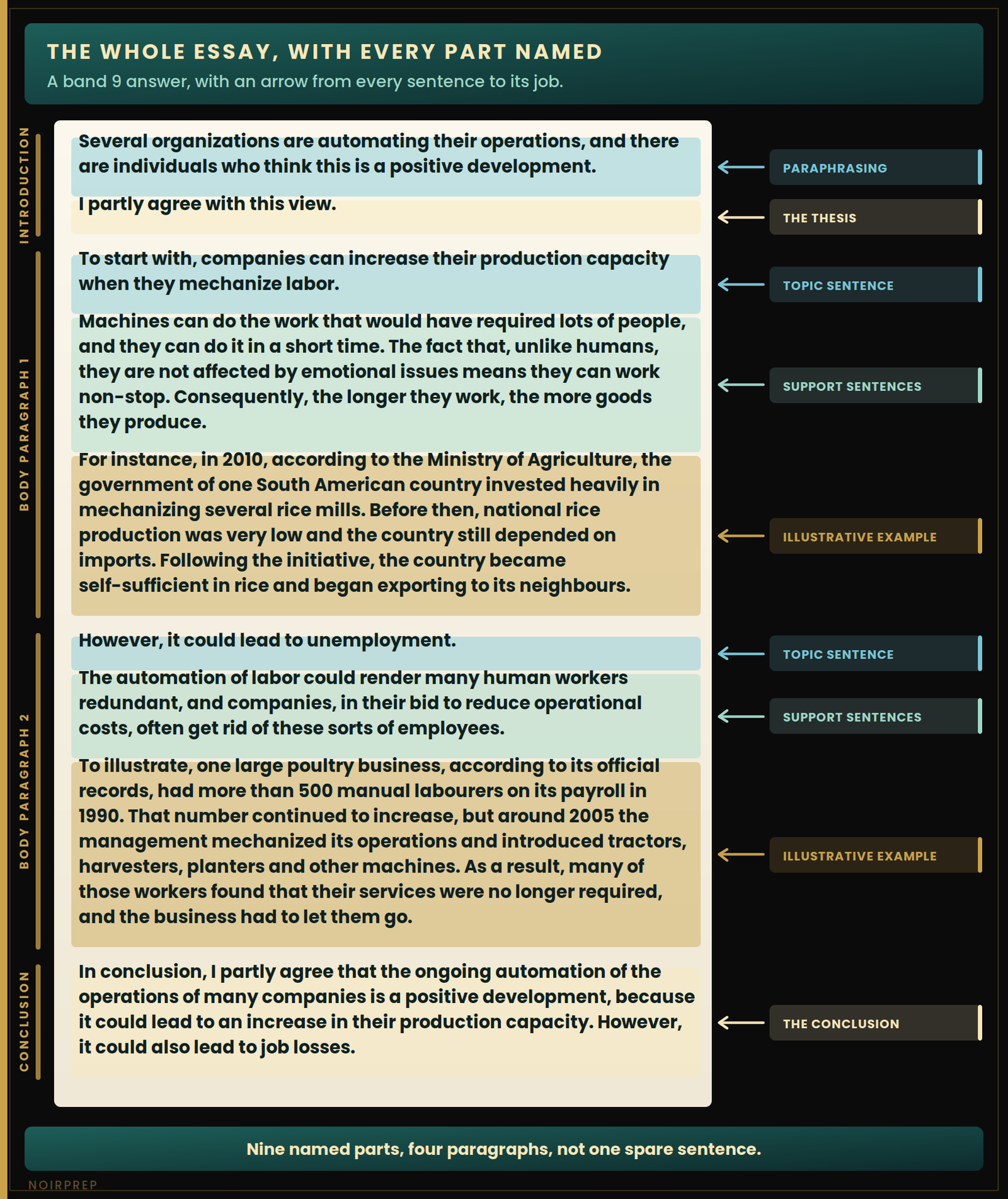
PRACTICE ESSAY TASK 2 QUESTION: Many companies are introducing machines in their operations, and some believe that this is a good thing.
To what extent do you agree or disagree?
Now pay close attention to how it is answered, because this is the standard that earns a band 9. Every sentence carries an arrow to the job it is doing. Blue states a position, green explains, gold tells the story.
How the IELTS Essay Structure Fits the Forty Minutes
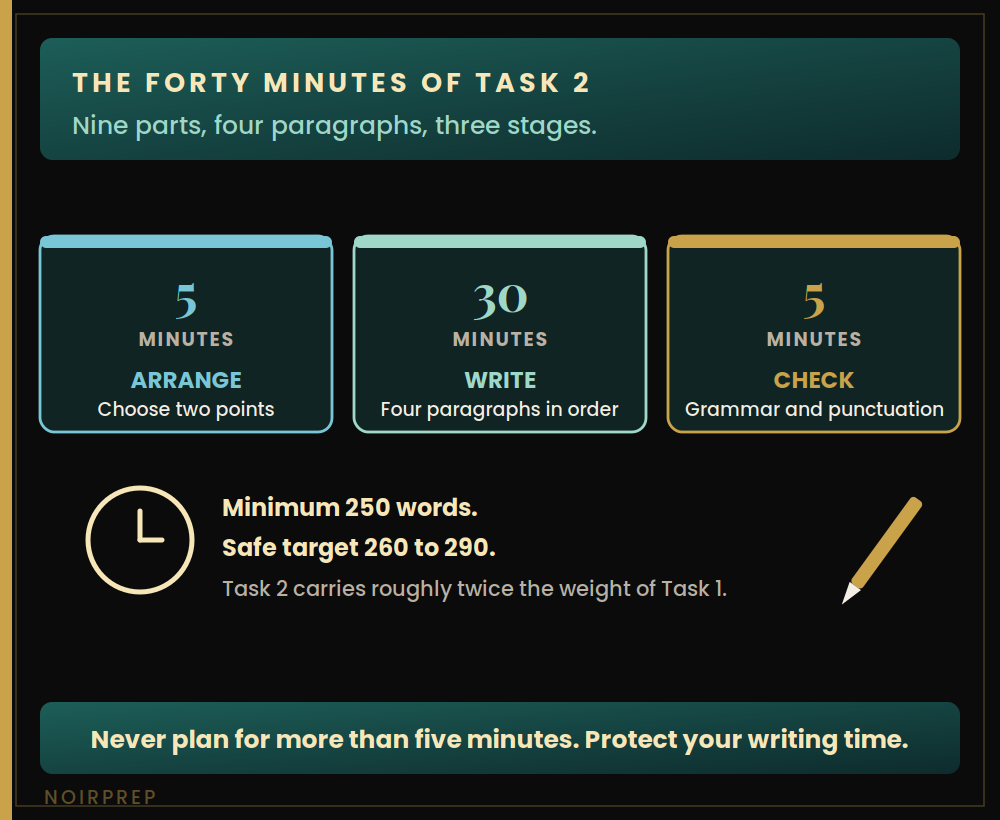
Those nine parts produce four paragraphs, which are the introduction, body paragraph 1, body paragraph 2 and the conclusion. The minimum length is 250 words, and a safe target is 260 to 290.
Spend the first five minutes arranging the skeleton, the next thirty writing the four paragraphs in order, and the last five checking for task response, run on sentences, punctuation and grammar. Never spend more than five minutes planning, because a short clear plan that leaves you time to write beats a detailed one that does not.
What to Do Before the Next Lesson
Take this practice question.
Many educational institutions are replacing traditional classroom teaching with online learning platforms, and some believe that this is a positive development. To what extent do you agree or disagree?
Do not write the full essay yet. Write only four lines: a paraphrase of the background, your thesis, and the two topic sentences you would use for your body paragraphs.
Those four lines are the skeleton of the IELTS essay structure, and a candidate who can produce them in three minutes has already done the hardest part of the task.
The next lesson deals with the essay itself, including the four sentence types the examiner expects to see and the punctuation that holds them together.