IELTS Paraphrase Examples: When One Word Becomes a Whole Phrase
IELTS paraphrase examples rarely look the way candidates expect. You picture a hard word being replaced by another hard word. What actually happens is stranger: the test takes a short, ordinary word from your question and stretches it into a whole phrase in the passage, or folds a phrase back into one word.
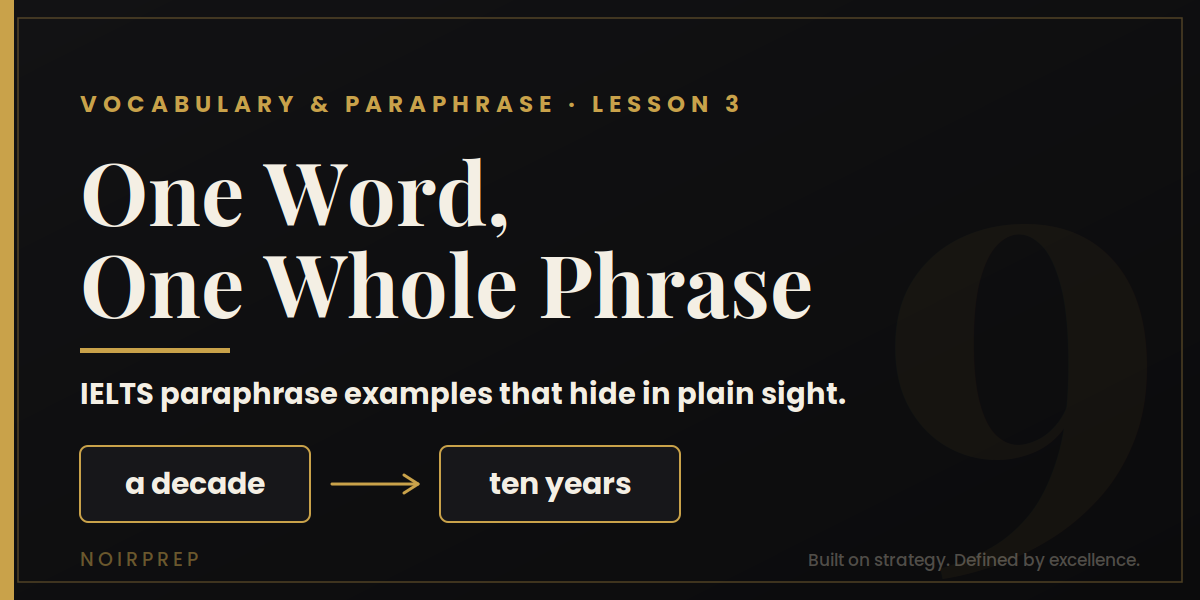
A decade becomes ten years. Because becomes due to the fact that. Nothing difficult has happened, yet the line on the page now looks nothing like the line in your question.
This is Pattern 2 of the six paraphrase patterns, and it catches candidates whose vocabulary is already strong. Knowing hard words does not help here. The words are easy. The shape is different.
First, a Quick Recap
Three pairs from the last lesson before we begin. Decide whether each one matches, ten seconds apiece.
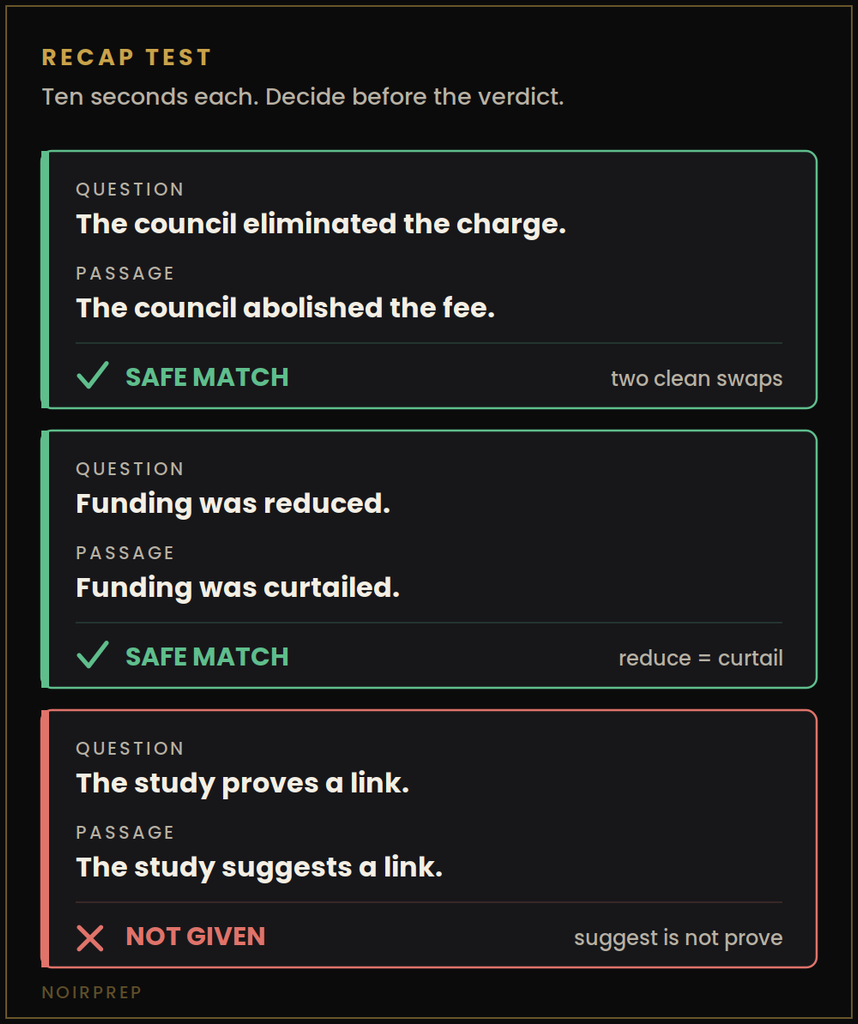
Did the third one catch you? Most candidates hesitate there. Strength is the check people forget once they are moving quickly, and speed is exactly when it matters.
What Word and Phrase Equivalence Is
Pattern 2 works in two directions.
Sometimes the question is short and the passage is long. You read annually and the passage says every year.
Sometimes the reverse happens. Your question stretches out into after a period of time while the passage simply says eventually.
Either way the meaning has not moved an inch. Only the number of words has changed.
Why These IELTS Paraphrase Examples Trap Good Readers
Think about how a single word looks on a page compared with a five-word phrase. They occupy different amounts of space. Your eye is scanning for a shape, and the shape has changed completely.
A candidate hunting for decade will pass over ten years without the faintest flicker of recognition, even though she knows perfectly well that a decade is ten years. She is not confused about the meaning. She simply never looked at those two words, because they did not resemble what she was hunting for.
That is the entire trap. Not difficulty. Recognition.
Which Words Get Stretched
Certain short words attract this treatment again and again. Once you know which ones, you can predict the swap before it happens.
Short time words are the biggest family. So are frequency words, linking words, and words of quantity. These are the ones to train your eye on.
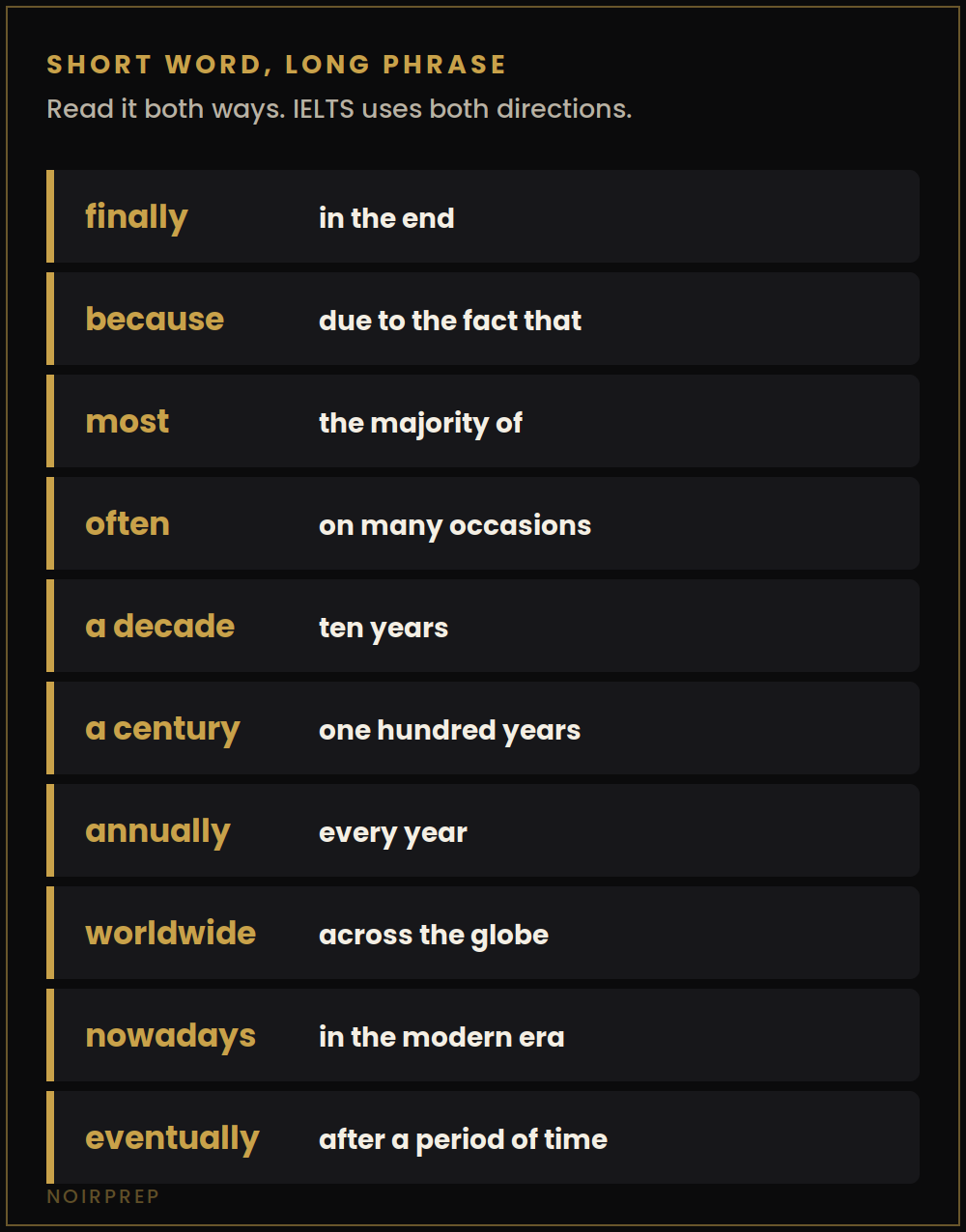
Read that list in both directions. Cover the right side and produce the phrase; cover the left and produce the single word. Both directions matter, because you will meet the pattern both ways round.
Watch It Happen
Below are three lines taken apart slowly. Read the question, read the passage, decide, and only then look at the verdict.
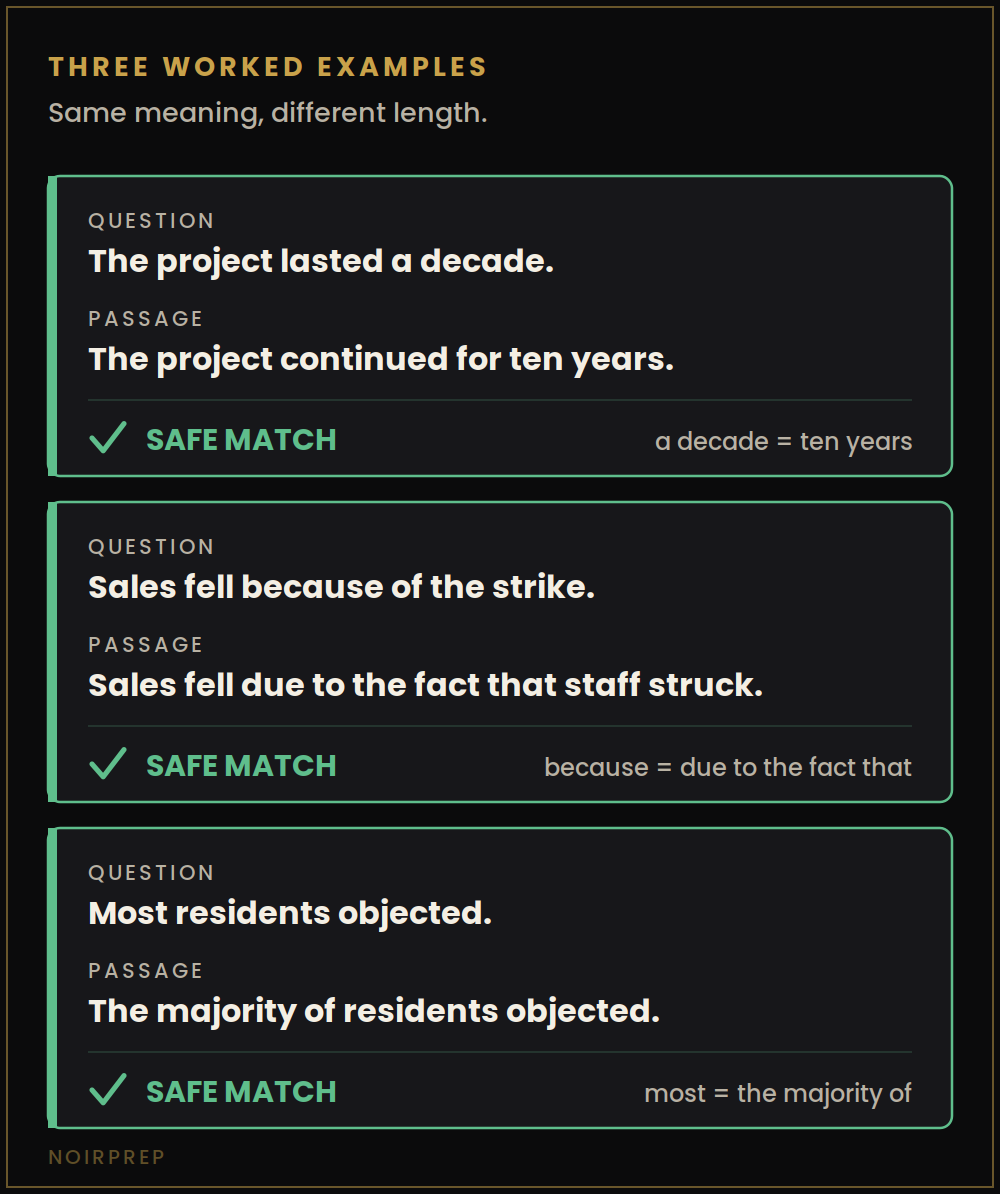
Take the first one. Every word is different, yet the meaning is untouched. Nothing was hidden except the shape.
The second is the same trick with a linking word. Because and due to the fact that mean precisely the same thing, but one is a word and the other is a small sentence. Candidates scanning for a cause often miss it entirely.
The third is where care is needed. Most and the majority of do match, and they match exactly. Compare that with many, which does not. This is the border between Pattern 2 and a quantity trap, and it is worth sitting with for a moment: a phrase can be a true equivalent, or it can be a quiet upgrade. Your job is to tell which.
The Mistake Behind Most Lost Marks
Of all the errors candidates repeat, one does more damage than any other with this pattern: searching only for exact repeated words, then concluding the answer is not in the passage.
It almost always is. Expressed differently, but there.
What makes this mistake so costly is that it does not feel like a mistake. You searched. You searched carefully. You reached the end and found nothing, so you marked Not Given and moved on with a clear conscience. Nobody corrects you until the results arrive.
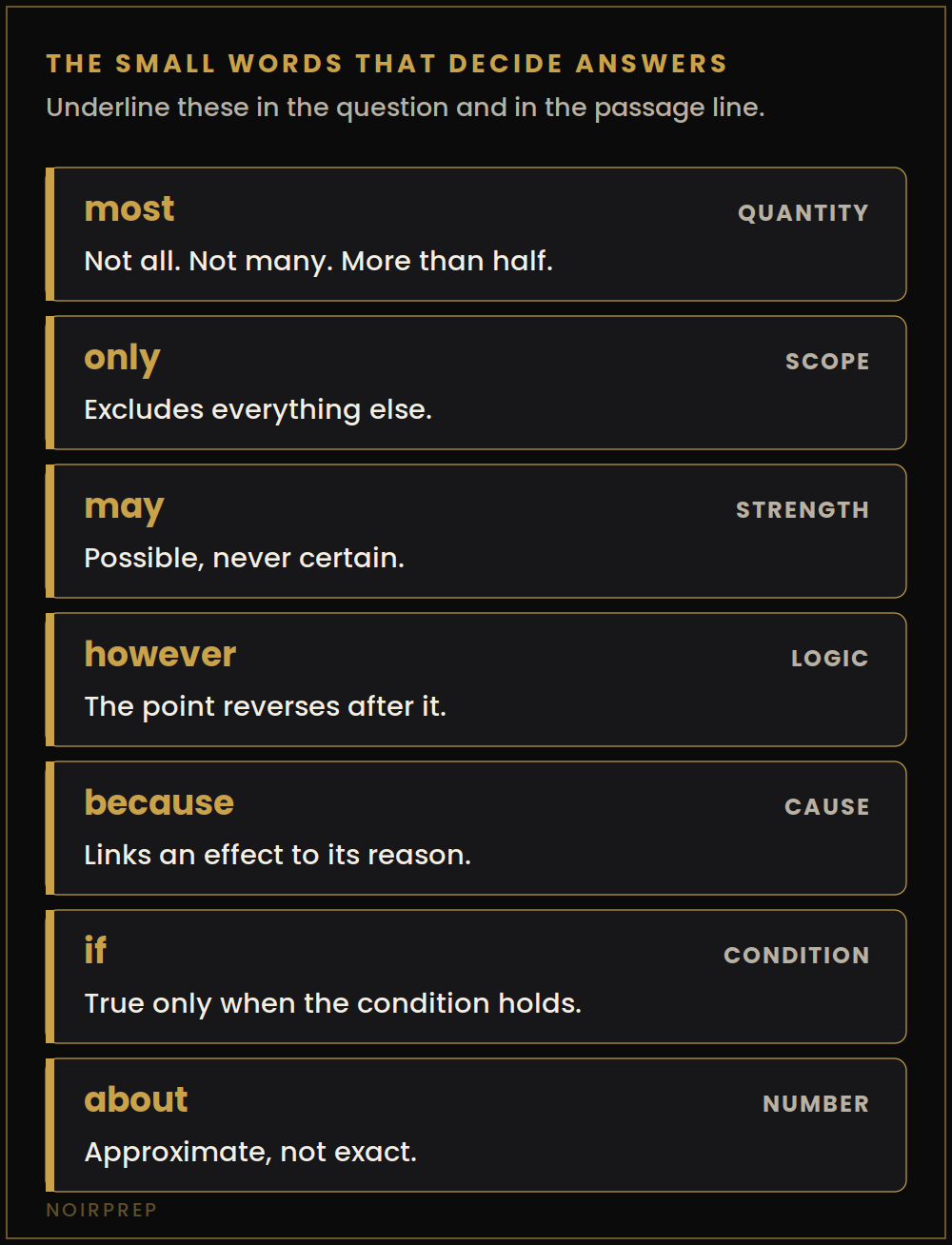
A second error travels with it. Candidates lock on to the big nouns in a question and skim over the small words: most, only, may, however, because, if, about. Those little words are precisely the ones Pattern 2 rewrites into phrases, so ignoring them means missing the very thing that changed.
Underline them. In the question and in the passage line. It takes a second and it is the difference between finding the sentence and walking past it.
The Order That Prevents It
There is a reading order that makes this pattern far less dangerous, and most candidates use the opposite one.
The wrong way is to read the whole passage first, slowly, then turn to the questions with a tired mind and half the details already gone.
Do this instead. Read the question. Pull out the keywords. Predict what those keywords could look like as phrases. Scan for both forms. When you find the area, stop scanning and read locally, properly, a sentence or two around it. Only then answer.
Prediction sits in the middle of that sequence for a reason. Skip it and you are scanning for shapes that were never printed.
The Habit to Build
Notice the short, ordinary words when you read a question. Not the topic words, the small ones: finally, often, because, most, annually, nowadays.
Ask what phrase could carry the same meaning. One or two possibilities is enough.
Then scan for both.
Over a few weeks this stops being a technique and becomes the way you read.
In Listening the Pattern Reverses
Something worth knowing before test day. In Reading, the question is often short and the passage stretches the idea out. In Listening, the reverse is common: the speaker uses ordinary conversational phrases, and the question compresses them.
You will hear we ran out of time in the end, and the question will ask what happened eventually.
So the preparation is the same skill pointed the other way. Read the question first, notice the compressed word, and be ready for a longer, more casual version of it in the audio.
Where This Pattern Hits Hardest
Some question types suffer from this more than others.
Sentence completion is the worst affected. You are given a sentence with a gap, and the sentence has usually been compressed from something longer in the passage. Candidates search for the compressed version and never find it, because the passage never used it.
Summary completion behaves the same way. A whole paragraph is squeezed into two or three lines, which means almost every phrase in that summary is a folded-up version of something the passage said at length.
True, False, Not Given is different again. Here the danger is not missing the line, but misjudging it. You find the sentence, you see a phrase instead of a word, and you have to decide whether the phrase means exactly the same thing or merely something similar.
Matching headings rewards the pattern rather than punishing it. A heading is a compression by design, so candidates who read IELTS paraphrase examples in both directions handle headings far more comfortably than those who do not.
A Two-Minute Drill
Try this tonight, and repeat it until it feels dull.
Open any practice passage. Do not answer the questions. Instead, read only the questions and circle every short, ordinary word in them.
Now open the passage and find where each circled word reappears, and note what form it took. Sometimes it will be the same word. Often it will be a phrase you would have missed under exam pressure.
Ten minutes of this teaches your eye more than an hour of timed practice, because it isolates the one skill that was failing.
Then the Harder Words
Vocabulary work continues alongside the pattern work. Eight more academic words follow, all of them the kind IELTS reaches for when a plainer word would do.
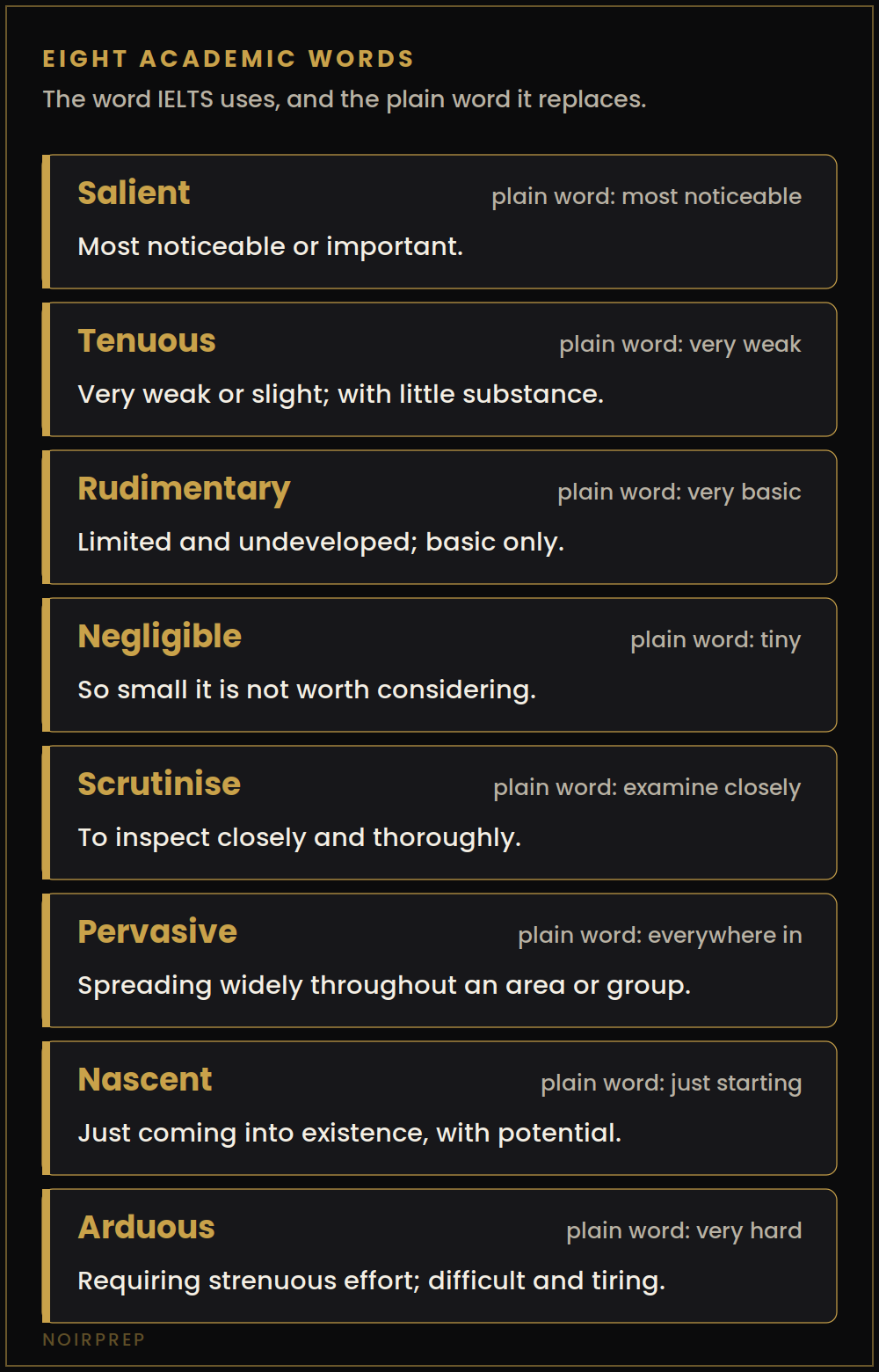
Cover the meanings. Recall each one from the word alone. Write a sentence of your own for each. Eight sentences, no more than that.
Your recognition speed is what decides your score, and recognition comes from use rather than from reading.
One Thing to Be Careful About
Not every phrase is a clean equivalent.
In the end and finally are the same. So are a century and one hundred years. But in recent years is not since 2018, and for a long period is not for a decade. The first pair in each case names the same thing twice. The second pair replaces something precise with something vague.
Precision can be lost in a paraphrase. When it is, you are no longer looking at Pattern 2. You are looking at a trap, and the answer is usually Not Given.
The NoirPrep Rule: a phrase that means the same thing is a paraphrase. A phrase that means roughly the same thing is a trap.
What to Do Before the Next Lesson
Two tasks, both short.
Work through the word-and-phrase list until you can move in both directions without pausing. Then, in your next practice passage, underline every short ordinary word in the questions before you read a single line of the text. You will be surprised how many of them reappear as phrases.
Where to Go Next
Pattern 3 comes next: the word-class shift, where the meaning stays put but the grammar moves. Increased becomes an increase. Successfully becomes with success.
That one troubles candidates whose grammar was never formally taught, and it is more common in Academic Reading than any other pattern except synonyms.