IELTS Speaking Part 2: How to Speak for 2 Minutes Without Stopping

Once the Part 1 questions come to an end, the examiner reaches for a card and slides it across the table to you, along with a pencil and a sheet of paper. That card is the start of IELTS speaking part 2, and from the moment it reaches your hand you have one minute. Nobody will speak to you during that minute, or during the two minutes of talking that follow it.
Most candidates are more nervous about this section than any other, although their English is usually not what goes wrong. What goes wrong is the order in which they say things. They have more than enough material, but because they have not decided what comes first, they repeat a point already made, wander away from what the card asked, or finish well before the two minutes are up.
What the IELTS Speaking Part 2 Cue Card Looks Like

The card has a task printed across the top of it and three or four bullet points underneath.
The bullets are there to help you rather than to be answered one at a time, so you may spend longer on one than another, or leave one almost untouched. The task at the top is different, because that is what the examiner is listening for, and a talk that never gets round to it has not done what was asked, however fluent it sounds.
So read the whole card before your pencil touches the paper. Candidates who begin scribbling against the first bullet sometimes discover, half a minute later, that the final line changed the task entirely.
The Four Kinds of Card You Will Get
Cue cards appear endless in number, but almost all belong to one of four families.
The largest group asks you to describe a person, perhaps someone who helped you or a teacher you still remember. Cards about places are nearly as common, covering somewhere you enjoy visiting or a city you would recommend. A third group is built around objects, so you might be asked about a possession or a gift somebody gave you. The last family deals with events and experiences, such as a time when you were extremely busy or a decision that was difficult to make.
Prepare three or four stories of your own and you will find you can bend them to fit almost anything those families produce. One relative, one journey, one possession and one difficult week will stretch a surprisingly long way.
None of this means learning answers by heart. It means arriving with a few subjects in your head, so the preparation minute goes on organizing a story instead of hunting for one.
The One Minute: Write Keywords, Not Sentences

Most of the damage in IELTS speaking part 2 is done before anybody has said a word.
What normally happens is that the candidate writes full sentences, the minute runs out with one and a half finished, and the talk is those sentences read aloud, after which nothing is left. Reading aloud does not sound like speaking either, and an examiner will notice the difference within a line or two.
So write keywords and nothing else, meaning single words and short phrases that remind you of an idea without spelling the idea out.
Sort them into four groups as you write, because those groups will become the shape of your talk. The first group holds what the thing is, or who the person is. The second takes care of when and where. The third carries the details, which means what happened, what was said and what was done. The fourth is for how you felt about it and why it mattered to you.
A card about a person who helped you might produce notes along these lines.
Weak notes: “I want to talk about my friend that I met in secondary school and we became very close and helped each other…”
Strong notes: “aunt, mother’s sister, secondary school, 2016, fees, phone calls, kept me focused, not the money, encouragement, still grateful”
That second set took fifteen seconds to write, and it will carry a full two minutes of speech.
The Two Minutes of IELTS Speaking Part 2, in Five Stages

The talk itself moves through five stages, and they come in the same order every time.
It begins with one clear sentence saying who or what you are about to describe. The background comes next, giving your listener the who, what, when and where they need in order to place the story. Your main part follows that, carrying whatever actually happened. Then you deepen it by telling the examiner how you felt, why it mattered, or what changed afterwards. A single sentence closes the whole thing.
Share the time out roughly evenly between those five and the two minutes will largely look after themselves. Give ninety seconds to the background and nothing will be left for the part the examiner has been waiting for.
Organized beats impressive. A simple story told in a clear order will score higher than a complicated one the listener cannot follow, and that holds true at every band.
A Full Answer, Stage by Stage
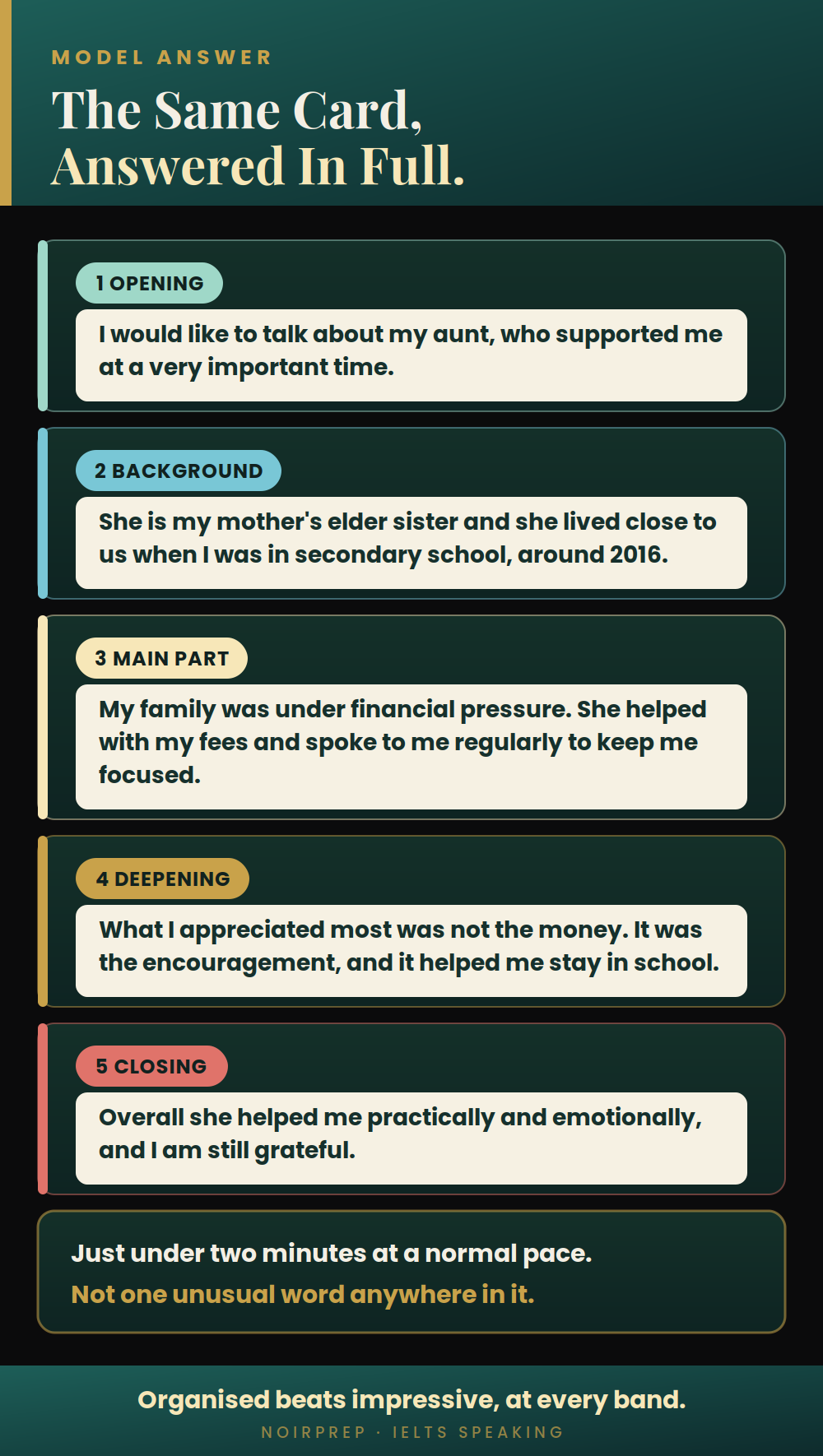
Here is that same card answered in full, with every stage marked so you can see where each one starts.
Opening: “I would like to talk about my aunt, who supported me at a very important time in my life.”
Background: “She is my mother’s elder sister and she lived close to us when I was in secondary school, around 2016. We were close because she was someone you could talk to without feeling afraid.”
Main part: “At that time my family was under financial pressure and I was worried about leaving school. She stepped in, helped with my fees, and spoke to me regularly to keep me focused.”
Deepening: “What I appreciated most was not the money. It was the encouragement. She kept reminding me that the situation was temporary and that I should not lose confidence. Her support helped me stay in school and stop feeling ashamed about needing help.”
Closing: “Overall, she helped me both practically and emotionally, and I still feel grateful whenever I think about that period.”
Spoken at a normal pace, that runs to just under two minutes. There is not a single unusual word in it, and every sentence is short enough to hold together to the end.
When You Run Out Before the Time Does

Running dry at a minute and twenty is what goes wrong most often in IELTS speaking part 2, and a shortage of depth usually causes it rather than a shortage of ideas.
Five lines will extend an answer naturally the moment you feel it closing too early, and each of them asks you for new material instead of inviting you to repeat yourself.
“Before that, I used to feel…, but after that…”
“The main reason was…”
“What I learned from it was…”
“It changed my mindset because…”
“Looking back now, I realize…”
If your mind empties altogether, there is a line for that too. Say “let me think for a second, okay, I would say,” then go back to the stages, taking the background first, then the details, the feelings and the close. Structure is your safety net, and it holds because you built it before the pressure arrived.
Timing in IELTS Speaking Part 2
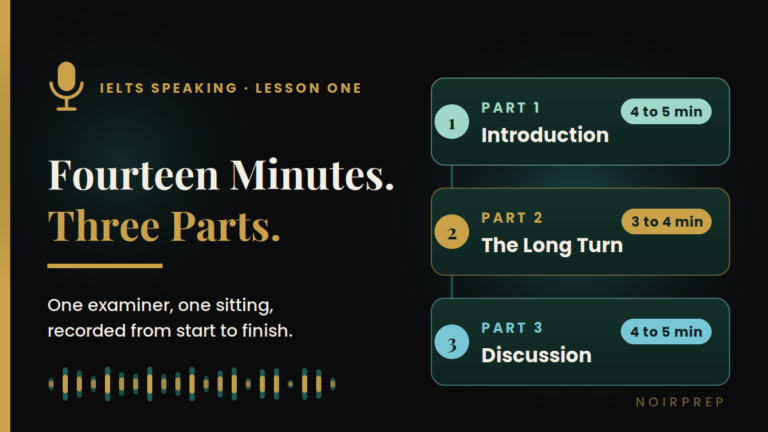
You will see three different numbers attached to this section, and they measure different things. The minute belongs to your preparation and the one to two minutes belongs to the talk. The three to four minutes printed in test format tables covers the whole section, including the instructions, your preparation, your talk, and the one or two short questions the examiner asks afterwards. Those final questions are brief and brief answers are expected.
Stopping before a minute and twenty costs you marks under fluency, because the examiner has not heard enough to judge you on. Anything between a minute and forty and the full two minutes leaves room to show what you can do.
Rushing creates the same difficulty by another route. Race through every bullet in the first forty-five seconds and you are left with a minute of empty air, which most candidates fill by repeating themselves.
Expect to be stopped at two minutes, quite possibly mid sentence. No penalty is attached to that and no rudeness meant by it, since being stopped means you used the whole of your time.
What to Do Before the Next Lesson
Set a timer and work through this card properly, with no shortcuts.
Describe a place you enjoy visiting. You should say where it is, how often you go there, what you do there, and explain why you enjoy it.
Allow yourself one minute for keywords in four groups, with no full sentences on the page, then record two minutes of speech without stopping.
Three things are worth listening for on playback. The first is length, so check whether you reached a minute and forty. The second is whether all five stages survived, since the deepening usually goes missing. The third is the balance between them, since a long background will have squeezed your feelings into a rushed sentence at the end.
Record the same card again on the same day from the same notes. Your second attempt will be better, and the distance between the two shows what that preparation minute is really worth.
Part 3 is where this topic comes back. The examiner takes the subject of your cue card and asks the broader questions sitting behind it, and that is what the next lesson deals with.