IELTS Linking Words: What Separates Band 6 From Band 8
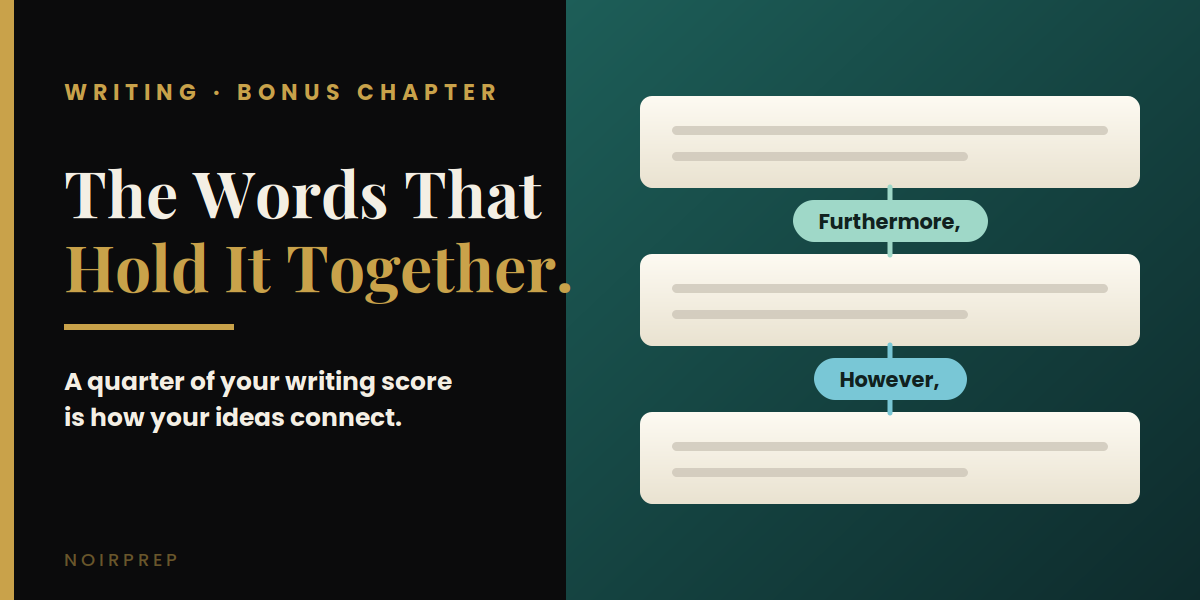
If you have ever read your own essay and felt that something was off, as though the ideas were good but the writing was choppy, the problem was most likely your IELTS linking words. These are the words that hold writing together.
A quarter of your Task 2 score is Coherence and Cohesion, which is a measure of how well your ideas connect. That makes this a scoring lesson rather than a grammar one.
Conjunctions Join Inside a Sentence, Transitions Join Between Them
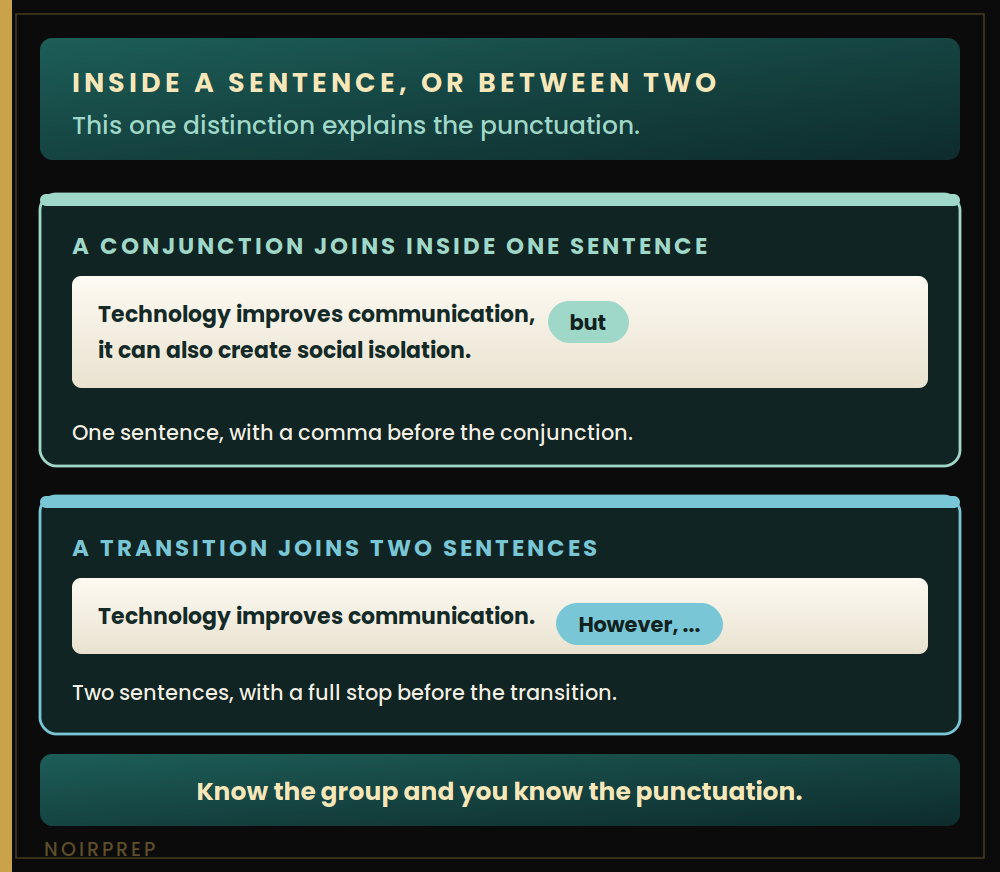
This single distinction explains most of the punctuation errors candidates make.
A conjunction connects two ideas inside one sentence. Technology improves communication, but it can also create social isolation.
A transition connects one sentence to the next. Technology improves communication. However, it can also create social isolation.
The conjunctions are the seven coordinating words, which are for, and, nor, but, or, yet and so, together with the subordinating words such as because, although, when and unless. Every other linking word on this page is a transition.
Two distinctions inside that list are worth holding on to.
But signals a plain contrast, while yet signals a contrast that is unexpected. Technology improves communication, but it can create isolation. A country can be rich in oil, yet many of its citizens live in poverty.
So gives a result, while so that gives a purpose. He studied hard, so he passed describes what happened. He studied hard so that he could pass describes why he did it.
The Pairs That Mark a Band 7 Essay
Some conjunctions work only in pairs, and these are worth learning because they show grammatical range without sounding forced. The pairs are both and, either or, neither nor, not only but also, and whether or.
The government should address not only unemployment but also underemployment. That sentence stands out in an essay, and it costs nothing to build.
Placement is the only trap. The words not only must sit immediately before the part they apply to, so write he is not only smart but also hardworking.
Linking Words for Transitions, Sorted by Job
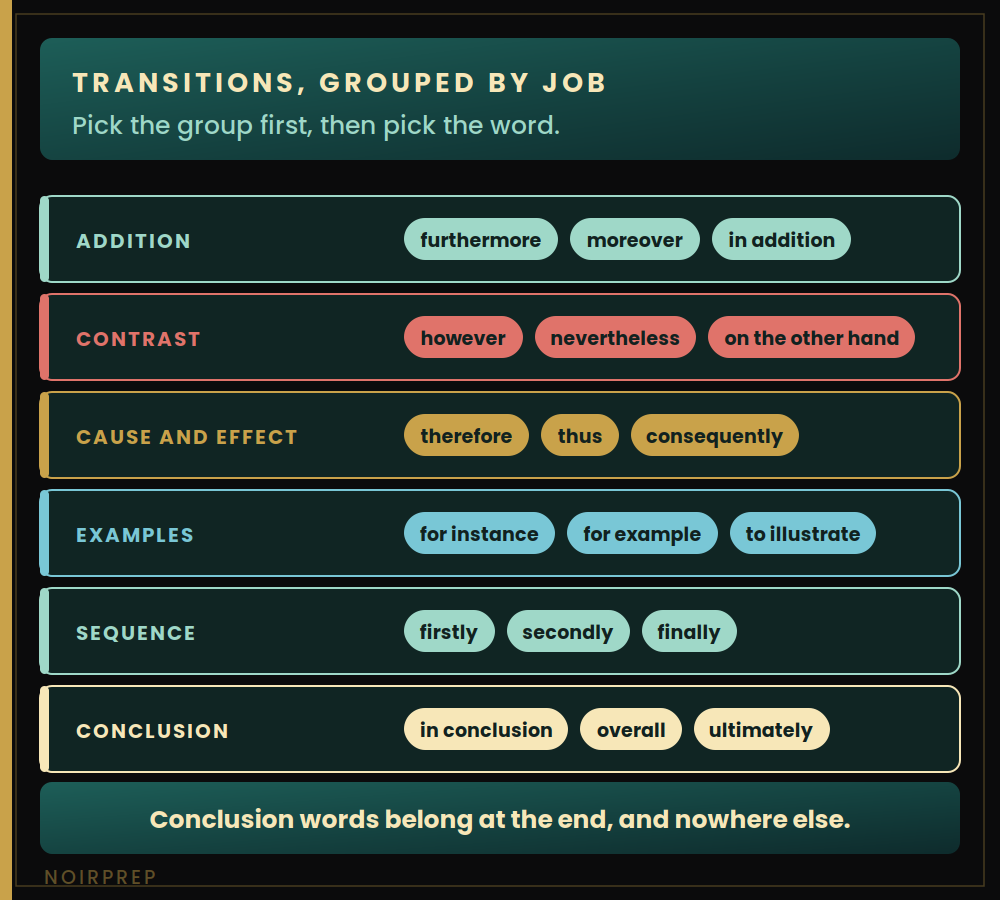
Choose the group before you choose the word, because picking a word from the wrong group confuses the reader more than using no word at all.
For addition, use furthermore, moreover or in addition. For contrast, use however, nevertheless or on the other hand. For cause and effect, use therefore, thus or consequently. For examples, use for instance or to illustrate. For sequence, use firstly, secondly and finally. For conclusions, use in conclusion, overall or ultimately.
Conclusion words belong at the very end of an essay and nowhere else, because in conclusion placed in the middle tells the reader you are finishing when you are not.
The Punctuation Rule That Costs the Most Marks
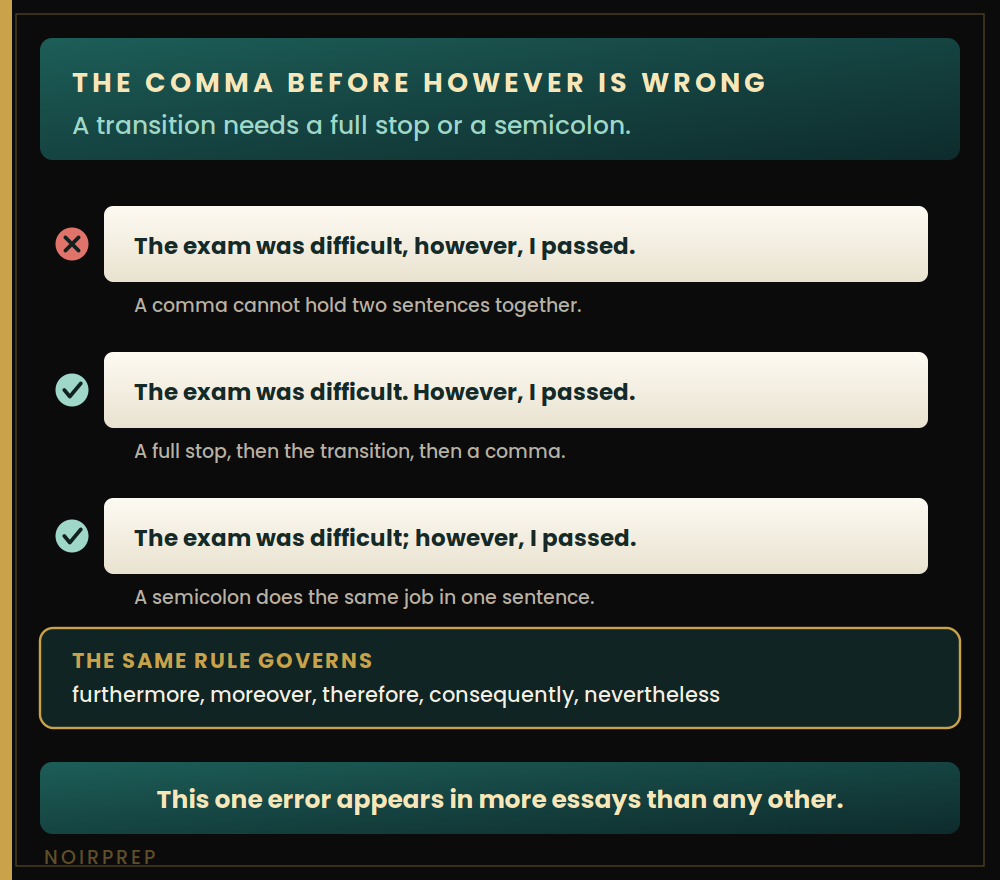
A transition must be separated from the sentence before it by a full stop or a semicolon. A comma alone is not enough.
The exam was difficult, however, I passed. This is wrong, and it appears in more essays than any other error on this page.
The exam was difficult. However, I passed. This is correct, and so is the version with a semicolon in place of the full stop.
The same rule governs furthermore, moreover, therefore, consequently and nevertheless.
Four Linking Word Errors to Stop Making
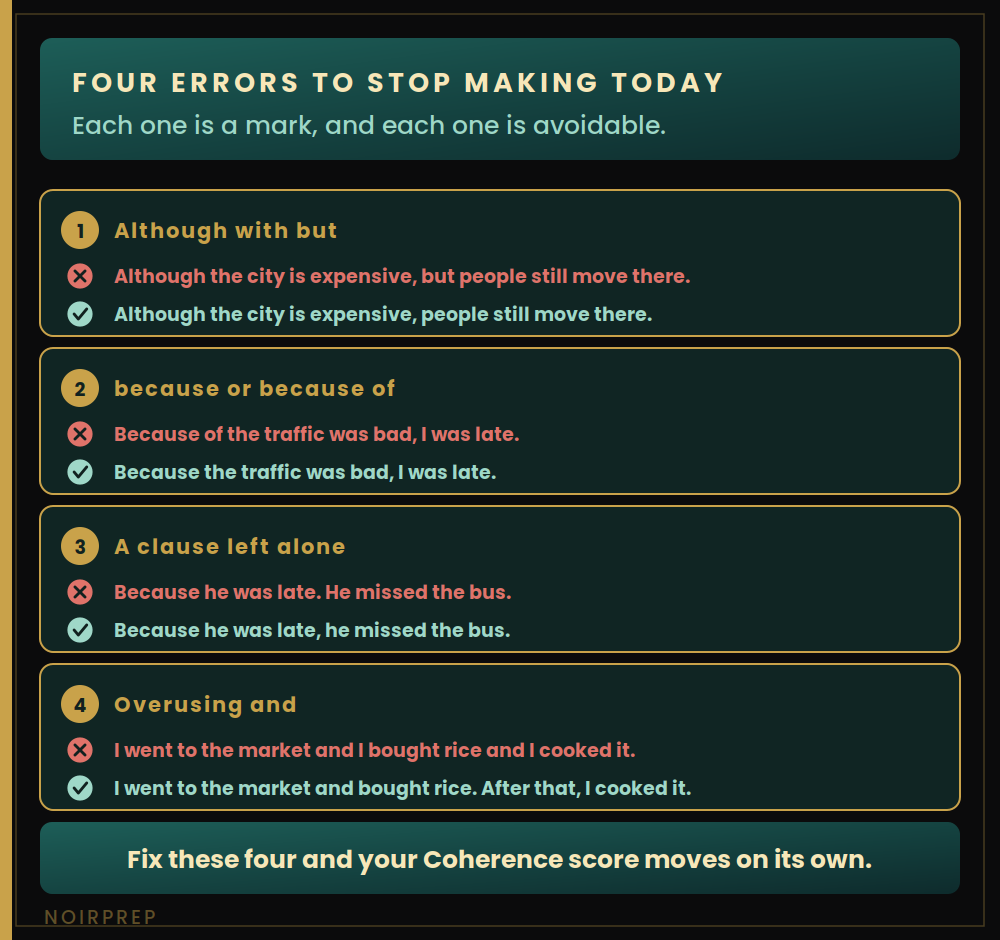
Combining although with but doubles the job, since both words already do it. Although the city is expensive, but people still move there is wrong. Pick one.
Confusing because with because of changes what must follow. Because takes a full clause, so write because the traffic was bad, I was late. Because of takes a noun phrase, so write because of the bad traffic, I was late.
Leaving a subordinate clause alone produces a fragment. Because he was late. He missed the bus. That first group of words cannot stand by itself, so attach it to the main clause with a comma.
Overusing and produces a chain where sentences should be. Break it, and let a transition carry the join instead.
What a Band Looks Like
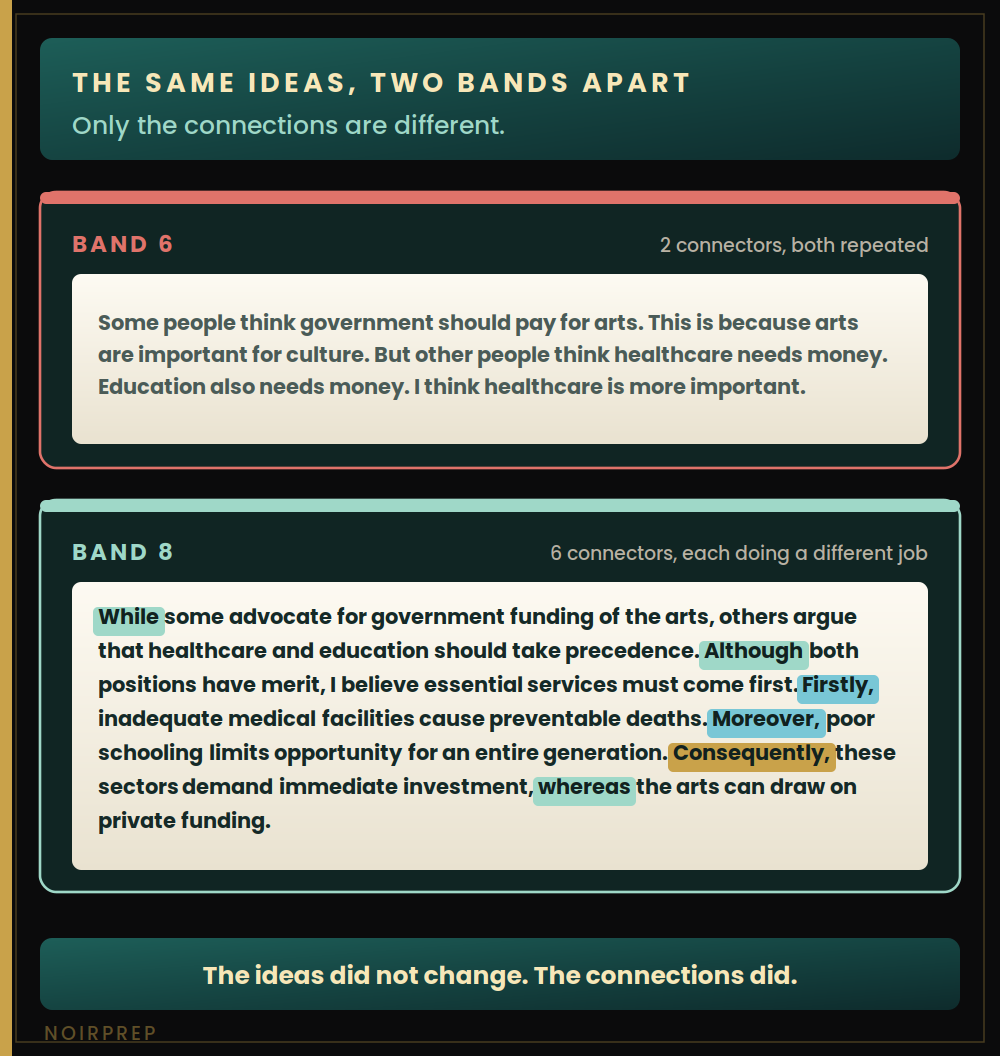
The ideas in these two answers are almost identical. Only the connections differ.
At band 6 it reads like this. Some people think government should pay for arts. This is because arts are important for culture. But other people think healthcare needs money. I think healthcare is more important.
At band 7 it reads like this. While some advocate for government funding of the arts, others argue that healthcare should be prioritized. Although both viewpoints have merit, I believe essential services must take precedence. Firstly, inadequate medical facilities cause preventable deaths. Consequently, these sectors require immediate investment.
Four connectors appear in the second version, and each one does a different job. That is the whole difference.
The Same Words Help You in Reading and Listening
These words are not only for writing. In the Reading test, a contrast word such as however or although warns you that what follows goes against what came before, and the answer to a question is very often hidden after that signal rather than before it.
In the Listening test, they work as advance warnings. When a speaker says however, something is about to change. When you hear for example, a specific detail is coming. When you hear firstly or to begin with, a new point is starting, and when you hear finally, the list is nearly complete.
Train yourself to react to these linking words as signals rather than as filler, and your notes will organize themselves.
What to Do Before the Next Lesson
Take an essay you have already written and mark every one of your linking words.
Count how many of your linking words are different from one another. Most candidates find that three or four words are doing all the work, usually and, but, so and also.
Replace three of them. Change one and into furthermore where a point is being added. Change one but into however at the start of a new sentence. Change one so into therefore.
Read it again afterwards. The ideas have not changed at all.