IELTS Multiple Choice Reading: Direct Questions and Indirect Ones
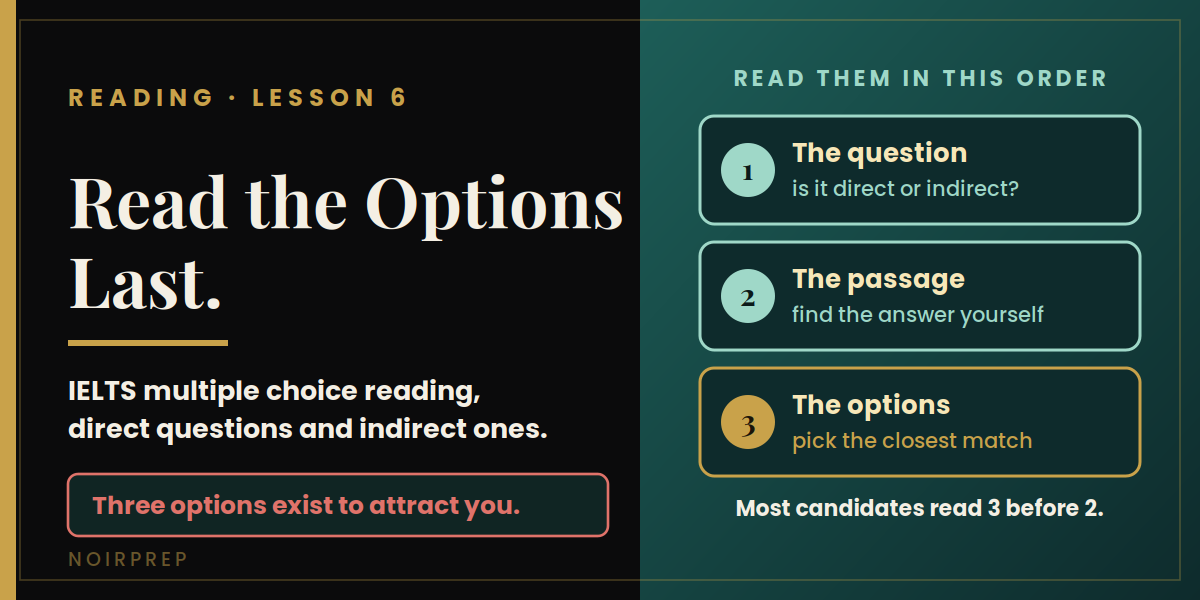
IELTS multiple choice reading questions are attached to the longest passages in the paper, and each one comes with four options labelled with letters. The examiner wants you to work out the information that answers the question in the passage, and then choose the option that is closest in meaning to the answer you found.
That instruction describes an order, and most candidates reverse it. They read the question, they read all four options, and then they go into the passage looking for whichever option feels familiar. The difficulty is that the three wrong options were written to feel familiar, because a question with three obviously wrong answers would test nothing at all.
There is a second difficulty, which is that multiple choice is not a single question type. It is two, and the two need to be handled in different ways.
The Two Kinds of IELTS Multiple Choice Reading Question
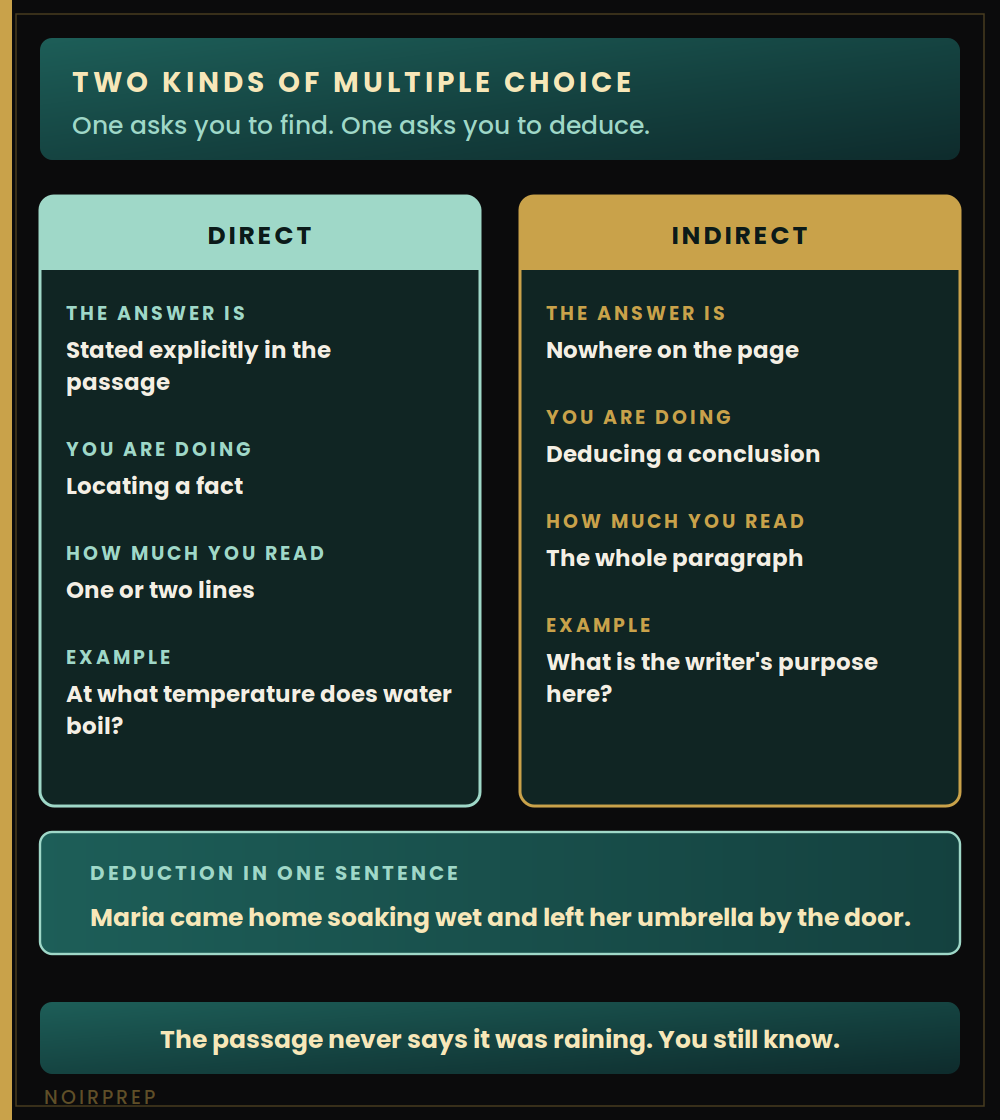
A direct question has its answer stated explicitly in the passage. The information sits in a sentence, and your work is to locate that sentence and match it against the options.
An indirect question has no answer stated anywhere. You have to deduce it from the passage, using the clues that are available to you.
Deduction means reaching a conclusion that is not directly written, based on the information you are given. Here is an everyday example. Imagine you read this sentence: Maria came home soaking wet and left her umbrella by the door. The passage never says that it was raining, but you can deduce that it was, because that is the only reasonable conclusion the information points to. That is the kind of thinking an indirect question asks for.
How to Recognise an Indirect Question
Knowing which of the two you are holding is the first skill to build in IELTS multiple choice reading, because the wrong method on an indirect question will cost you the mark even when your English is strong.
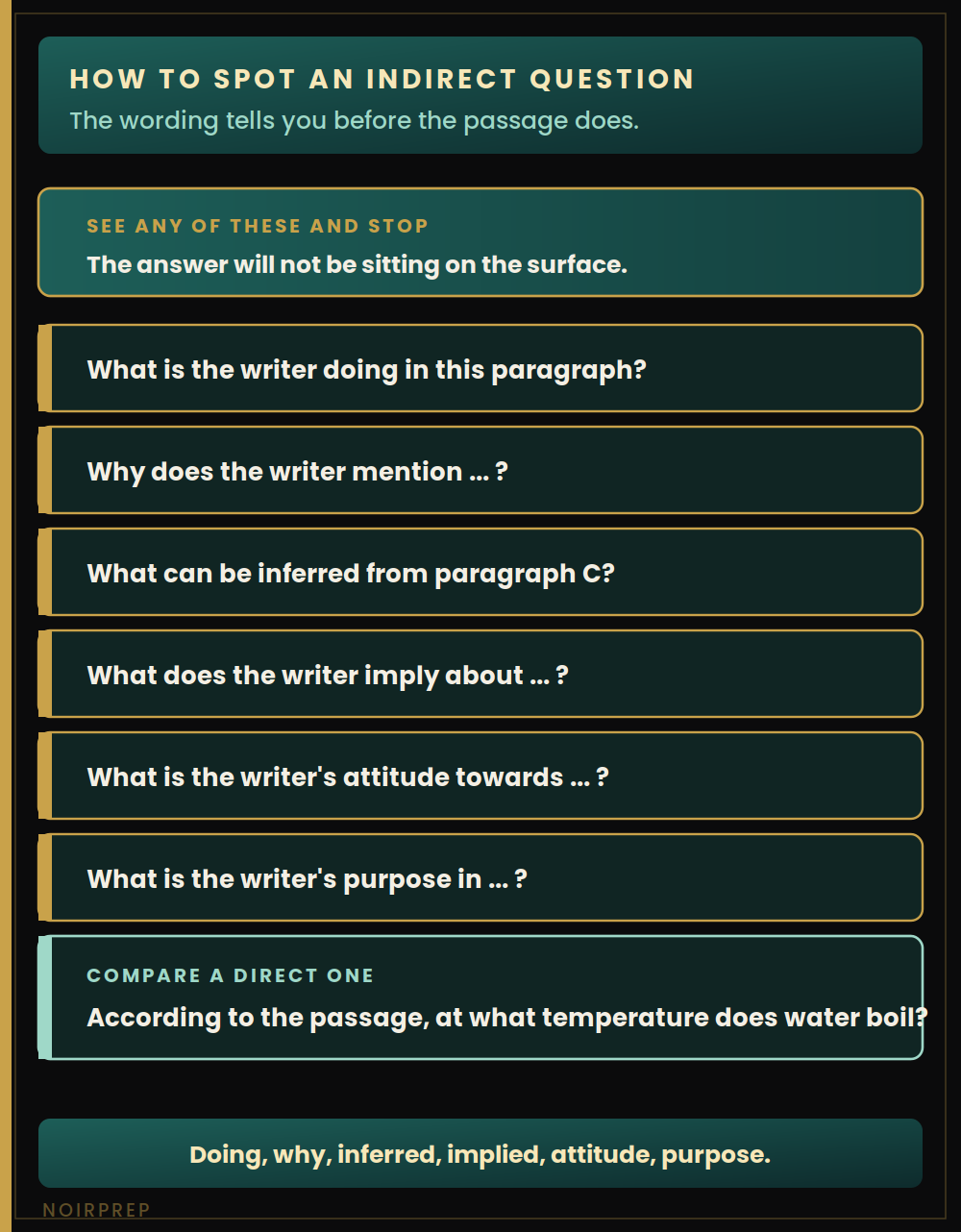
Indirect questions tend to use particular language. Watch for questions that ask what the writer is doing in a paragraph. Watch for questions that ask why the writer mentions something. Watch for questions that ask what can be inferred or what is implied. Watch for questions that ask about the writer’s attitude, opinion or purpose.
The moment you see any of those phrases, remind yourself that the answer will not be sitting on the surface, and that a deeper level of reading is required.
Compare these two questions and notice the difference. According to the passage, at what temperature does water boil? That is a direct question, so you find the number and you are finished. What is the writer’s purpose in the second paragraph? That is an indirect question, and you cannot answer it from one sentence, because you have to read the whole paragraph and work out what the writer is trying to achieve.
Why You Should Not Read the Options First
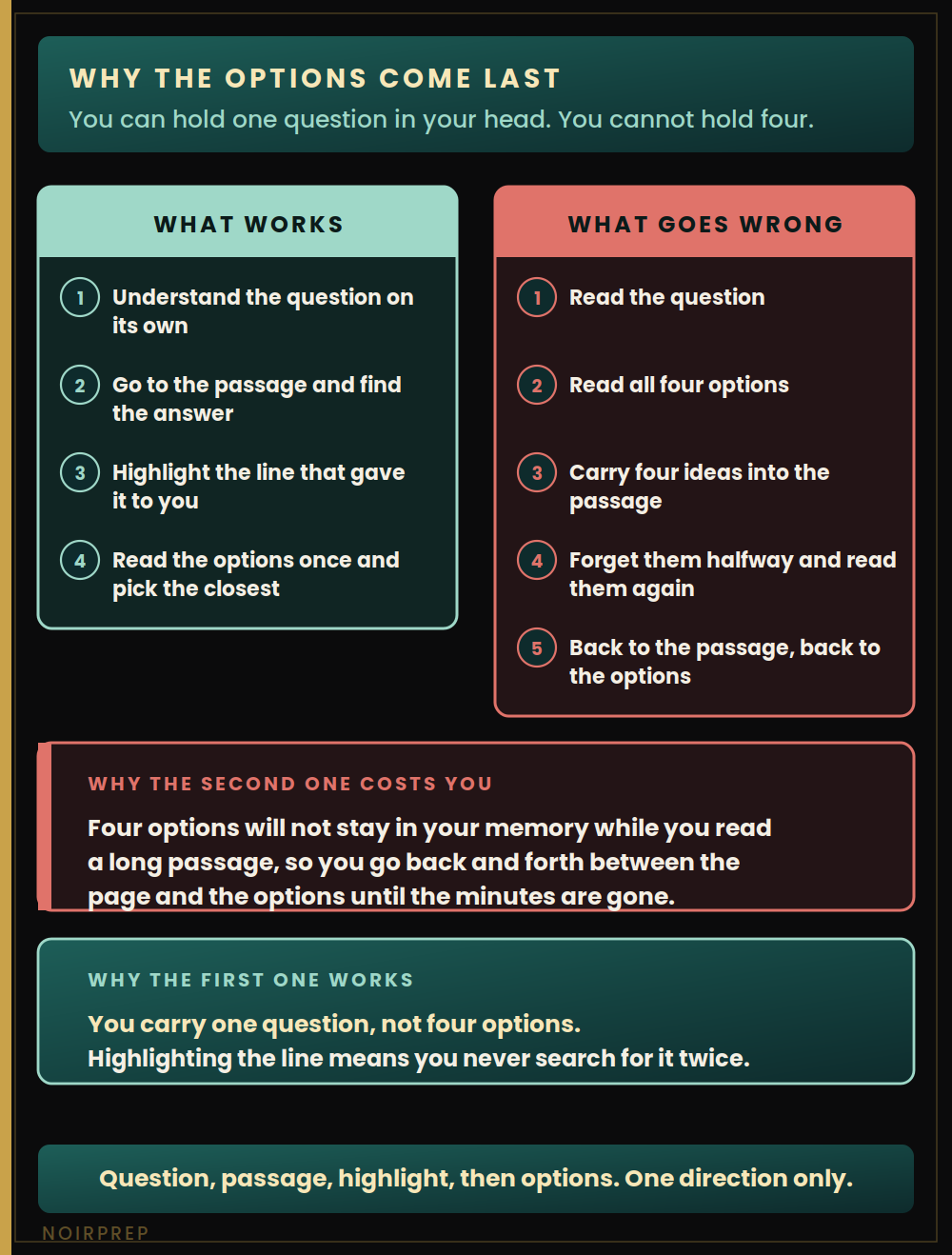
Understand the question first, then go to the passage and work out the answer, then highlight the line that gave it to you, and only after all of that should you read the options.
The reason is memory. You can hold one question in your head while you read a long passage. You cannot hold four options. A candidate who reads all four before searching carries four competing ideas into the text, loses them halfway through a dense paragraph, goes back to read the options again, returns to the passage having lost their place, and then repeats that movement two or three more times. The minutes disappear in the travelling rather than in the reading.
There is a second cost. The three wrong options were written by someone whose task was to make them plausible, so they contain words taken from the passage and describe things the passage genuinely mentions. Once those ideas are in your head, you stop searching for the answer and begin searching for confirmation, and you will usually find it.
Highlighting matters here more than anywhere else. When you find the line that answers the question, mark it before you turn to the options. You will need it again while you weigh two options that both look possible, and a marked line is there in a second while an unmarked one has to be hunted down a second time.
Work in one direction. Question, passage, highlight, options.
A Direct Question, Worked Through
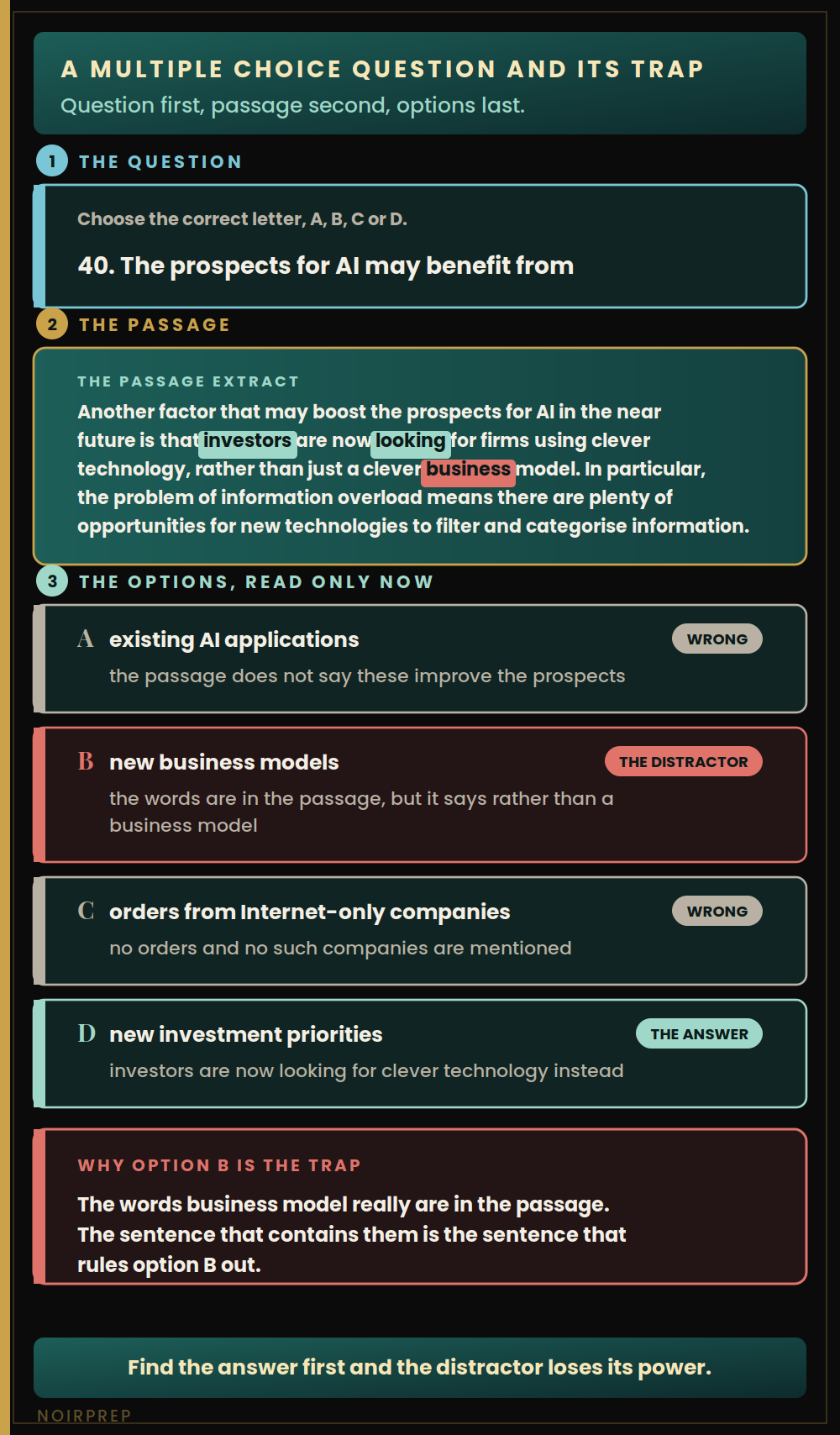
Here is a real multiple choice question from a passage about artificial intelligence.
The first thing to notice is the shape of it. The question is not written as a question at all. It is written as an unfinished sentence, and one of the four options finishes it. This is the most common shape multiple choice takes in IELTS reading, and candidates who expect a question mark are often confused for a moment.
The instruction reads: choose the correct letter, A, B, C or D. The unfinished sentence reads: the prospects for AI may benefit from. The four options are existing AI applications, new business models, orders from Internet-only companies, and new investment priorities.
Put that unfinished sentence into your own words before you do anything else. It is asking what might help artificial intelligence do well in the coming years.
Now go to the passage and look for that idea. The passage says: another factor that may boost the prospects for AI in the near future is that investors are now looking for firms using clever technology, rather than just a clever business model.
You are in the right place, and you can prove it. The question says may benefit from, and the passage says may boost the prospects for AI. Those two say the same thing in different words. Highlight that line now, because you will need it again in a moment.
Read the rest of the sentence to find what the factor actually is. It says that investors are now looking for firms using clever technology. In other words, investors have changed what they want. A change in what investors want is a new investment priority, so the answer is D.
Now look at option B, because it is the most useful part of this question. The words business model appear in the passage, so a candidate who scans for something familiar will find them. The difficulty is that the passage uses those words to say the opposite of option B. Investors want clever technology rather than just a clever business model, so the very sentence that contains option B is the sentence that rules it out.
Options A and C are easier to remove. The passage does not say that existing applications will help the prospects for AI, and it says nothing at all about orders from Internet-only companies.
This is what a distractor really is. It is not a random wrong answer. It is usually built from words the passage genuinely contains, placed beside a question those words do not answer.
The Five Steps for an Indirect Question
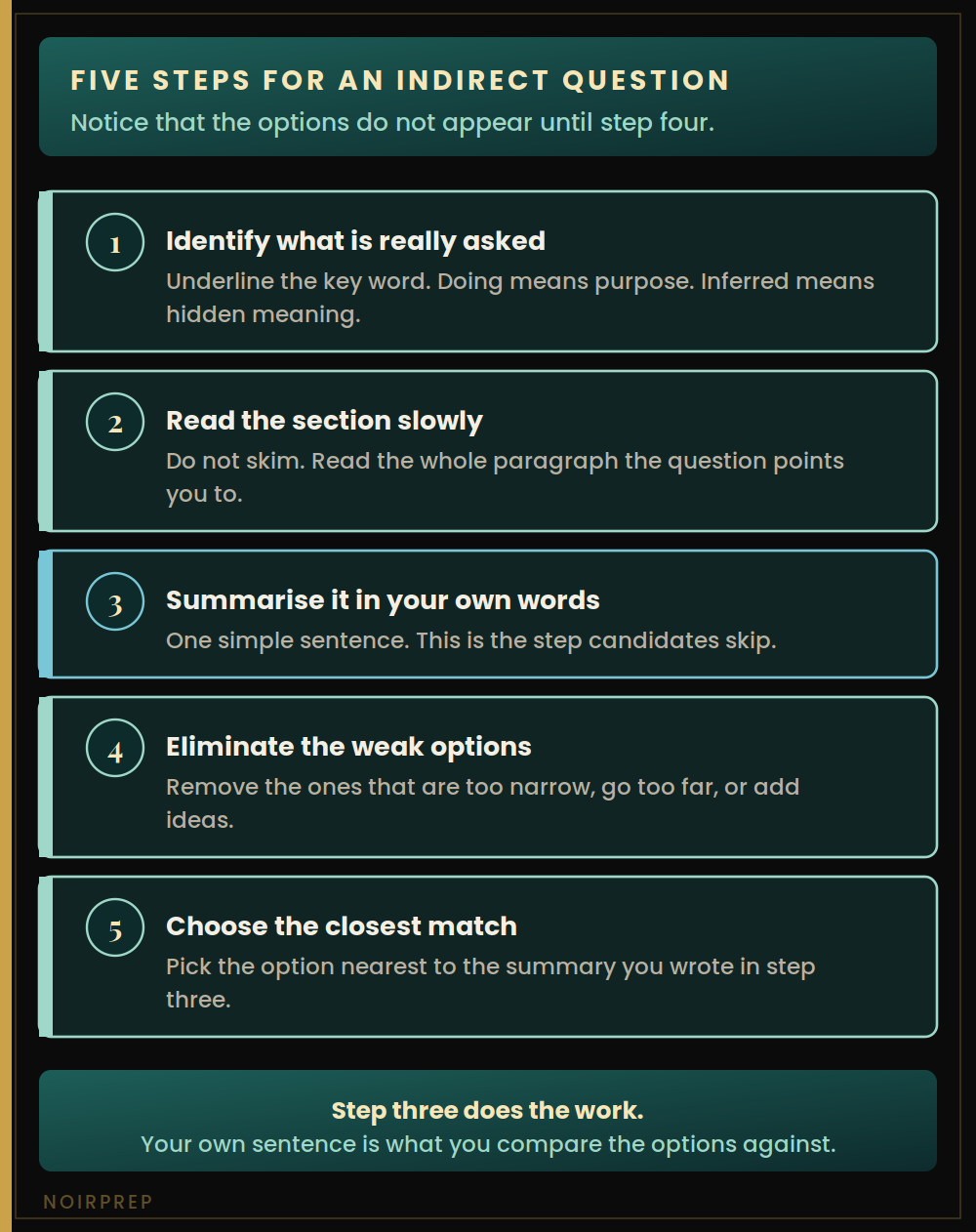
Identify what the question is really asking, and underline the key word. If it asks what the writer is doing in a paragraph, the key word is doing, which means you are looking for purpose. If it asks what can be inferred, you are looking for a meaning that was never written down.
Read the relevant section slowly and completely. Do not skim at this point, because deduction questions reward careful reading, so read the whole paragraph the question is pointing you to.
Summarise what you have just read in your own words, in one simple sentence. This is the step most candidates skip, and it is the step that does the work, because putting a paragraph into your own words forces you to process the meaning rather than recognise the words.
Look at the options now, and eliminate the ones that go too far, the ones that are too narrow, and the ones that bring in ideas the passage does not support.
Choose the option that is closest to the conclusion you reached in step three.
An Indirect Question, Worked Through
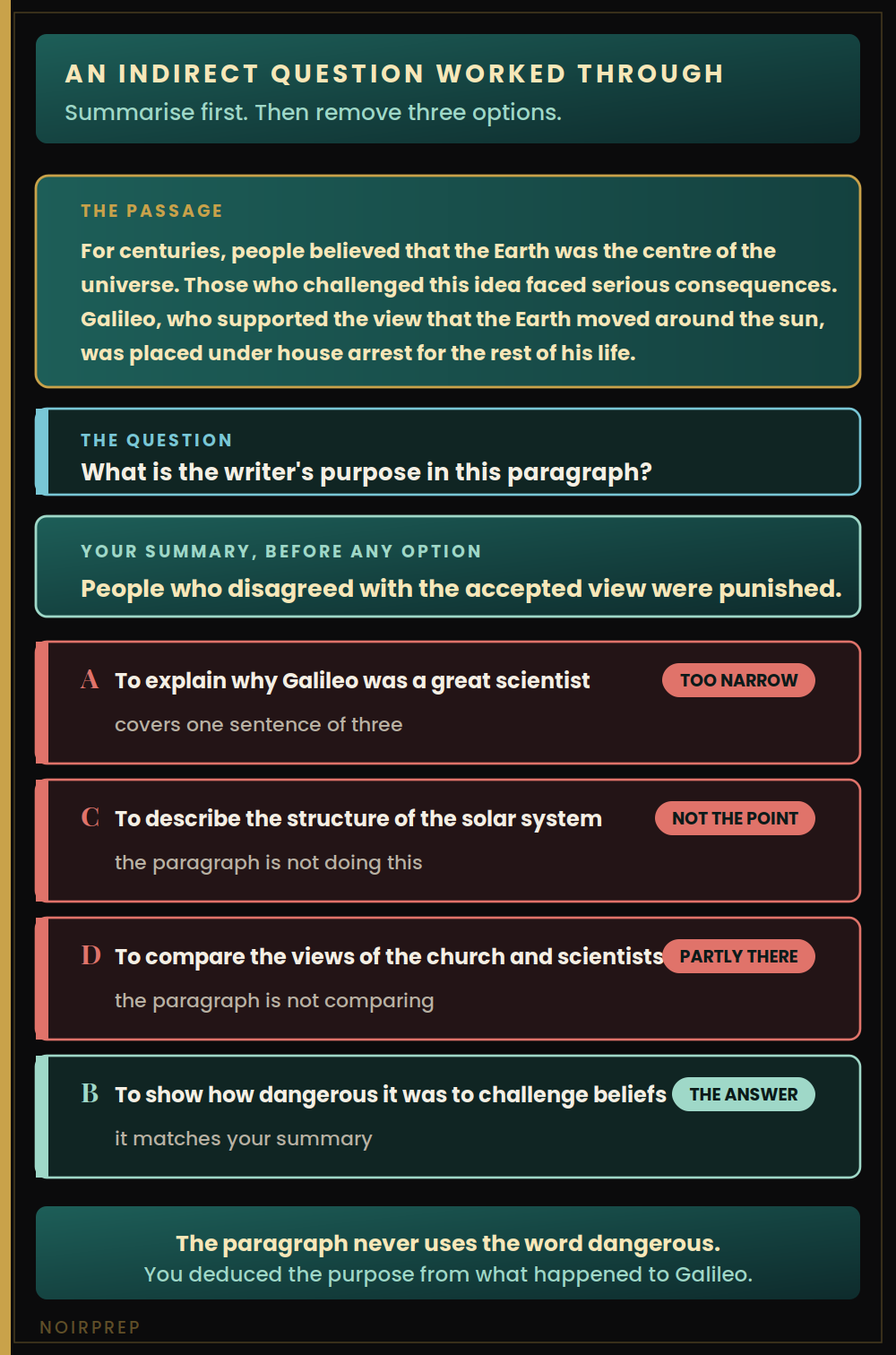
The passage reads: for centuries, people believed that the Earth was the centre of the universe and that the sun and stars revolved around it. Those who challenged this idea faced serious consequences. Galileo, who supported the view that the Earth in fact moved around the sun, was placed under house arrest for the rest of his life by the church authorities.
The question asks what the writer’s purpose is in this paragraph.
Summarise it first, before you read a single option. The paragraph describes a belief that people held, the risk of questioning that belief, and what happened to one person who did. Your summary might be that people who disagreed with the accepted view were punished.
Now take the options one at a time. To explain why Galileo was a great scientist is too narrow, because it covers one sentence out of three. To describe the structure of the solar system is not what the paragraph is doing at all. To compare the views of the church and scientists is partly there, but the paragraph is not really comparing anything. To show how dangerous it was to challenge accepted beliefs matches your summary, so that is the answer.
Notice that the paragraph never uses the word dangerous and never uses the word challenge in the sense the option uses it. You reached the answer by deduction, which is why the summary step mattered.
How the Three Wrong Options Are Built
Once you know the shapes a wrong option takes, you can remove them quickly, and removing three is easier than selecting one.
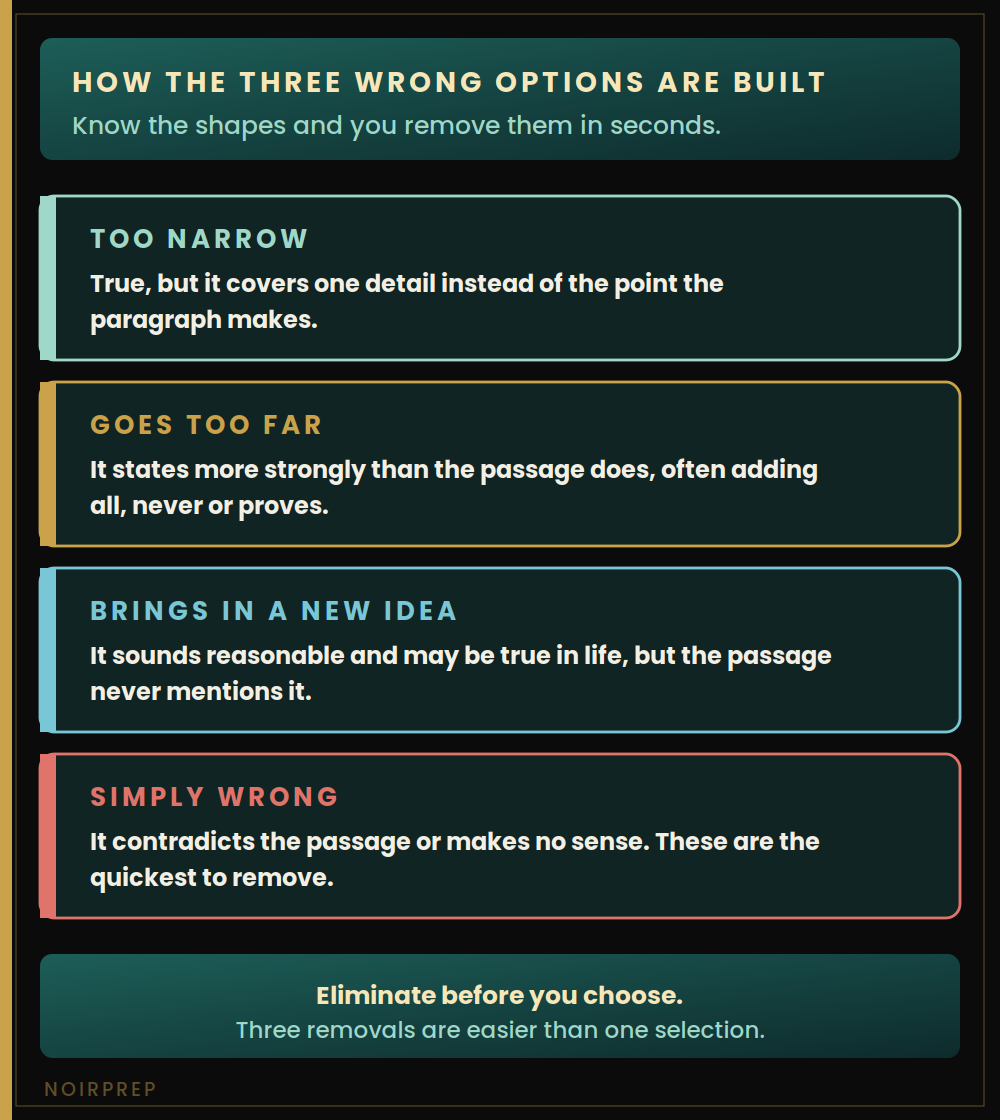
An option can be too narrow, which means it is true but covers only one detail rather than the point the paragraph is making.
An option can go too far, which means it states something more strongly than the passage does, often by adding a word such as all, never or proves.
An option can bring in an idea the passage never mentions. It sounds reasonable and it may well be true in the world, but the passage said nothing about it.
An option can simply be wrong, and those are the quickest to remove.
Here is a second example that shows three of those shapes at once. A paragraph reports that independent bookshops in a city fell from forty three in 2005 to eleven today, that the largest online retailer now delivers within twenty four hours, and that former bookshop premises are being converted into storage for online businesses.
The question asks what can be inferred. The option that people are reading fewer books than in 2005 brings in an idea the passage never mentions, because nothing was said about how much people read. The option about government policies hurting small businesses brings in another idea that never appears. The option that bookshop owners prefer to work in storage facilities makes no sense. The option that online shopping has contributed to the decline of physical bookshops matches what the three facts add up to, so that is the answer.
The passage never states that online shopping caused the decline. You deduced it.
Two Rules for Every IELTS Multiple Choice Reading Question
Read the instructions first, because they tell you how to record each answer.
Remember that the answers come in sequence, exactly as they do in True, False and Not Given. Question thirty nine sits after question thirty eight in the passage, so you search forward from your last answer and never from the beginning. The previous lesson shows how much time that habit saves across a section.
Common Mistakes in IELTS Multiple Choice Reading
The first mistake is choosing an option because its words appear in the passage, which is matching rather than answering.
The second mistake is answering an indirect question with a direct method, since finding one sentence will never give you a writer’s purpose.
The third mistake is skipping the summary step, which leaves you comparing four options against a paragraph you have not yet understood.
The fourth mistake is choosing an option that is true in life but unsupported by the passage.
The fifth mistake is spending three minutes on one question because two options both look possible. Mark it, choose the better one, and come back if time allows.
What to Do Before the Next Lesson
Find a set of multiple choice questions in any practice paper, and sort them before you answer anything. Write D beside every direct question and I beside every indirect one, using the signal phrases from earlier in this lesson.
Then answer only the indirect ones, and for each of them write your own summary sentence before you look at the options. Afterwards, check whether your summary pointed you to the correct answer.
If it did, your reading is sound and only your habit needed changing. If it did not, the problem sits in the second step, and you were reading too quickly.
The next lesson deals with matching information to paragraphs, where the answers do not come in sequence at all, and the searching habit you have built across the last three lessons has to be set aside.