What Is IELTS? The Four Tests Explained for Beginners
IELTS is not a test of how much English you know. It is a test of how well you use it: under time, under pressure, and under rules most candidates never take the time to understand.
That difference is where scores are won and lost.
IELTS stands for the International English Language Testing System. Universities, employers and immigration authorities use it to measure one thing: can you function in English?
Academic or General Training?
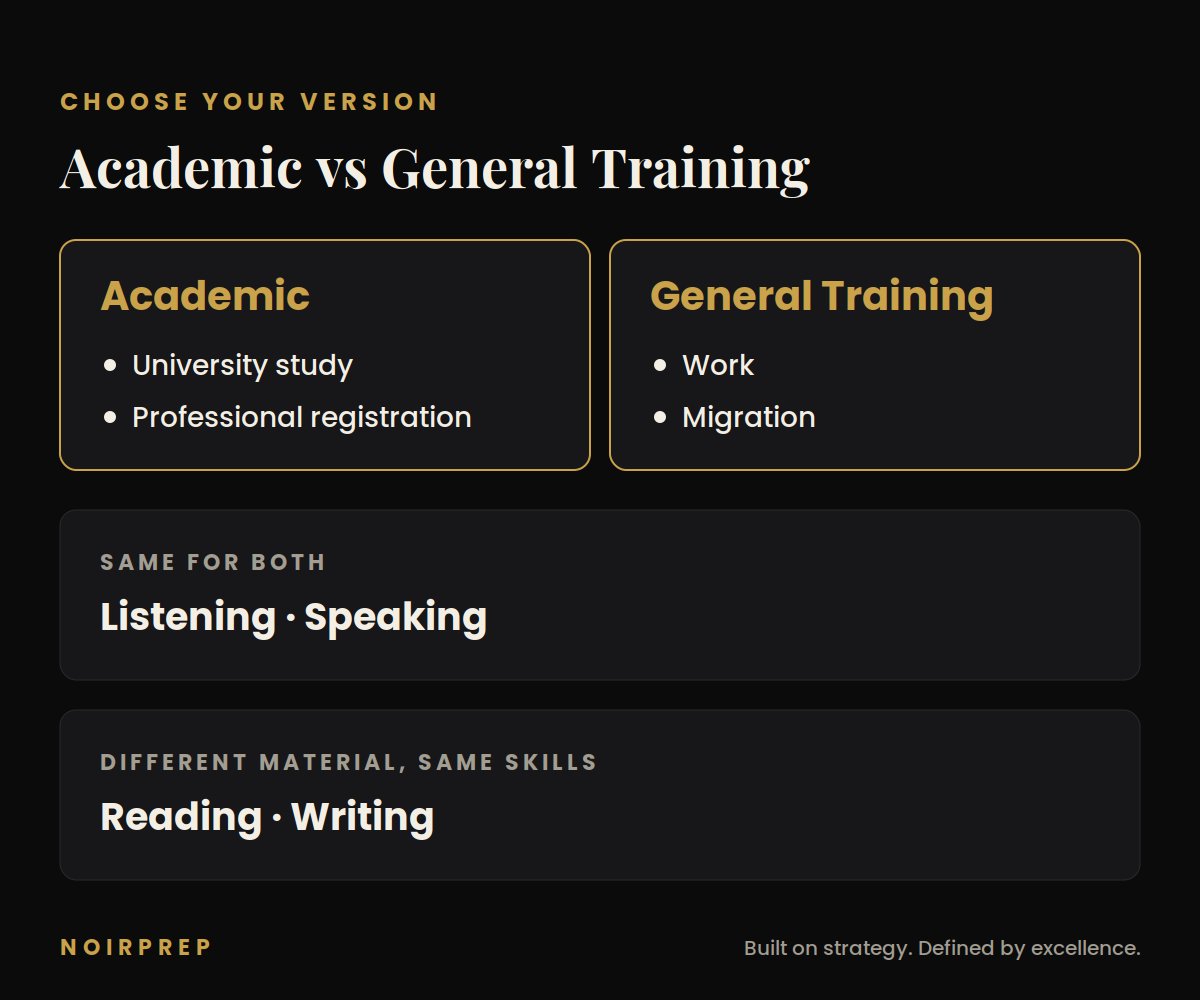
There are two versions of IELTS.
Academic is usually for university study and professional registration. General Training is usually for work and migration.
Listening and Speaking are the same in both. Reading and Writing use different material, but they test the same skills. Always confirm which version your school, employer or visa program requires before you book. Do not guess.
How IELTS Is Scored
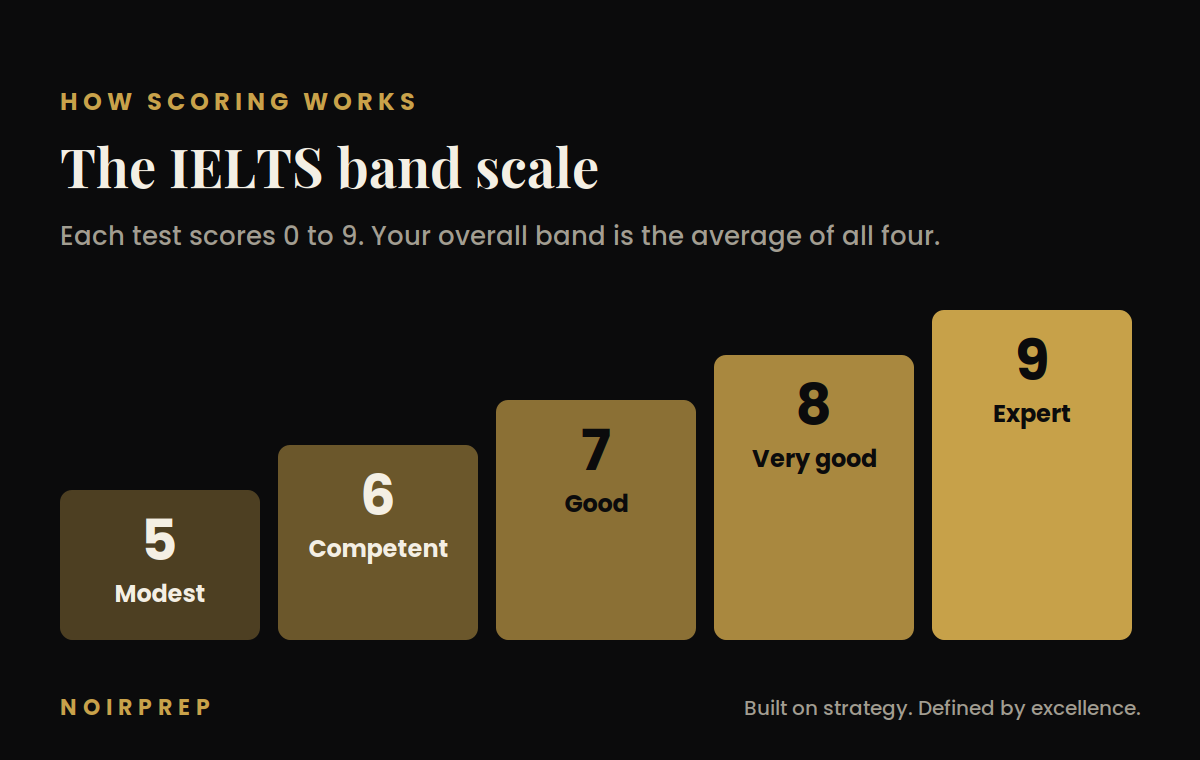
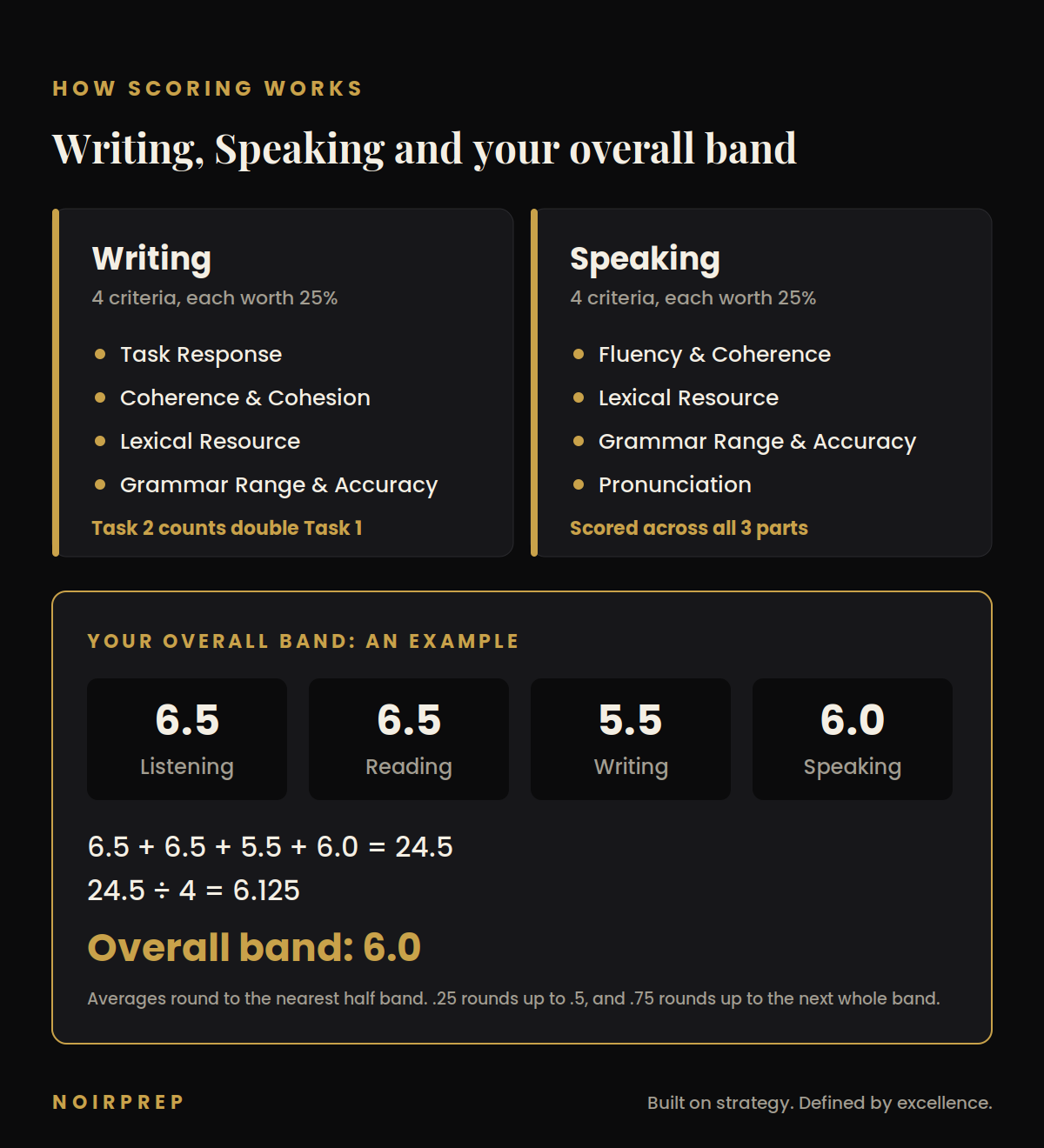
There is no pass or fail. Each of the four tests is scored from 0 to 9, and your overall band is the average of all four.
The band you need depends entirely on where you are going. Know your target before you start preparing. It shapes everything.
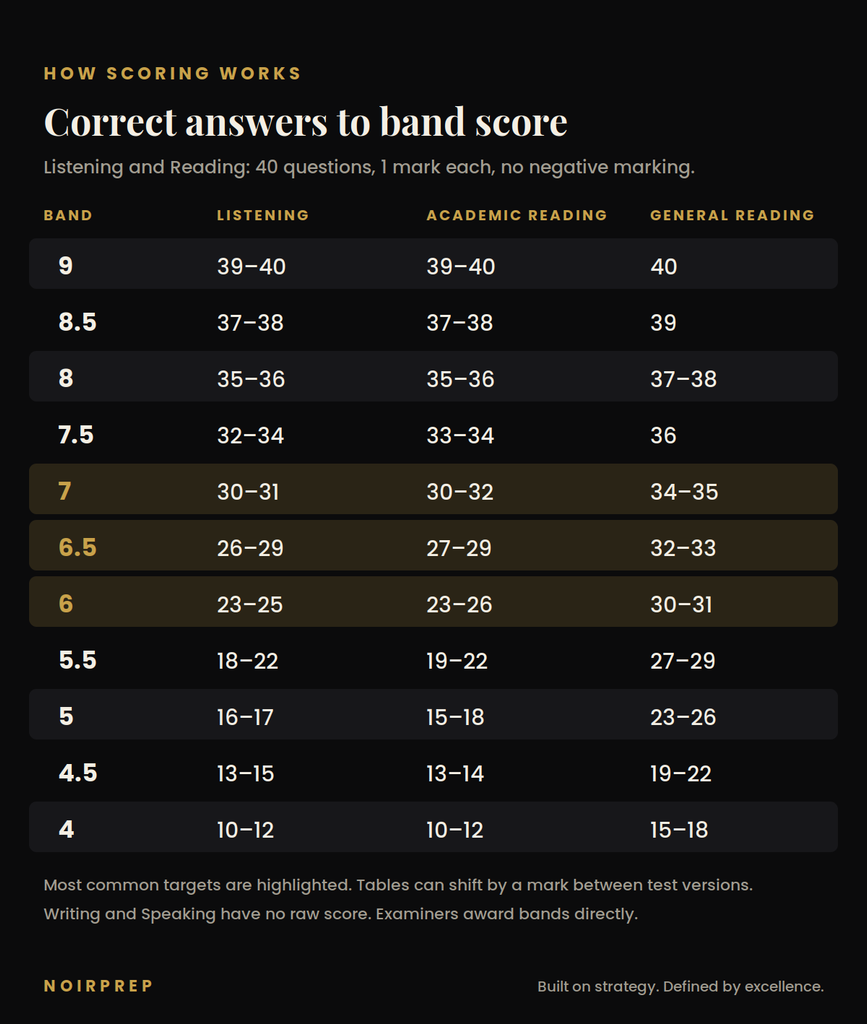
Listening and Reading each have 40 questions. Every correct answer earns one mark, and there is no negative marking, so never leave a question blank. Your total out of 40 is then converted into a band.
Every mark matters. In Academic Reading, the gap between Band 6 and Band 7 can be as small as four answers. Four answers are rarely lost to weak English. They are lost to method mistakes.
Writing and Speaking work differently. There is no answer key and no raw score. A trained examiner reads your writing or listens to you speak, then awards your band directly, using four criteria that each carry equal weight. In Writing, Task 2 counts twice as much as Task 1.
Notice what the examiner is not looking for: impressive words, complicated sentences or clever opinions. Examiners reward control. Accurate, natural English scores higher than advanced English used wrongly, every time.
Once all four tests are scored, your results are averaged and rounded to the nearest half band. That is why every test matters. One weak score can pull your whole result down, and one stronger score can lift it.
The Four Tests
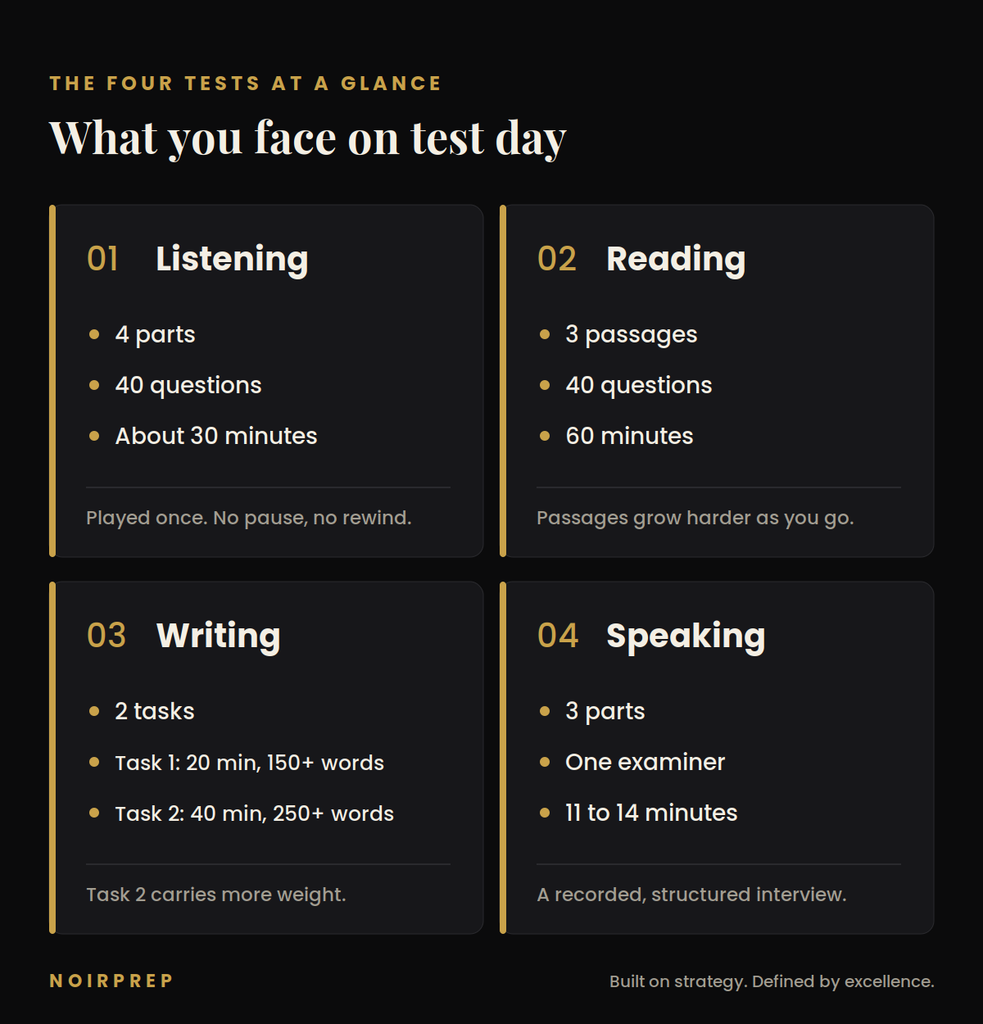
IELTS measures your English through four separate tests: Listening, Reading, Writing and Speaking. Each test has its own score, its own timing and its own rules.
Listening, Reading and Writing are taken together in one sitting, one after the other, with no break in between. Speaking is taken separately, face to face with an examiner, either on the same day or within a few days of the other three.
On the surface, each test seems simple. You listen, you read, you write, you speak. But each one is designed to test something deeper than it appears. Understanding that difference before you start preparing will save you weeks of practicing the wrong things.
Here is what you will face, and what each test is really looking for.
Listening: A Moving Train
4 parts · 40 questions · about 30 minutes
The IELTS Listening test is a moving train. You cannot pause it. You cannot rewind it. The recording plays once, and the test moves from an everyday conversation, such as booking a room or filling a form, to a full academic lecture.
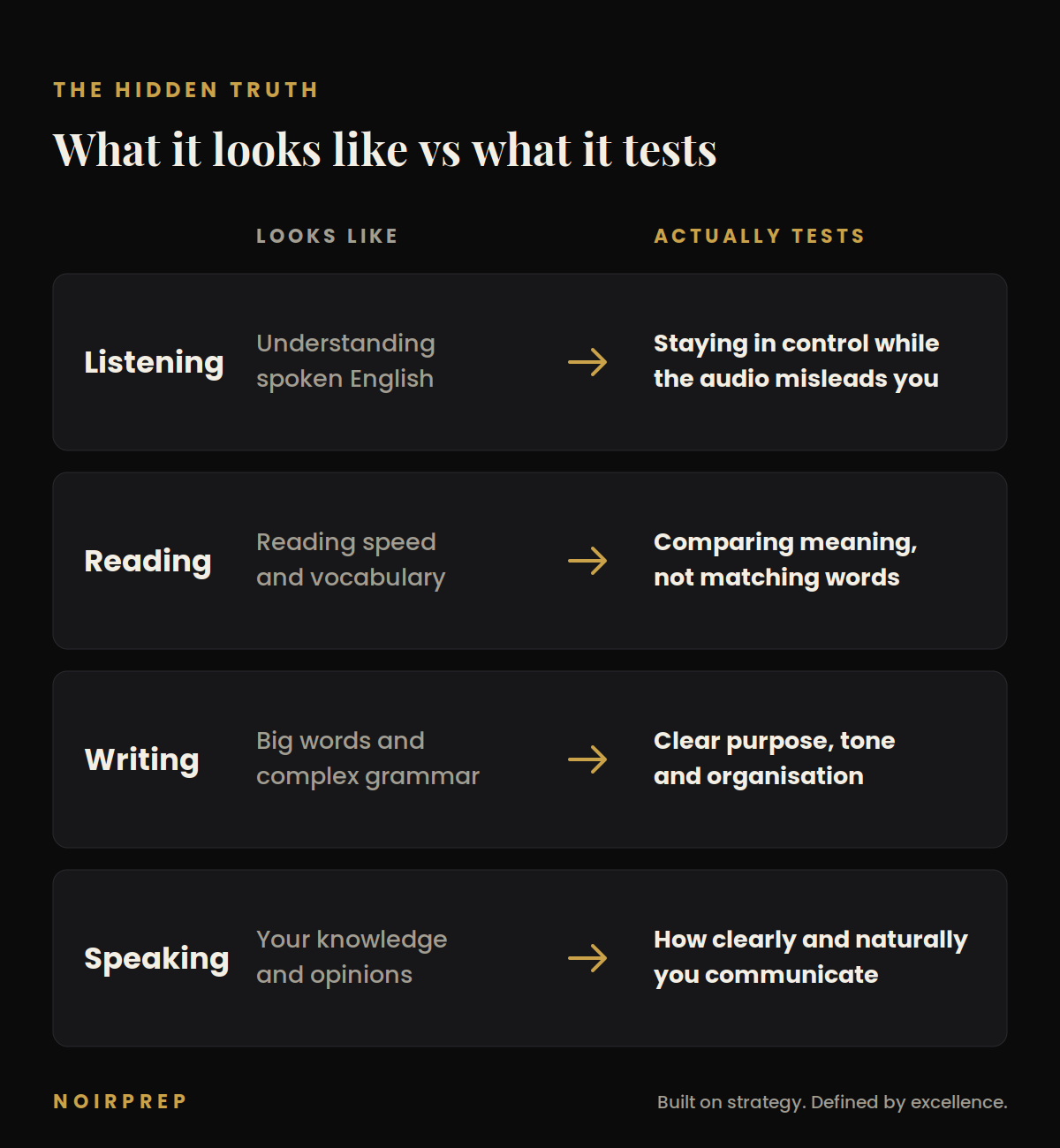
What it looks like: a test of whether you understand spoken English.
What it actually tests: whether you can stay in control while the audio leads you away from the answer. Speakers correct themselves. Details change mid-sentence. The words you hear rarely match the words on your question paper.
NoirPrep Rule: The goal is not to catch every word. It is to catch the answer moments. Chase every sentence and you fall behind. Hunt for answers and you stay in control.
Reading: A Meaning Test
3 passages · 40 questions · 60 minutes
In everyday life, you read at your own pace. You re-read, you pause, you skip what bores you. IELTS Reading removes every one of those options. The passages grow harder as you go, and the clock does not wait.
What it looks like: a test of reading speed and vocabulary.
What it actually tests: whether you can compare meaning precisely. IELTS almost never repeats the words from the question in the passage. It paraphrases. And one small word, some instead of all, may instead of must, decides whether an answer is right or wrong.
NoirPrep Rule: IELTS Reading is a meaning test, not a word-matching test. If the passage does not prove it, do not choose it.
Writing: Precise Beats Impressive
2 tasks · 60 minutes
Task 1 takes 20 minutes and a minimum of 150 words. Academic candidates describe a chart, graph, process or map. General Training candidates write a letter.
Task 2 takes 40 minutes and a minimum of 250 words. Every candidate writes an essay, and it carries more weight than Task 1.
What it looks like: a test of big vocabulary and complex grammar.
What it actually tests: clear purpose, correct tone, logical organisation, and fully developed ideas. Candidates who chase long words and complicated sentences often score lower than candidates who simply write clearly.
NoirPrep Rule: Do not pursue impressive. Pursue precise. Precise English with clear structure produces higher band scores every time.
Speaking: A Structured Interview
3 parts · 11 to 14 minutes · one examiner
IELTS Speaking is not a casual conversation. It is a recorded interview with clear rules. Part 1 is short questions about familiar topics. Part 2 gives you a cue card, one minute to prepare, and up to two minutes to speak. Part 3 is a deeper discussion connected to your Part 2 topic.
What it looks like: a test of your knowledge and opinions.
What it actually tests: how clearly and naturally you communicate. The examiner is not checking whether your ideas are clever. They are listening to your fluency, your vocabulary, your grammar and your pronunciation.
NoirPrep Rule: You are not being tested on your knowledge. You are being tested on your English. Structure your answers and the language will follow.
The Pattern Across All Four
Look back at those four tests and one truth repeats itself.
Most candidates who miss their target band do not fail because their English is weak. They fail because they prepared for what the test looks like instead of what it actually tests.
They practiced listening to everything instead of hunting answers. They matched words instead of meaning. They wrote to impress instead of to communicate. They memorized answers instead of learning structure.
These are not language problems. They are method problems. And method can be learned.
Where to Begin
Every test on this site has its own complete series, and every series begins at the foundation.
Start Here: Vocabulary & Paraphrase
Before any single test, there is one skill that sits underneath all four: paraphrase.
Reading hides its answers in paraphrase. Listening disguises its answers with it. Writing and Speaking reward you for using it. A candidate who cannot recognize the same idea in different words will struggle in every test, no matter how hard they practice.
That is why this series comes first.
- Vocabulary & Paraphrase: Lesson 1
Then Choose Your Test
Once the foundation is in place, start with the test that worries you most, or the one where you need the highest score. Each series builds one lesson at a time, and every technique comes with a real example, broken down step by step, so you see exactly where candidates get trapped and how to avoid it.
- IELTS Listening: Lesson 1
- IELTS Reading: Lesson 1
- IELTS Writing Task 1: Lesson 1
- IELTS Writing Task 2: Lesson 1
- IELTS Speaking: Lesson 1
One Comment