The IELTS Writing Test: Task 1, Task 2, Academic and General Training
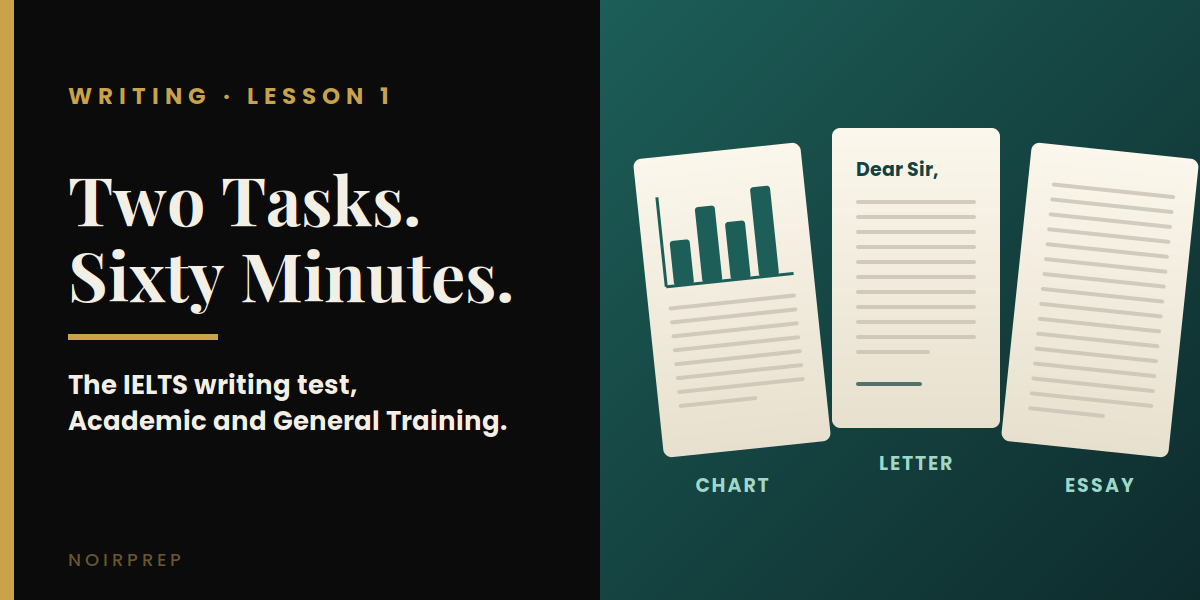
The IELTS writing test lasts sixty minutes and contains two tasks. Both tasks are compulsory and both are marked, but they do not carry the same weight, so the time you give to each one matters.
Task 1 takes twenty minutes and carries thirty three per cent of your writing score. Task 2 takes forty minutes and carries roughly twice as much as Task 1. The examiner expects you to divide the hour in that proportion.
What the IELTS Writing Test Asks You to Produce
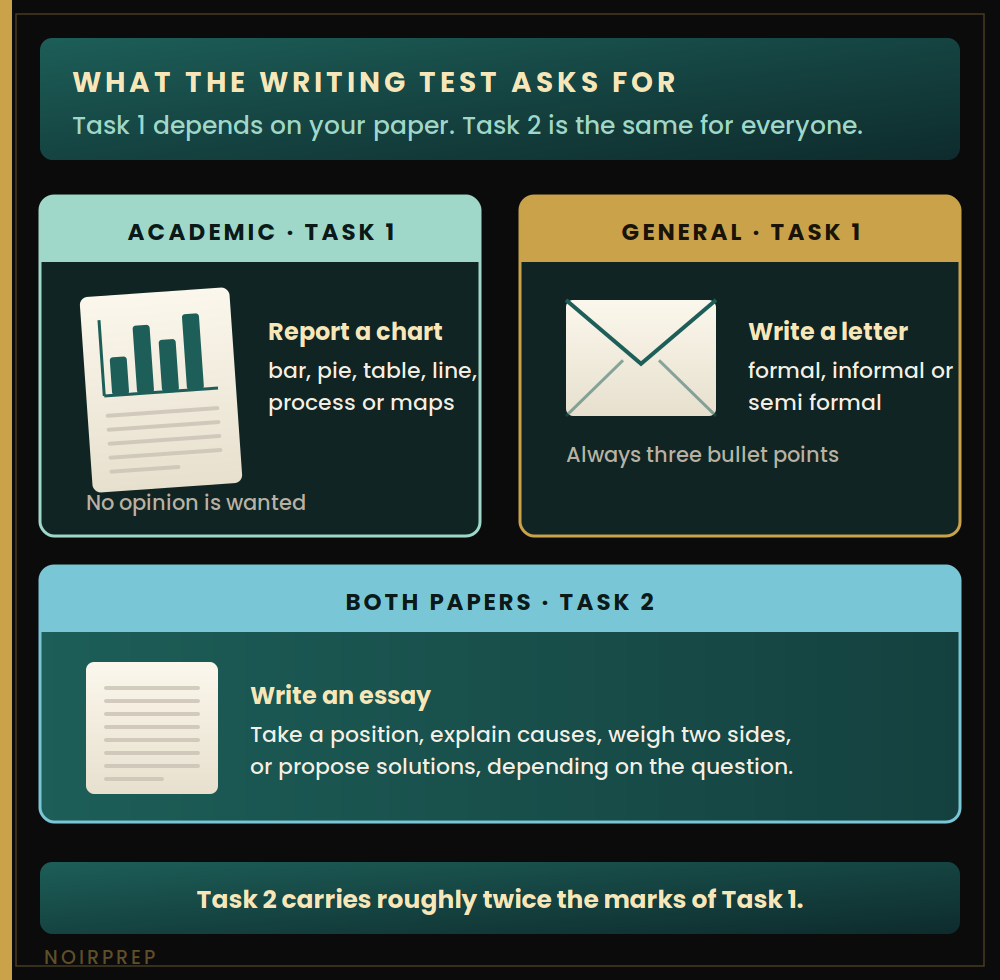
Task 1 is different for Academic candidates and General Training candidates. Task 2 is the same for both groups.
Academic Task 1 is a technical report. The examiner gives you an illustration, which may be a bar chart, a pie chart, a table, a line graph, a combination of charts, a process diagram or a set of maps, and wants you to summarize the information it contains. Your opinion is not required at any point.
General Training Task 1 is a letter. The letter may be formal, informal or semi formal, and the question always gives you three bullet points. The examiner wants you to address every one of the three.
Task 2 is an essay. The question gives you a background, and then asks you to take a position, explain causes, weigh two sides or propose solutions, depending on the type of question.
The Numbers That Govern the IELTS Writing Test
Task 1 essential numbers Time: 20 minutes Words: minimum of 150 words, with a safe target of 160 to 190 words Marks: 33 per cent of your writing score Bullet points: always 3 in General Training, and every one must be fully addressed
Task 2 essential numbers Time: 40 minutes Words: minimum of 250 words, with a safe target of 260 to 290 words Marks: roughly twice the weight of Task 1 Structure: four paragraphs, which are the introduction, body paragraph 1, body paragraph 2 and the conclusion
These numbers shape your strategy. Since you have only twenty minutes for Task 1, you need a structure that is quick, reliable and easy to control. Since Task 2 carries the larger share of the mark, it must receive the larger share of the hour.
Writing fewer words than the minimum risks a penalty. Writing far more than the safe target wastes time and adds errors.
How to Spend the Forty Minutes of Task 2
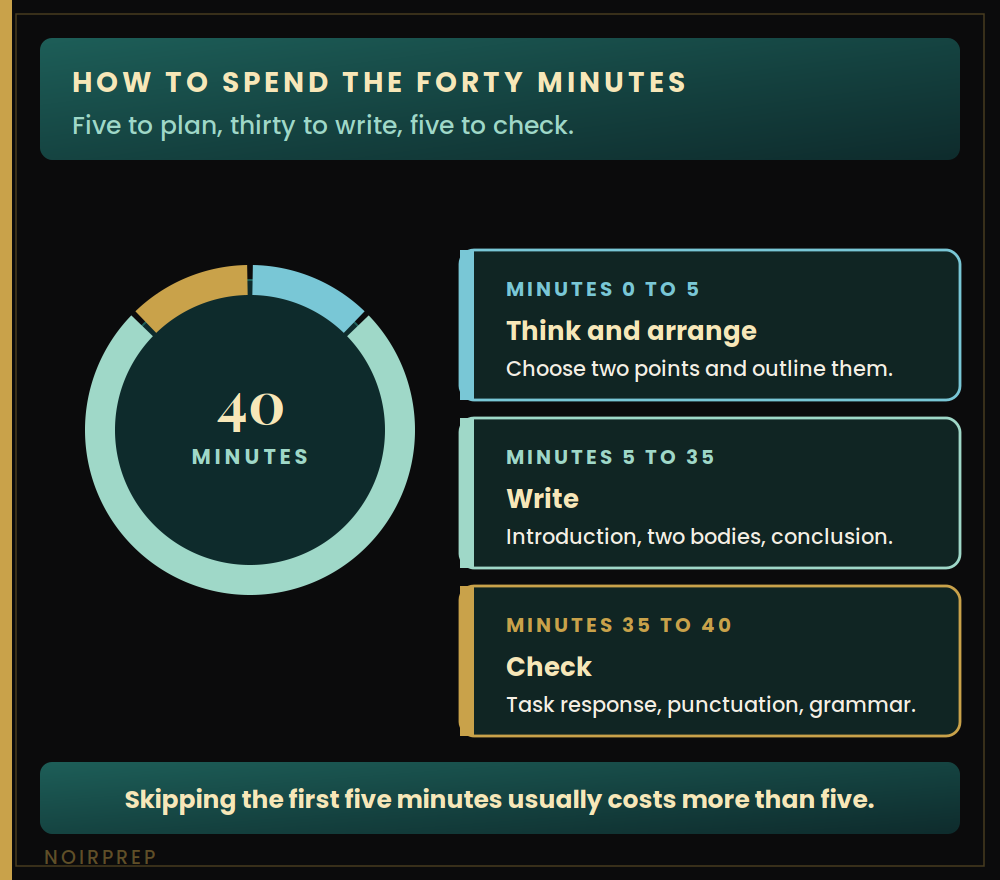
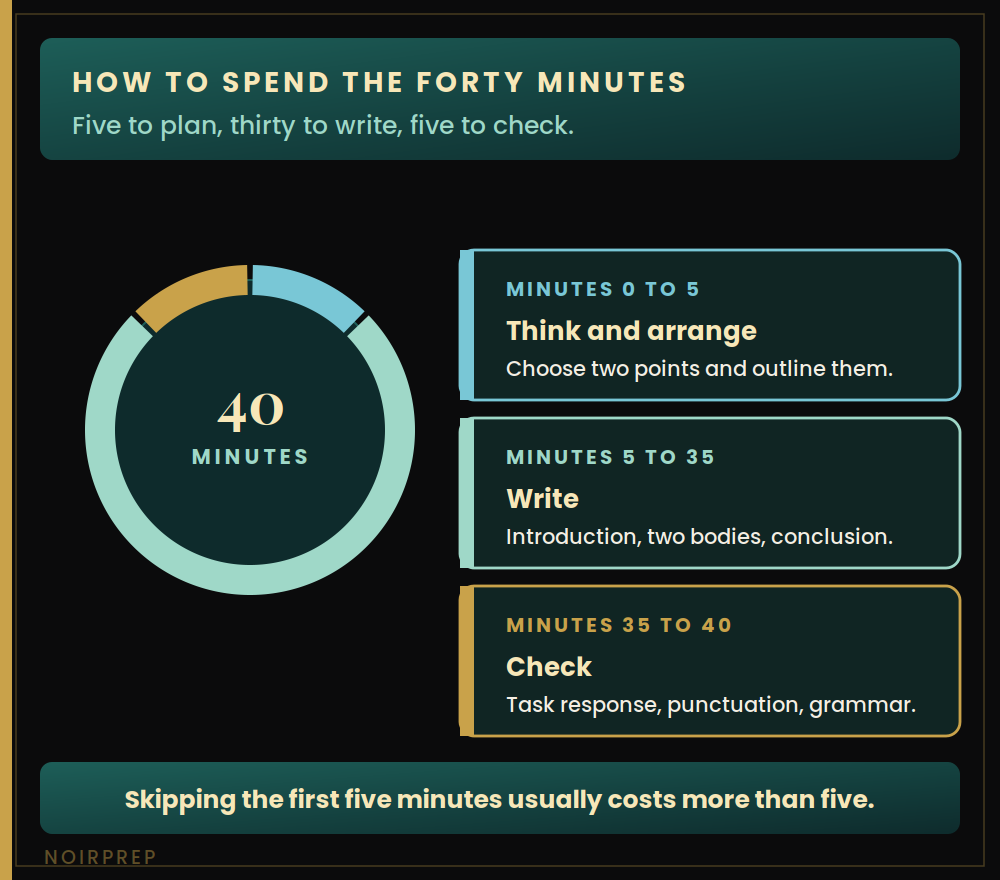
Minutes 0 to 5: think and arrange. Understand the question, choose two strong points, and write a quick outline.
Minutes 5 to 35: write. Produce your introduction, your two body paragraphs and your conclusion, following the outline you made.
Minutes 35 to 40: check. Proofread for task response, run on sentences, punctuation and grammar.
The five minutes of planning are what keep the essay on one line of argument, because a candidate who begins writing without an outline often changes direction inside the second body paragraph.
What the Examiner Is Marking
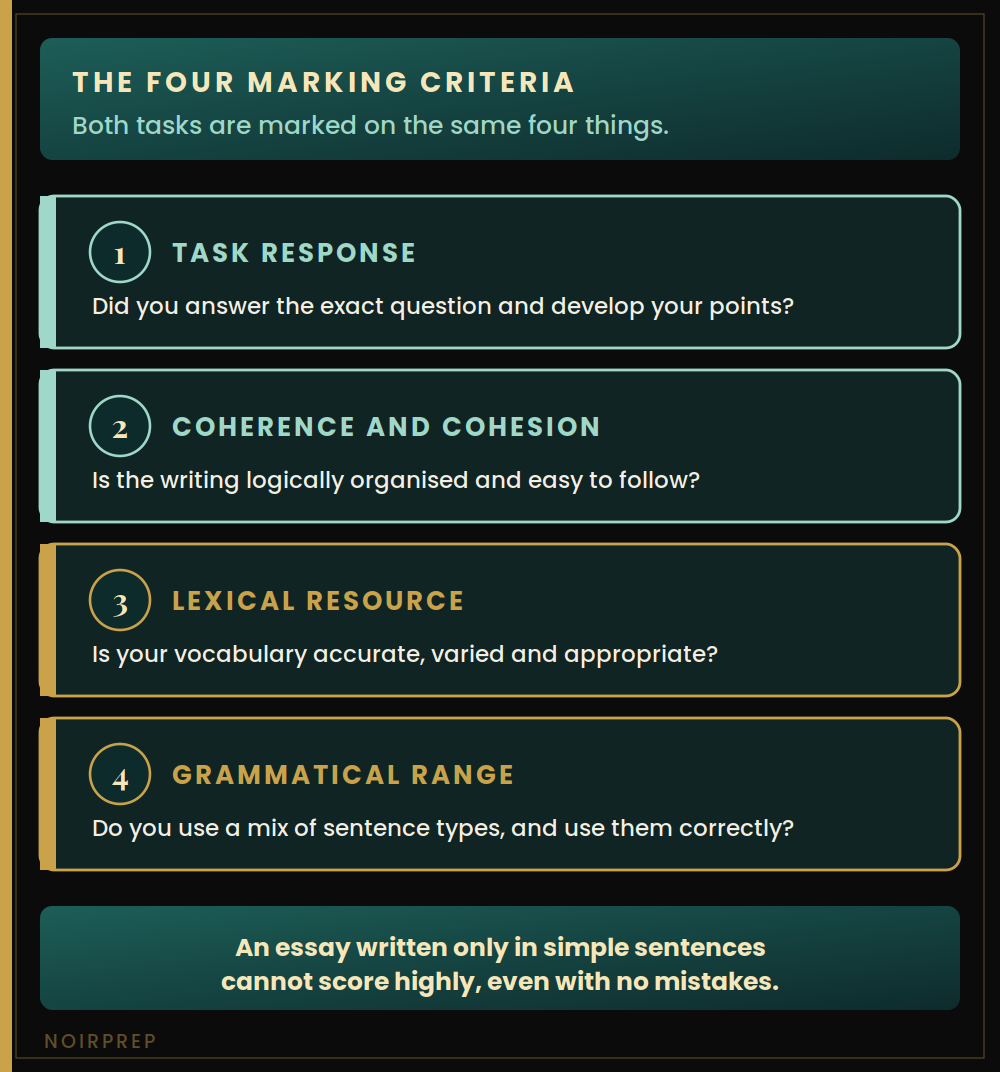
Both tasks in the IELTS writing test are marked on four criteria. Learn them, because they tell you what to look for when you check your work.
Task Response: did you answer the exact question, and did you develop your points? An essay can discuss the topic accurately and still lose marks here if it does not answer what was asked.
Coherence and Cohesion: is your writing logically organized and easy to follow? This depends on your paragraphing and on the linking words between your ideas.
Lexical Resource: is your vocabulary accurate, varied and appropriate for the task?
Grammatical Range and Accuracy: do you use a mix of sentence types, and do you use them correctly? Range is part of this criterion, so an essay written entirely in simple sentences is limited here even when every sentence is correct.
The Features That Apply to Both Tasks
Whichever task you are writing, the same standards apply to the language itself.
Clarity: convey your information as clearly as possible by paying close attention to sentence construction, correct punctuation, word choice and grammar.
Language: present your information using literal expressions. Avoid figurative expressions, contracted forms and idioms.
Sentence structure: no sentence should contain more than three ideas. This prevents ambiguity and keeps the writing readable.
Conciseness: be brief and go straight to the point, since every sentence should add new value.
Completeness: make sure the work is complete, because all noteworthy information must be referenced.
Academic Task 1 in Brief
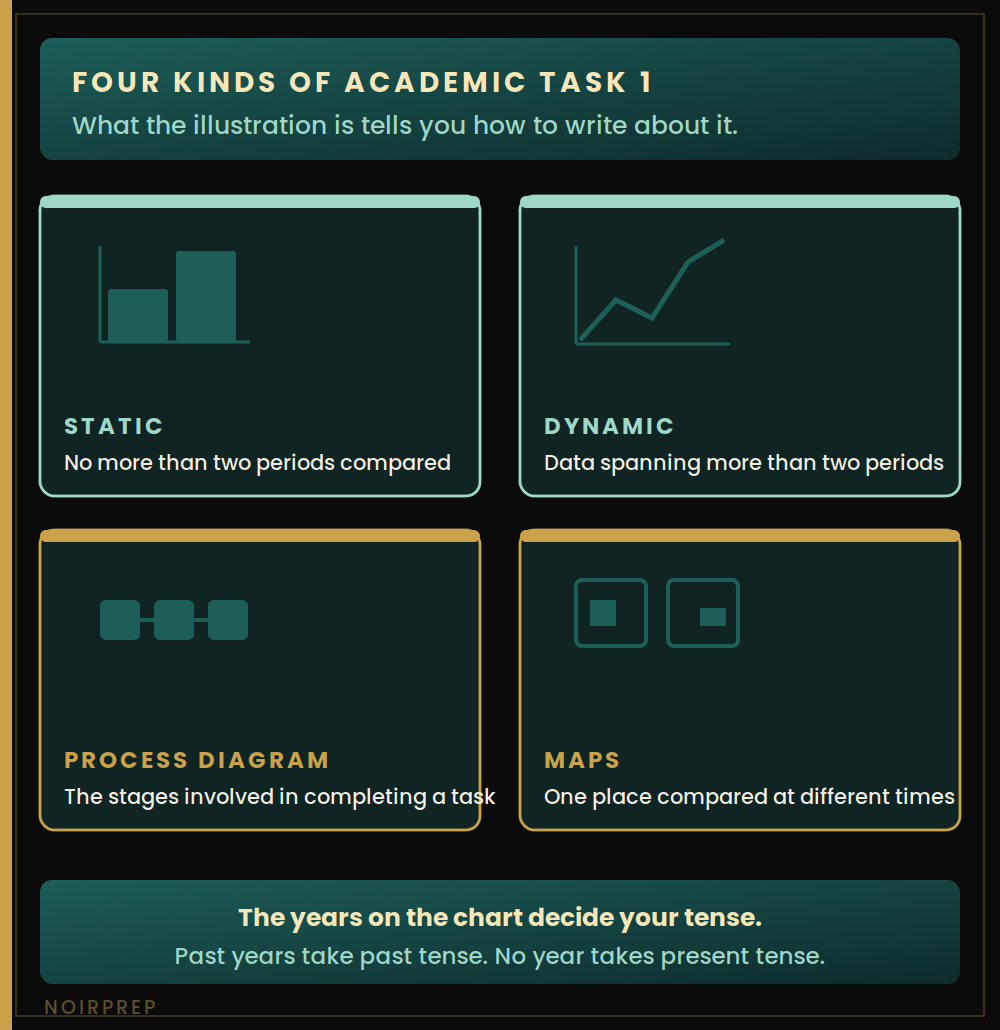
An illustration in Academic Task 1 belongs to one of four groups, and the group tells you how to write about it.
A chart is static if it compares information across no more than two periods. A chart is dynamic if the data spans more than two periods. An illustration that shows the stages involved in completing a task is a process diagram. An illustration that compares the layout of a specific location at different times is a set of maps.
The years on the chart decide your tense. Past years take the past tense, a chart with no year shown takes the present tense, and future years take the future tense with projections.
Figures matter in this task. Charts contain numerical data, and you must reference those figures accurately when you report the body of the work.
General Training Task 1 in Brief
Your greeting tells you what kind of letter you are writing. A letter is formal in IELTS if you are asked to begin with Dear Sir or Madam, and your sign off must then match that greeting.
The structure is fixed, which is what makes the task quick to control. You need a greeting, a thesis, one paragraph for each of the three bullet points, a statement of what you expect to happen, and a sign off.
The thesis rephrases the question as your reason for writing, and it includes the main background information given in the task. Do not begin a bullet point inside the thesis, because each bullet has its own paragraph in the body.
What to Do Before the Next Lesson
Find out which version of the IELTS writing test you are sitting, Academic or General Training, and look at one real Task 1 question of that type.
Write the six numbers from this lesson at the front of your notebook. Twenty minutes and 150 words for Task 1, forty minutes and 250 words for Task 2, thirty three per cent and roughly double that for Task 2.
Then write one Task 2 essay under the real clock, using the five, thirty and five split, even if the essay is weak. You are not testing the quality of the essay at this stage. You are finding out what forty minutes actually feels like.
The next lesson explains the terms used in every Task 2 question, including the background, the thesis, the topic sentence, the support sentences and the illustrative example.